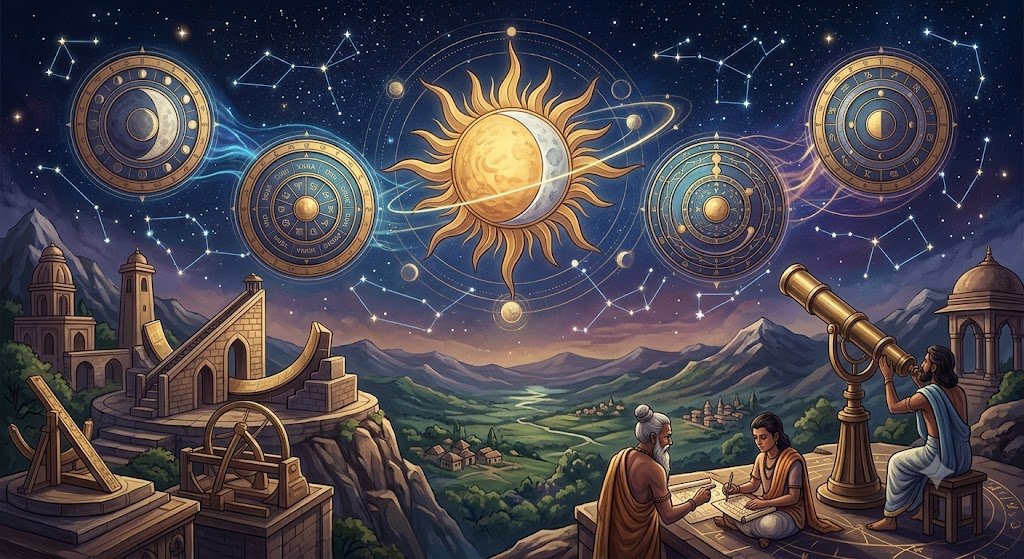
For thousands of years, civilizations have observed the movements of celestial bodies to understand time, seasons, and natural cycles. Ancient India developed a sophisticated timekeeping system known as Panchang, which combines astronomy, mathematics, and traditional knowledge to calculate important aspects of time.
Unlike a simple calendar that only shows dates and months, Panchang is based on the astronomical positions of the Sun, Moon, and other celestial references. It is a lunisolar calendar system that considers both solar and lunar movements to determine days, festivals, auspicious timings, and important astronomical events.
Today, Panchang continues to be widely used in India for understanding Tithi, Nakshatra, Yoga, Karana, Vara, Muhurat, and festival timings, connecting ancient astronomical calculations with modern daily life.
What is Panchang?
The word Panchang comes from two Sanskrit words:
- Pancha – Five
- Anga – Limbs or Parts
Panchang represents the five important astronomical elements used to understand a particular day:
- Tithi (Lunar Day)
- Vara (Weekday)
- Nakshatra (Lunar Constellation)
- Yoga (Sun-Moon Combination)
- Karana (Half of a Tithi)
These five components are calculated based on the positions and movements of celestial bodies, especially the Sun and Moon.
The Astronomical Foundation of Panchang
The foundation of Panchang is based on the observation of the relationship between:
- Earth’s rotation
- Earth’s revolution around the Sun
- Moon’s movement around Earth
- Positions of stars and constellations
- Relative movement of celestial bodies
Ancient Indian astronomers developed mathematical methods to calculate these movements and create accurate calendars.
The Hindu calendar is considered a lunisolar calendar, meaning it combines both lunar cycles and solar cycles.
Understanding the Five Elements of Panchang
1. Tithi – The Lunar Day
Tithi is one of the most important components of Panchang.
It is calculated based on the angular distance between the Sun and Moon. As the Moon moves around Earth, its position relative to the Sun changes, creating different lunar phases.
A lunar month is divided into 30 Tithis:
- 15 Tithis in Shukla Paksha (Waxing Moon)
- 15 Tithis in Krishna Paksha (Waning Moon)
Examples:
- Pratipada
- Dwitiya
- Tritiya
- Ekadashi
- Purnima
- Amavasya
The duration of a Tithi is not fixed like a normal 24-hour day because it depends on the movement of the Moon.
2. Vara – The Solar Day
Vara refers to the weekday system based on the movement of the Sun.
The seven Varas are:
- Ravivara (Sunday)
- Somavara (Monday)
- Mangalavara (Tuesday)
- Budhavara (Wednesday)
- Guruvara (Thursday)
- Shukravara (Friday)
- Shanivara (Saturday)
The concept connects daily time measurement with planetary and astronomical observations.
3. Nakshatra – The Lunar Constellations
Nakshatra represents the position of the Moon against the background of stars.
The zodiac belt is divided into 27 Nakshatras, each covering approximately 13 degrees and 20 minutes of the celestial sphere.
Examples include:
- Ashwini
- Rohini
- Pushya
- Magha
- Swati
- Revati
Nakshatras are used in Panchang calculations to understand the Moon’s position and are an important part of Vedic astronomical traditions.
4. Yoga – Sun and Moon Relationship
Yoga is calculated using the combined longitude of the Sun and Moon.
There are 27 Yogas in Panchang calculation.
The calculation involves:
- Position of the Sun
- Position of the Moon
- Their combined movement through the zodiac
Yoga helps determine the quality and characteristics of a particular day according to traditional Panchang systems.
5. Karana – Half of a Lunar Day
Karana represents half of a Tithi.
Since one Tithi covers 12 degrees of the Sun-Moon angular difference, one Karana covers 6 degrees.
There are:
- 11 Karanas
- 60 Karanas in a lunar month cycle
Karana is considered important in traditional Panchang calculations for determining daily activities and timings.
Panchang and Ancient Indian Astronomy
Panchang reflects the advanced astronomical understanding developed by ancient Indian scholars.
Ancient astronomers studied:
- Planetary movements
- Solar and lunar eclipses
- Seasonal changes
- Celestial cycles
- Mathematical astronomy
Works like Surya Siddhanta contributed significantly to Indian astronomical calculations and calendar development.
The accuracy of Panchang calculations demonstrates the importance of observation, mathematics, and astronomy in ancient Indian scientific traditions.
How Panchang Calculates Time?
Modern Panchang calculations use astronomical data and mathematical models to determine:
- Sunrise and sunset
- Moonrise and moonset
- Lunar phases
- Planetary positions
- Tithi changes
- Nakshatra timings
- Yoga and Karana
Today, many Panchang systems use astronomical calculations and software-based ephemeris data for precision.
Importance of Panchang in Indian Culture
Panchang has played an important role in Indian traditions for:
- Festival calculations
- Religious ceremonies
- Agricultural planning
- Cultural events
- Muhurat selection
- Understanding seasonal cycles
Many festivals such as Diwali, Holi, Navratri, and Janmashtami are determined according to Panchang calculations.
Panchang and Modern Technology
Although Panchang originated thousands of years ago, technology has made it more accessible.
Today, people can access:
- Digital Panchang apps
- Online calendars
- Astrology platforms
- Astronomical calculators
Modern tools combine traditional calculations with astronomical data to provide accurate daily Panchang information.
Difference Between Panchang and Regular Calendar
| Regular Calendar | Panchang |
|---|---|
| Based mainly on solar dates | Based on solar and lunar movements |
| Shows dates and months | Shows astronomical details |
| Fixed day length | Includes changing lunar calculations |
| Used for general planning | Used for cultural and astronomical understanding |
Why Understanding Panchang Matters Today
Panchang represents the connection between humans and the universe.
It teaches us how ancient civilizations observed:
- The movement of planets
- The cycles of nature
- The relationship between Earth, Sun, and Moon
Beyond tradition, Panchang represents an important chapter in the history of astronomy, mathematics, and scientific observation.
Conclusion
Panchang is much more than an ancient calendar. It is a detailed astronomical system that combines celestial observations, mathematical calculations, and cultural knowledge.
By understanding the principles behind Tithi, Nakshatra, Yoga, Karana, and Vara, we can appreciate how ancient Indian scholars developed a sophisticated method of measuring time based on the movements of the cosmos.
The astronomical foundation of Panchang continues to inspire interest among researchers, historians, astronomers, and those exploring India’s scientific heritage.
External Backlinks
1. NASA – Understanding the Moon
https://science.nasa.gov/moon/
2. Encyclopaedia Britannica – Indian Astronomy
https://www.britannica.com/science/astronomy
3. Indian Institute of Astrophysics
https://www.iiap.res.in/
4. Drik Panchang
https://www.drikpanchang.com/
5. Indian Space Research Organisation (ISRO)
https://www.isro.gov.in/