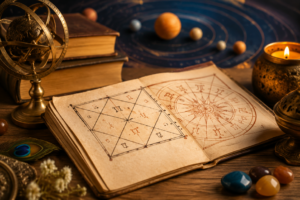

A Prashna Kundli, also called Prashna Kundali, is an astrological chart created for the time and place when a person asks a specific question. Unlike a birth chart, which is based on the moment of birth, a Prashna chart focuses on one particular concern.
For example, someone might ask, “Will I get this job?” or “Where is my lost item?” In traditional Vedic astrology, an astrologer studies the chart to interpret the question. This practice is commonly compared with horary astrology in Western astrology.
What Is Prashna Kundli?
The Sanskrit word Prashna means “question,” while Kundli means “chart.” Therefore, Prashna Kundli refers to a chart created to explore a specific question.
According to traditional practice, an astrologer prepares this chart using the date, time, and place associated with the question. The astrologer then interprets the planetary positions and houses to understand the matter.
Three main ideas form the foundation of Prashna Kundli:
1. The Moment of the Question Matters
The chart represents the moment when the question is asked or received by the astrologer. Practitioners interpret this chart to explore the issue.
2. One Chart Focuses on One Main Concern
A birth chart covers many areas of life, including career, relationships, health, and finances. In contrast, a Prashna chart focuses on a particular question or situation.
3. The Question Should Be Genuine
Traditional texts and learning resources often emphasize sincerity. The question should reflect a real concern rather than an attempt to test the astrologer. Some traditions also discourage repeatedly asking the same question.
Prashna Kundli vs. Janma Kundli
Both Prashna Kundli and Janma Kundli belong to Vedic astrology. However, they serve different purposes.
| Feature | Janma Kundli | Prashna Kundli |
|---|---|---|
| Chart basis | Moment of birth | Moment of the question |
| Main purpose | Explore broader life patterns | Explore a specific concern |
| Birth details | Required | Not strictly required |
| Common uses | Career, relationships, personality, and long-term themes | Decisions, missing items, and specific outcomes |
| Main focus | Overall life patterns | One particular matter |
Prashna Kundli works as a complementary method rather than a replacement for a birth chart. Some practitioners use it when birth details are unavailable or unreliable. Others use it alongside a birth chart to examine a particular concern.
However, interpretations vary across astrological traditions, and neither method can guarantee future events.
History of Prashna Astrology
Prashna astrology has roots in traditional Jyotish literature. Several classical texts and regional practices have influenced its development.
Roots in Indian Astrology
The following texts and traditions play an important role in discussions of Prashna astrology.
Prasna Marga: This text is widely regarded as a comprehensive work on horary astrology. It is commonly dated to 1649 CE and associated with Narayanan Nambutiri of Kerala. It discusses traditional astrological principles and methods for interpreting questions.
Prashna Tantra: This text covers different aspects of question-based astrology. Its subjects include preliminary considerations, house-related questions, special questions, and concluding guidance. Traditional accounts associate it with Neelakantha, although questions remain about its authorship.
Tajika Jyotish: This tradition reflects the influence of Perso-Arabic astrology on Indian astrological literature. It introduced additional techniques, aspects, and combinations used in some forms of Prashna interpretation.
Ashtamangala Prasna: This is a traditional Kerala practice associated with temple consultations. It uses eight auspicious objects and may involve an extended interpretive process.
Together, these texts and practices show the variety of methods found within traditional question-based astrology.
The Western Parallel: Horary Astrology
In Western astrology, a similar practice is known as horary astrology. One well-known text is Christian Astrology, published by William Lilly in 1647.
The book includes a dedicated section on horary techniques and worked examples. William Lilly is also remembered for his role in the development of traditional English horary astrology.
Both Prashna and horary astrology use the chart associated with a question as the starting point for interpretation. However, their specific rules and techniques can differ.
How Is a Prashna Chart Created?
The process usually involves four main steps. Specific practices may vary between astrologers and traditions.
Step 1: Ask a Clear Question
First, identify the matter you want to explore.
For example, “Will I receive a job offer this year?” is more focused than “What will happen in my life?”
A clear question helps the astrologer identify the relevant subject of the chart.
Step 2: Establish the Time
Next, determine the time associated with the question. Some astrologers use the moment the person asks it, while others use the time they first understand or receive it.
The chosen approach depends on the practitioner’s tradition.
Step 3: Establish the Location
The location helps determine the chart’s Ascendant, also known as the Lagna. Astrologers use the relevant time and geographical coordinates to calculate the chart.
Step 4: Calculate and Interpret the Chart
Finally, the astrologer prepares the chart and examines the Ascendant, planets, houses, and their relationships.
In traditional Vedic practice, astrologers may also apply rules specific to Prashna astrology.
Some traditions allow several questions during one consultation. In such cases, practitioners may examine different houses within the same chart or use a separate temporary Ascendant for each question.
How Do Astrologers Read a Prashna Chart?
A common starting point involves three important factors: the Lagna, the Moon, and the house related to the question.
1. Lagna and Its Lord
The Lagna, or Ascendant, represents the person asking the question in many traditional interpretations. Its ruling planet is called the Lagna lord.
Astrologers examine the lord’s placement, strength, and connections with other planets. Some traditional approaches associate a well-placed Lagna lord, especially in an angular house, with greater potential for progress.
The four angular houses, also called kendras, are the 1st, 4th, 7th, and 10th houses.
2. The Moon
The Moon is often associated with the mind and the flow of events in Prashna astrology.
Practitioners examine its placement and relationship with the house connected to the question. For example, some traditions interpret an applying connection between the Moon and the relevant house lord as a sign of movement toward a result.
Other planetary influences may be interpreted as possible signs of delay or obstacles. These are traditional interpretations, not scientifically established predictions.
3. The Relevant House and Its Lord
The house associated with the question helps the astrologer focus on the relevant subject.
Common examples include:
- 3rd house: Communication and short journeys.
- 7th house: Marriage, partnerships, and agreements.
- 10th house: Career, work, and public status.
- 11th house: Gains, aspirations, and fulfilment of wishes.
After identifying the relevant house, astrologers examine its ruling planet, planetary aspects, and connections with the Lagna lord and Moon.
They may also consider other planetary strengths and traditional combinations, known as yogas, before forming an interpretation.
Classical Rules of Prashna Astrology
Traditional Prashna texts describe several rules for interpreting a question chart. Their application differs across schools, so these rules should not be treated as universal or guaranteed outcomes.
Ascendant Sign and Its Nature
Some traditional sources distinguish between Shirshodaya signs, described as head-rising signs, and Prishtodaya signs, described as back-rising signs.
Gemini, Leo, Virgo, Libra, Scorpio, and Aquarius are commonly classified as Shirshodaya signs. Certain traditional interpretations consider these signs favourable under specific planetary conditions.
However, the sign alone does not determine the final interpretation. Astrologers also examine planetary aspects and the overall chart.
Connection Between Planetary Lords
Some classical rules examine the relationship between the Lagna lord and the lord of the house associated with the question.
A connection between these planets, particularly when supported by the Moon, may traditionally indicate progress toward the desired result.
Nevertheless, different schools may interpret the same planetary relationship differently.
The Role of Fixed Signs
Fixed signs are traditionally associated with stability and persistence. Some Prashna texts consider combinations involving fixed signs, the Sun, and the Moon when assessing whether a matter may continue or reach completion.
Astrologers generally consider these factors alongside the rest of the chart.
Checking the Nature of the Question
Some traditional authors describe planetary patterns that they interpret as signs of an unclear, insincere, or unreliable question.
These rules form part of historical astrological practice. They should not be used to make unsupported judgments about a person’s honesty or intentions.
Travel-Related Questions
Traditional texts also describe specific planetary combinations for travel questions. For example, some interpretations examine the Moon’s placement in the 7th house and its connection with the 4th-house lord when considering whether a traveller may be on the way or nearing arrival.
Such interpretations depend on the astrological school and the full chart.
What Is KP Prashna?
Krishnamurti Paddhati, commonly called KP astrology, is a modern astrological system that uses its own approach to horary questions.
One well-known technique asks the person to select a number between 1 and 249. The number corresponds to a specific subdivision of the zodiac and helps determine the Ascendant used in the analysis.
KP practitioners pay particular attention to house cusps, sub-lords, planetary significators, and ruling planets. They use these factors to interpret whether a matter may progress and, in some cases, to estimate timing.
Parashari-Style Prashna vs. KP Prashna
| Feature | Classical Prashna | KP Prashna |
|---|---|---|
| Chart basis | Time and place of the question | Number-based method, with time and place used according to the technique |
| Main factors | Lagna, Moon, house lords, and yogas | Cusp sub-lords, significators, and ruling planets |
| Interpretation style | Often descriptive and contextual | Often focused on specific outcomes and timing |
| Approach | Traditional Vedic horary rules | Krishnamurti Paddhati techniques |
Both approaches belong to astrological traditions, but their methods and interpretations differ. Therefore, their results should not be assumed to match.
Which Questions Suit Prashna Kundli?
Traditional practitioners use Prashna Kundli to explore a wide range of specific concerns.
Common examples include:
- Career: Job offers, interviews, promotions, and workplace decisions.
- Relationships: Marriage proposals, partnerships, and relationship concerns.
- Travel: Visa applications, relocation, and travel plans.
- Missing items: Questions about lost objects or missing belongings.
- Business: Agreements, business decisions, and property-related matters.
- Personal concerns: Questions about everyday choices and uncertainty.
Some practitioners also discuss health-related questions through astrology. However, an astrological reading cannot diagnose an illness, predict recovery reliably, or replace medical care.
In general, a focused question is easier to explore within the traditional framework than a broad question about every aspect of life.
Limitations and Ethical Considerations
Prashna Kundli has a long history in traditional astrology. However, readers should understand its limitations before relying on an interpretation.
Astrology Is Not Scientifically Proven
Astrology is a belief-based and interpretive practice. Mainstream scientific evidence has not established that astrological charts can reliably predict individual events.
Different practitioners may also reach different conclusions from the same chart.
Interpretations Vary Between Schools
Classical Vedic, Tajika, Kerala, and KP methods use different rules. As a result, two astrologers may interpret the same question differently.
The outcome also depends on the method and the practitioner’s interpretation.
Do Not Replace Professional Advice
An astrological reading should never replace qualified medical, legal, or financial advice.
For example, consult a qualified professional about a health concern, legal dispute, investment, or major financial decision. Use reliable information and your own judgment when making important choices.
Avoid Fear-Based Predictions
A responsible consultation should not frighten people with claims of certain misfortune or pressure them into buying expensive rituals or remedies.
Readers should be cautious of anyone who promises guaranteed results or uses fear to influence decisions.
Frequently Asked Questions
What Is Prashna Kundli in Simple Words?
Prashna Kundli is a chart created for the moment a person asks a question. In traditional Vedic astrology, practitioners interpret it to explore that specific concern rather than the person’s entire life.
Is Prashna Kundli the Same as Horary Astrology?
They are comparable practices. Prashna is the Sanskrit term used in Indian astrology, while horary astrology is the commonly used term in Western astrology. Their techniques and rules are not identical.
Do I Need Birth Details for Prashna Kundli?
Not necessarily. Traditional Prashna methods use the time and place associated with the question. Some astrologers may also consult a birth chart for additional context.
Can I Ask the Same Question More Than Once?
Some traditional approaches discourage repeatedly asking the same question. They generally emphasize asking a sincere question and following a consistent method. Practices vary between astrologers.
Why Does KP Prashna Use a Number Between 1 and 249?
In a popular KP horary method, the selected number corresponds to a subdivision of the zodiac. The astrologer uses that subdivision to establish the Ascendant and then examines relevant planetary significators and sub-lords.
Which Is the Main Classical Book on Prashna Astrology?
Prasna Marga is widely cited as a major comprehensive work on Prashna astrology. Prashna Tantra and other traditional texts also contribute to the subject.
Is Prashna Kundli Accurate?
Followers of Prashna astrology consider it a useful traditional method for exploring specific questions. However, astrological predictions have not been scientifically validated as reliable forecasts. Interpretations also vary between practitioners, so readers should not treat them as certain outcomes.
Key Takeaways
- Prashna Kundli is a question-based chart associated with the time and place of an inquiry.
- Unlike a birth chart, it focuses on one specific concern and does not strictly require birth details.
- Traditional interpretations examine the Lagna, Moon, relevant house lords, and planetary relationships.
- Classical Prashna literature includes Prasna Marga and Prashna Tantra.
- KP Prashna uses a number-based method and places particular emphasis on sub-lords and significators.
- Astrology is not a substitute for professional advice or evidence-based decision-making.
Prashna Kundli remains an important part of traditional Jyotish for people interested in question-based astrology. Understanding its methods, history, and limitations can help readers explore the subject with a balanced perspective.
Disclaimer: This article is for educational and cultural information only. Astrological interpretations are not scientifically proven predictions and should not replace medical, legal, or financial advice.
Sources and further reading
- Prasna Marga, Wikipedia
- Prashna Tantra, Wikipedia
- Nilakantha Daivajna, Wikipedia
- Tajika Jyotish, Wikipedia
- Ashtamangala Prasnam, Wikipedia
- Horary astrology, Wikipedia
- Christian Astrology (William Lilly), Wikipedia
- William Lilly biography, Skyscript
- Prashna Chandeshwar (translation), Source Library
- KP System overview, Dekho Panchang
- Prashna module, Dekho Panchang
- Krishnamurti Paddhati (KP) Astrology, Vikaspedia
- Prashna Kundli: Question-Based Vedic Astrology Explained, AstroSight