What Is Drishti in Vedic Astrology?
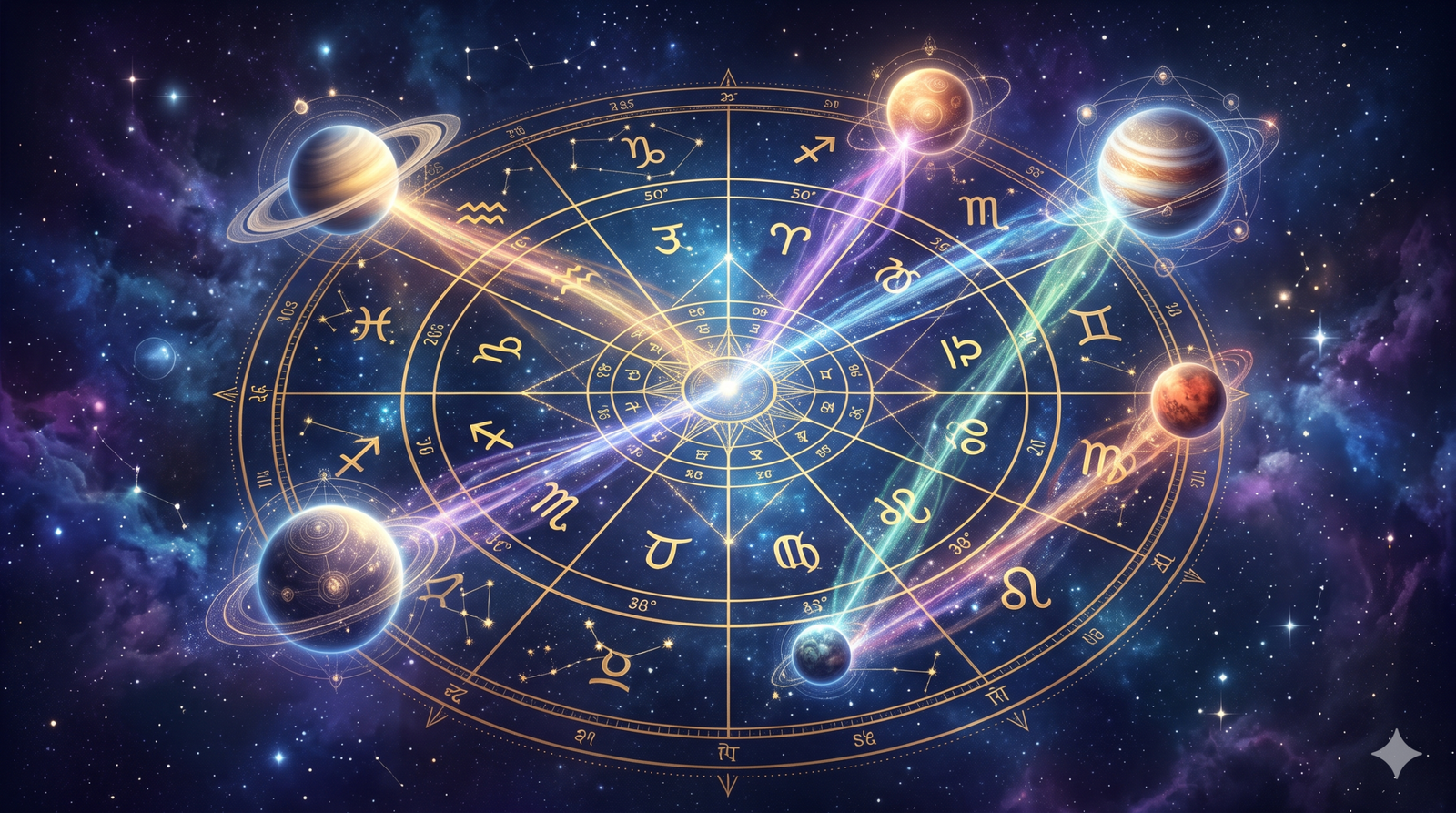
Drishti is a Sanskrit word that means “sight” or “gaze.” In Vedic astrology, it describes how a planet influences other planets and houses in a birth chart (Kundli).
In traditional Parashari astrology, every planet aspects the 7th house from its position. However, Mars, Jupiter, and Saturn also have special aspects:
- Mars: 4th, 7th, and 8th aspects
- Jupiter: 5th, 7th, and 9th aspects
- Saturn: 3rd, 7th, and 10th aspects
Some traditions also assign the 5th, 7th, and 9th aspects to Rahu and Ketu. However, astrologers do not agree on this rule.
Overview of Drishti
Drishti describes how planets influence other planets and houses through their aspects.
All traditional planets have a 7th-house aspect. In addition, Mars, Jupiter, and Saturn have special aspects called Vishesha Drishti.
To calculate an aspect, start counting from the house where the planet sits. Count that house as number one.
Drishti is different from a conjunction, or Yuti. During a conjunction, planets occupy the same sign or house. Through an aspect, planets influence each other from different positions.
Astrologers often link Jupiter’s aspects with growth and support. Saturn’s aspects may relate to discipline, responsibility, and delays. Meanwhile, Mars may bring energy, courage, and urgency.
However, the full birth chart matters. A single aspect cannot explain every result.
Vedic astrology mainly uses two aspect systems:
- Graha Drishti: Planetary aspects used in Parashari astrology.
- Rashi Drishti: Sign-based aspects used in the Jaimini system.
The final interpretation also depends on planetary strength, house lordship, and the running Dasha.
What Does Drishti Mean in Jyotisha?
In Sanskrit, दृष्टि (Drishti) means “sight,” “vision,” or “gaze.”
In Jyotisha, a planet casts its influence on another planet, sign, or house. Astrologers use this idea to understand how different parts of a Kundli connect.
Think of a planet as a light source. During a conjunction, two planets occupy the same space. In contrast, an aspect connects planets from different parts of the chart.
One classical text that discusses planetary aspects is the Brihat Parashara Hora Shastra (BPHS). Chapter numbers may differ between editions and translations. Therefore, check the chapter and verse in the edition you use.
Why Are Planetary Aspects Important in a Kundli?
A house receives influence from more than the planet placed inside it. Other planets may also affect that house through their aspects.
For example, astrologers associate the 7th house with relationships and partnerships. The planets aspecting this house may change how they interpret it.
The same planet can produce different interpretations in different charts. This happens because planetary strength, house lordship, aspects, and other factors all matter.
Understanding Drishti helps astrologers examine:
- How planets influence one another.
- How planets affect different houses.
- How aspects may influence planetary combinations and yogas.
- How astrologers interpret certain themes during Dashas and transits.
Therefore, always study Drishti alongside the complete birth chart. Do not use one aspect as a standalone prediction.
The 7th Aspect: The General Rule
In Parashari astrology, all seven traditional planets cast a full aspect on the 7th house from their position.
This house lies directly opposite the planet’s placement.
To find the 7th aspect, count the planet’s own house as number one.
Example
Suppose the Sun sits in the 2nd house. Its 7th aspect then falls on the 8th house.
Use this table as a quick reference:
| Planet’s House | 7th Aspect Falls On |
|---|---|
| 1st | 7th |
| 2nd | 8th |
| 3rd | 9th |
| 4th | 10th |
| 5th | 11th |
| 6th | 12th |
| 7th | 1st |
| 8th | 2nd |
| 9th | 3rd |
| 10th | 4th |
| 11th | 5th |
| 12th | 6th |
When two planets occupy opposite houses, they aspect each other through their 7th aspects.
Special Aspects of Mars, Jupiter, and Saturn
Mars, Jupiter, and Saturn have additional aspects beyond the general 7th aspect. Astrologers call these Vishesha Drishti, or special aspects.
Mars: 4th, 7th, and 8th Aspects
Mars aspects the 4th, 7th, and 8th houses from its position.
| Mars’ Aspect | Associated House Themes |
|---|---|
| 4th | Home, mother, property, and comfort |
| 7th | Marriage, relationships, and business partnerships |
| 8th | Transformation, shared resources, and sudden changes |
Astrologers link Mars with energy, courage, drive, and urgency. Its influence may encourage action. However, it can also suggest impatience, conflict, or tension.
Jupiter: 5th, 7th, and 9th Aspects
Jupiter aspects the 5th, 7th, and 9th houses from its position.
| Jupiter’s Aspect | Associated House Themes |
|---|---|
| 5th | Children, intelligence, creativity, and learning |
| 7th | Relationships, partnerships, and advisors |
| 9th | Dharma, fortune, higher learning, and mentors |
Jupiter’s special aspects connect it with the 5th and 9th houses. Traditionally, astrologers link these houses with learning, wisdom, and fortune.
Jupiter often represents growth, support, and protection. Still, its effects depend on its placement, strength, house lordship, and other chart factors.
Saturn: 3rd, 7th, and 10th Aspects
Saturn aspects the 3rd, 7th, and 10th houses from its position.
| Saturn’s Aspect | Associated House Themes |
|---|---|
| 3rd | Effort, courage, siblings, and communication |
| 7th | Relationships and partnerships |
| 10th | Career, responsibilities, and reputation |
Astrologers associate Saturn with discipline, responsibility, patience, and delays.
Its aspects may highlight areas that need steady effort. As a result, astrologers often link Saturn’s influence with gradual progress, lasting results, and maturity.
Examples of Special Aspects
| Planetary Position | Houses Aspecting |
|---|---|
| Mars in the 1st house | 4th, 7th, and 8th |
| Jupiter in the 3rd house | 7th, 9th, and 11th |
| Saturn in the 10th house | 12th, 4th, and 7th |
These examples count aspects from the planet’s own house.
Example of a Mutual Special Aspect
Suppose Mars sits in Scorpio and Saturn sits in Aquarius.
Aquarius is the 4th sign from Scorpio. Therefore, Mars casts its 4th aspect on Saturn.
Scorpio is the 10th sign from Aquarius. As a result, Saturn casts its 10th aspect on Mars.
In this example, both planets influence each other through their special aspects.
However, special aspects are not always mutual. One planet may aspect another without receiving an aspect in return.
Do Rahu and Ketu Have Aspects?
Astrologers disagree about the aspects of Rahu and Ketu.
Some traditions assign the lunar nodes the 5th, 7th, and 9th aspects. Others recognize only the 7th aspect. Meanwhile, some schools use different rules for the nodes.
These differences can lead to different interpretations of the same chart.
Common Interpretations
| Planet | Commonly Associated Themes |
|---|---|
| Rahu | Ambition, desire, intensification, and obsession |
| Ketu | Detachment, introspection, and intuition |
These themes represent broad traditional interpretations, not fixed outcomes.
Some astrologers also consider the sign lord when interpreting Rahu and Ketu. Since different schools use different methods, state which approach you follow when reading the lunar nodes.
Quick Reference Table of Planetary Aspects
This table summarizes a commonly used Parashari aspect pattern.
| Planet | 3rd | 4th | 5th | 7th | 8th | 9th | 10th |
|---|---|---|---|---|---|---|---|
| Sun | — | — | — | ✓ | — | — | — |
| Moon | — | — | — | ✓ | — | — | — |
| Mercury | — | — | — | ✓ | — | — | — |
| Venus | — | — | — | ✓ | — | — | — |
| Mars | — | ✓ | — | ✓ | ✓ | — | — |
| Jupiter | — | — | ✓ | ✓ | — | ✓ | — |
| Saturn | ✓ | — | — | ✓ | — | — | ✓ |
| Rahu* | — | — | ✓ | ✓ | — | ✓ | — |
| Ketu* | — | — | ✓ | ✓ | — | ✓ | — |
Rahu and Ketu’s aspects vary between astrological traditions.
Easy Way to Remember
- Mars: Special aspects on the 4th and 8th houses.
- Jupiter: Special aspects on the 5th and 9th houses.
- Saturn: Special aspects on the 3rd and 10th houses.
- All traditional planets: Aspect the 7th house.
Planetary Aspect Intensity
Some Parashari teachings describe different levels of aspect strength based on the relative position of a planet.
| Aspect Position | Traditional Aspect Strength |
|---|---|
| 3rd and 10th | 25% |
| 5th and 9th | 50% |
| 4th and 8th | 75% |
| 7th | 100% |
These percentages come from a traditional framework for understanding aspect strength.
In standard Parashari interpretations, astrologers commonly treat the special aspects of Mars, Jupiter, and Saturn as full aspects.
However, texts and calculation methods may differ. So, verify the system before applying these rules to a specific chart.
Types of Drishti: Graha, Rashi, and Sphuta
Vedic astrology uses different methods to study aspects.
| Type | Based On | Associated System |
|---|---|---|
| Graha Drishti | Planetary positions | Parashari astrology |
| Rashi Drishti | Sign relationships | Jaimini astrology |
| Sphuta Drishti | Exact planetary degrees | Degree-based calculations |
Graha Drishti: Planetary Aspects
Graha Drishti is the aspect system most commonly used in standard Parashari Kundli readings.
This method examines each planet’s position and the houses it aspects. Many astrology reports and chart-reading tools also use it.
Rashi Drishti: Sign-Based Aspects
The Jaimini system uses sign-based aspects rather than relying only on planetary positions.
The commonly described rules are:
- Movable signs aspect fixed signs, except the fixed sign next to them.
- Fixed signs aspect movable signs, except the movable sign next to them.
- Dual signs aspect other dual signs.
The three sign groups are:
- Movable signs: Aries, Cancer, Libra, and Capricorn.
- Fixed signs: Taurus, Leo, Scorpio, and Aquarius.
- Dual signs: Gemini, Virgo, Sagittarius, and Pisces.
A planet in an aspecting sign may influence a planet in the sign receiving the aspect.
Rashi Drishti follows different rules from Graha Drishti. Therefore, learn each system before combining them in a chart reading.
Sphuta Drishti: Degree-Based Aspects
Sphuta Drishti considers the exact degrees of planets when calculating aspects.
As a result, this method can require more detailed calculations than simply counting houses.
Some astrologers use software to calculate degree-based aspects because manual calculations can take time.
Benefic and Malefic Aspects
Traditional astrology sometimes classifies aspects according to the nature of the planet casting them.
Commonly Considered Benefic Planets
Jupiter, Venus, a well-placed Moon, and Mercury under suitable conditions are often considered natural benefics.
Astrologers may interpret their aspects as supportive, harmonious, or helpful.
Commonly Considered Malefic Planets
Saturn, Mars, Rahu, and Ketu are often considered natural malefics in traditional astrology.
Their aspects may relate to pressure, delays, challenges, or intense experiences.
However, these categories are not absolute. For example, a well-placed Saturn may represent stability and discipline. On the other hand, a poorly placed Jupiter may suggest excess or overconfidence.
The interpretation also depends on:
- The planet’s strength and dignity.
- The houses it rules for the Ascendant.
- The house and planet receiving the aspect.
- Conjunctions and other planetary relationships.
- The running Dasha.
Therefore, do not predict a fixed outcome from one aspect alone.
Drishti Effects of Different Planets
The following table outlines broad traditional interpretations.
| Planet | General Themes | Common Interpretation |
|---|---|---|
| Sun | Authority, identity, and visibility | Leadership and self-expression |
| Moon | Emotions, nurturing, and change | Emotional sensitivity and connection |
| Mercury | Intellect, communication, and trade | Communication and adaptability |
| Venus | Comfort, harmony, and attraction | Relationships and enjoyment |
| Mars | Energy, courage, and conflict | Motivation, action, and possible friction |
| Jupiter | Wisdom, growth, and protection | Expansion and support |
| Saturn | Discipline, delays, and responsibility | Effort, maturity, and long-term results |
| Rahu | Ambition, desire, and intensification | Increased focus or obsession |
| Ketu | Detachment and intuition | Reduced attachment or inward focus |
These meanings are general. The interpretation can change based on the birth chart and the astrological tradition.
How Planetary Aspects May Influence Houses
Here are a few examples from traditional astrology:
- Jupiter aspecting the 7th house: Astrologers often interpret this as supportive for relationships and partnerships.
- Saturn aspecting the 10th house: This may relate to career duties, steady effort, and gradual progress.
- Mars aspecting the 4th house: Astrologers may link this aspect with energy around home and property. It may also suggest tension.
- Rahu aspecting the 5th house: In traditions that use Rahu’s aspects, this may intensify themes related to creativity, education, or children.
These examples do not guarantee specific results.
Instead, astrologers consider the planet’s sign, dignity, house lordship, strength, and the running Dasha.
How to Read Aspects in Your Kundli
Follow these steps to examine planetary aspects in your birth chart:
- Identify the house and sign occupied by each planet.
- Count from the planet’s position. Treat its own house as number one.
- Find its 7th aspect and any special aspects.
- Note which houses and planets receive those aspects.
- Check whether the aspecting planet is a natural benefic or malefic.
- Examine the houses that planet rules for your Ascendant.
- Look for mutual aspects between planets.
- Check the strength, dignity, and conjunctions of the planets involved.
- Consider the relevant Mahadasha and Antardasha.
- Review the Navamsa chart when appropriate.
Tip: A Kundli calculator can help you identify Graha Drishti and Rashi Drishti. However, learning the basic rules will help you understand the results.
Common Mistakes When Reading Drishti
Avoid these common mistakes when studying planetary aspects:
- Confusing conjunctions with aspects: A conjunction occurs when planets share a sign or house. An aspect connects planets from different positions.
- Counting from the wrong house: Always count the planet’s own house as number one.
- Assuming every aspect has equal strength: Traditional systems may assign different strengths to aspects.
- Treating Saturn’s aspect as automatically negative: Saturn can also represent discipline, stability, and long-term effort.
- Ignoring differences between astrological traditions: Rules for Rahu, Ketu, Rashi Drishti, and partial aspects may vary.
- Making predictions from one aspect alone: Consider the full chart, including planetary strength and house lordship.
Vedic Astrology vs. Western Astrology Aspects
Vedic and Western astrology use different methods to study planetary relationships.
| Feature | Vedic Astrology | Western Astrology |
|---|---|---|
| Common approach | Counting houses or signs | Measuring angular distances |
| Common aspects | 7th and special planetary aspects | Conjunction, sextile, square, trine, and opposition |
| Calculation | Often based on house or sign positions | Often based on degrees and orbs |
| Special rules | Mars, Jupiter, and Saturn have special aspects in Parashari astrology | Aspect patterns generally apply across planets, with interpretations varying by tradition |
Although the two systems share some ideas, their calculation methods and interpretations differ.
Tajika astrology, which some astrologers use for annual charts, also follows aspect methods that differ from standard Parashari rules.
A Note on Interpretation and Limitations
Drishti belongs to the traditional astrological framework of Jyotisha.
However, astrology has not been established as a scientific method for predicting events. Do not use astrological interpretations as the sole basis for medical, legal, financial, or other major decisions.
For important matters, consult a qualified professional.
Frequently Asked Questions
What does Drishti mean in Vedic astrology?
Drishti means “sight” or “gaze.” It describes the influence that a planet is traditionally believed to cast on other houses or planets in a Vedic birth chart.
Which planets have special aspects?
Mars has special aspects on the 4th and 8th houses. Jupiter has special aspects on the 5th and 9th houses. Saturn has special aspects on the 3rd and 10th houses.
All three planets also aspect the 7th house.
Do the Sun, Moon, Mercury, and Venus have special aspects?
In standard Parashari astrology, the Sun, Moon, Mercury, and Venus have the general 7th aspect. However, they do not have the same special aspects as Mars, Jupiter, and Saturn.
What is the difference between a conjunction and an aspect?
A conjunction, or Yuti, occurs when planets occupy the same sign or house. An aspect occurs when planets influence each other from different positions in the chart.
Is Jupiter’s aspect always beneficial?
Astrologers traditionally consider Jupiter’s aspect supportive and expansive. However, its interpretation depends on its strength, placement, house lordship, and the planet or house receiving the aspect.
Is Saturn’s aspect always negative?
No. Saturn represents discipline, responsibility, patience, and delays in traditional astrology. When well placed, astrologers may also interpret its influence as supporting stability and long-term effort.
What is Rashi Drishti?
Rashi Drishti is a sign-based aspect system used in Jaimini astrology. It focuses on relationships between signs rather than only on planetary positions.
Do Rahu and Ketu aspect houses?
Some traditions assign Rahu and Ketu the 5th, 7th, and 9th aspects. Others recognize only the 7th aspect or follow different methods. The rules vary between schools.
How are planetary aspects measured?
In traditional Parashari teachings, astrologers consider the 7th aspect full. Some systems assign partial strength to other aspects. Sphuta Drishti uses exact planetary degrees for more detailed calculations.
Can planets aspect other planets?
Yes. A planet aspects certain houses, and planets placed in those houses may receive its aspect.
How can I find planetary aspects in my Kundli?
You can count the 7th and special aspects from each planet’s position. Alternatively, use a Kundli calculator that displays Graha Drishti and Rashi Drishti.
Conclusion
Drishti helps astrologers understand the relationships between planets and houses in a Kundli.
In standard Parashari astrology, all traditional planets aspect the 7th house. Mars also aspects the 4th and 8th houses, Jupiter the 5th and 9th houses, and Saturn the 3rd and 10th houses.
Meanwhile, astrologers continue to debate the aspects of Rahu and Ketu.
To understand a chart more fully, consider planetary strength, house lordship, Dasha periods, and the differences between Graha Drishti and Rashi Drishti.
Want to learn more about Vedic astrology? Explore these related guides:
- Planetary Conjunctions (Yuti) in Vedic Astrology
- Rahu and Ketu in the 12 Houses
- How to Read Your Kundli: A Beginner’s Guide
- Vimshottari Dasha Explained
Disclaimer: This article discusses traditional astrological concepts for educational purposes. Astrology should not replace professional advice or serve as the sole basis for important life decisions.
Sources and Further Reading
Classical Texts
- Brihat Parashara Hora Shastra, Chapter 26 (Sanskrit text with transliteration)
- BPHS English Translation by R. Santhanam (Internet Archive)
- BPHS: “Evaluation of Planetary Aspects” (Wisdomlib)
Reference and Explainers
- Drishti: Definition and Meaning (Wisdomlib)
- Astrological Aspects in Hindu Astrology (Wikipedia)
- Drishtis (Aspects), Saravali
- Graha Drishti: Parashari Principles, Barbara Pijan Lama
- Planetary Aspects Guide, DekhoPanchang
- How to Determine Planetary Aspects, Good Stars Jyotish
- Planetary Aspects (Graha Drishti), OnlineJyotish
- Aspects in Vedic Astrology: Complete Guide to Planetary Drishti