
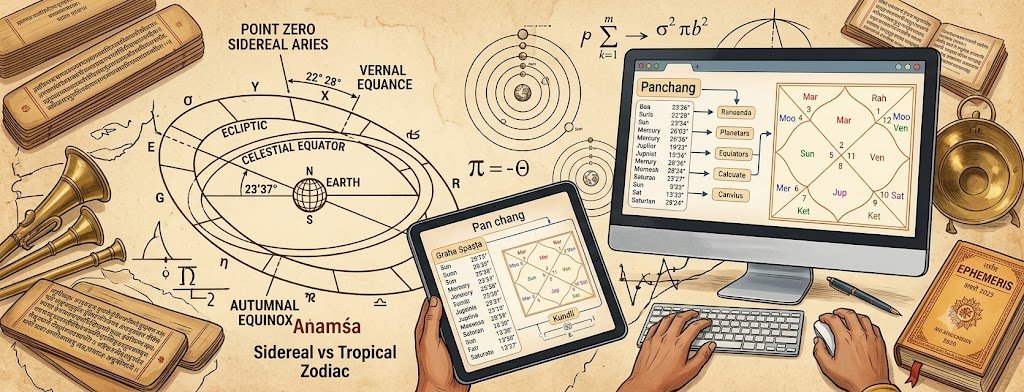
In Vedic Astrology (Jyotish), planetary positions play a significant role in creating a Janam Kundli (birth chart). A Kundli represents the positions of celestial bodies at the exact moment and location of a person’s birth.
The calculation of planetary positions involves multiple astronomical factors, including birth date, exact birth time, geographical location, zodiac system and planetary movements. Modern astrology software uses astronomical data sources such as ephemeris tables to calculate planetary longitudes and chart placements.
KundliTime uses advanced calculations based on traditional Vedic astrology principles to help users understand their birth charts, planetary placements, Nakshatras and horoscope details.
What Are Planetary Positions in Vedic Astrology?
Planetary positions refer to the location of planets within the zodiac signs at a particular time.
In Vedic Astrology, the primary planetary bodies considered are:
- Sun (Surya)
- Moon (Chandra)
- Mars (Mangal)
- Mercury (Budh)
- Jupiter (Guru)
- Venus (Shukra)
- Saturn (Shani)
- Rahu
- Ketu
These nine entities are collectively known as Navagraha in Jyotish traditions. A Kundli displays where these planets are placed among the 12 zodiac signs (Rashis) at the time of birth.
Step 1: Collecting Accurate Birth Details
The first step in calculating planetary positions is collecting accurate birth information.
A Kundli calculation requires:
Date of Birth
The date determines the planetary positions on that specific day.
Exact Birth Time
Birth time helps calculate:
- Ascendant (Lagna)
- House placements
- Planetary degrees
Even a small difference in time can change the Ascendant calculation because the rising sign changes continuously with Earth’s rotation.
Birth Location
The geographical location determines:
- Local time conversion
- Latitude and longitude
- Rising zodiac sign
- House calculations
A complete birth chart calculation depends on accurate date, time and place details.
Step 2: Understanding Planetary Ephemeris
An ephemeris is a table containing calculated positions of astronomical objects for specific dates and times.
Astrologers use planetary ephemeris data to identify:
- Planetary longitude
- Zodiac placement
- Degrees and minutes
- Planetary movements
Modern digital astrology tools use electronic ephemeris data for accurate calculations.
For Vedic astrology, planetary positions are commonly calculated using sidereal zodiac systems with specific ayanamsa calculations.
Step 3: Calculating Planetary Longitude
Each planet travels through the zodiac at different speeds.
The zodiac circle consists of:
- 360 degrees total
- 12 zodiac signs
- 30 degrees per sign
For example:
- Aries = 0° to 30°
- Taurus = 30° to 60°
- Gemini = 60° to 90°
The exact degree of a planet determines its placement in the Kundli.
Example:
If Jupiter is calculated at:
45°
It means:
- Planet is in Taurus sign
- Degree placement is 15° Taurus
Step 4: Applying Sidereal Zodiac Calculation
One major difference between Vedic Astrology and Western Astrology is the zodiac system.
Vedic Astrology primarily uses the Sidereal Zodiac, which considers the fixed star background.
The calculation includes:
Tropical Position
Based on the seasonal zodiac system.
Ayanamsa Adjustment
The difference between tropical and sidereal positions is adjusted using ayanamsa.
Common Vedic calculations use:
- Lahiri Ayanamsa
- Raman Ayanamsa
- Krishnamurti Ayanamsa
This adjustment helps determine the sidereal planetary position used in many Vedic charts.
Step 5: Calculating the Ascendant (Lagna)
The Ascendant is the zodiac sign rising on the eastern horizon at the time of birth.
The Lagna calculation depends on:
- Exact birth time
- Birth location
- Earth’s rotation
The Ascendant determines:
- First house
- House arrangement
- Planetary house placements
Unlike planetary signs, the Lagna changes quickly, making accurate birth time important.
Step 6: Placing Planets into Houses
After calculating planetary degrees and Lagna, planets are placed into the 12 houses of the Kundli.
The 12 houses represent different life areas according to traditional Vedic astrology:
| House | Represents |
|---|---|
| 1st House | Self & personality |
| 2nd House | Wealth & family |
| 3rd House | Communication & courage |
| 4th House | Home & emotions |
| 5th House | Creativity & learning |
| 6th House | Health & challenges |
| 7th House | Relationships |
| 8th House | Transformation |
| 9th House | Knowledge & beliefs |
| 10th House | Career |
| 11th House | Gains |
| 12th House | Expenses & spirituality |
Step 7: Calculating Nakshatra Positions
Vedic Astrology divides the zodiac into 27 Nakshatras.
Each Nakshatra covers:
- 13°20′ of the zodiac
The Moon’s position is especially important for determining:
- Birth Nakshatra
- Emotional characteristics
- Dasha calculations
Step 8: Planetary Strength and Interpretations
After calculating positions, astrologers traditionally analyse:
- Planetary signs
- Houses
- Degrees
- Aspects
- Conjunctions
- Strength conditions
These interpretations form the basis of horoscope analysis in Vedic astrology.
How KundliTime Makes Planetary Calculations Easier
Traditional calculations required manual astronomical tables and complex mathematical processes.
Today, digital platforms like KundliTime simplify the process by combining:
✅ Accurate birth details
✅ Planetary calculations
✅ Kundli generation
✅ Zodiac placements
✅ Nakshatra calculations
✅ Horoscope insights
Users can generate their birth charts quickly while exploring traditional Vedic astrology concepts.
Why Accurate Planetary Calculation Matters in Kundli?
Accurate planetary positions help create a detailed birth chart containing:
- Correct Lagna
- Correct Moon sign
- Planet placements
- Nakshatra
- House positions
- Dasha calculations
Incorrect birth details can affect chart calculations, especially Ascendant and house placements.
Frequently Asked Questions
How are planetary positions calculated in Vedic Astrology?
Planetary positions are calculated using birth date, exact time, location and astronomical data such as ephemeris tables combined with Vedic zodiac calculations.
What information is needed to calculate a Kundli?
A Kundli requires:
- Date of birth
- Exact birth time
- Birthplace
Why is birth time important in Kundli calculation?
Birth time helps determine the Ascendant and house placements, which are important parts of a Vedic birth chart.
Does KundliTime calculate planetary positions automatically?
Yes, digital astrology platforms use automated calculations to generate planetary placements, zodiac signs and birth charts based on entered birth details.
Conclusion
Calculating planetary positions in Vedic Astrology involves a combination of astronomical data, mathematical calculations and traditional Jyotish principles.
From determining planetary degrees to calculating Lagna, Nakshatra and house placements, every step contributes to creating a detailed Kundli.
With KundliTime, users can explore their Vedic birth charts and understand the traditional significance of planetary placements in a simple and accessible way.
External Authority & Reference Backlinks
NASA Solar System Exploration
Swiss Ephemeris (Astronomical Calculation Software)
https://www.astro.com/swisseph/
Encyclopaedia Britannica – Astrology Background
https://www.britannica.com/topic/astrology