
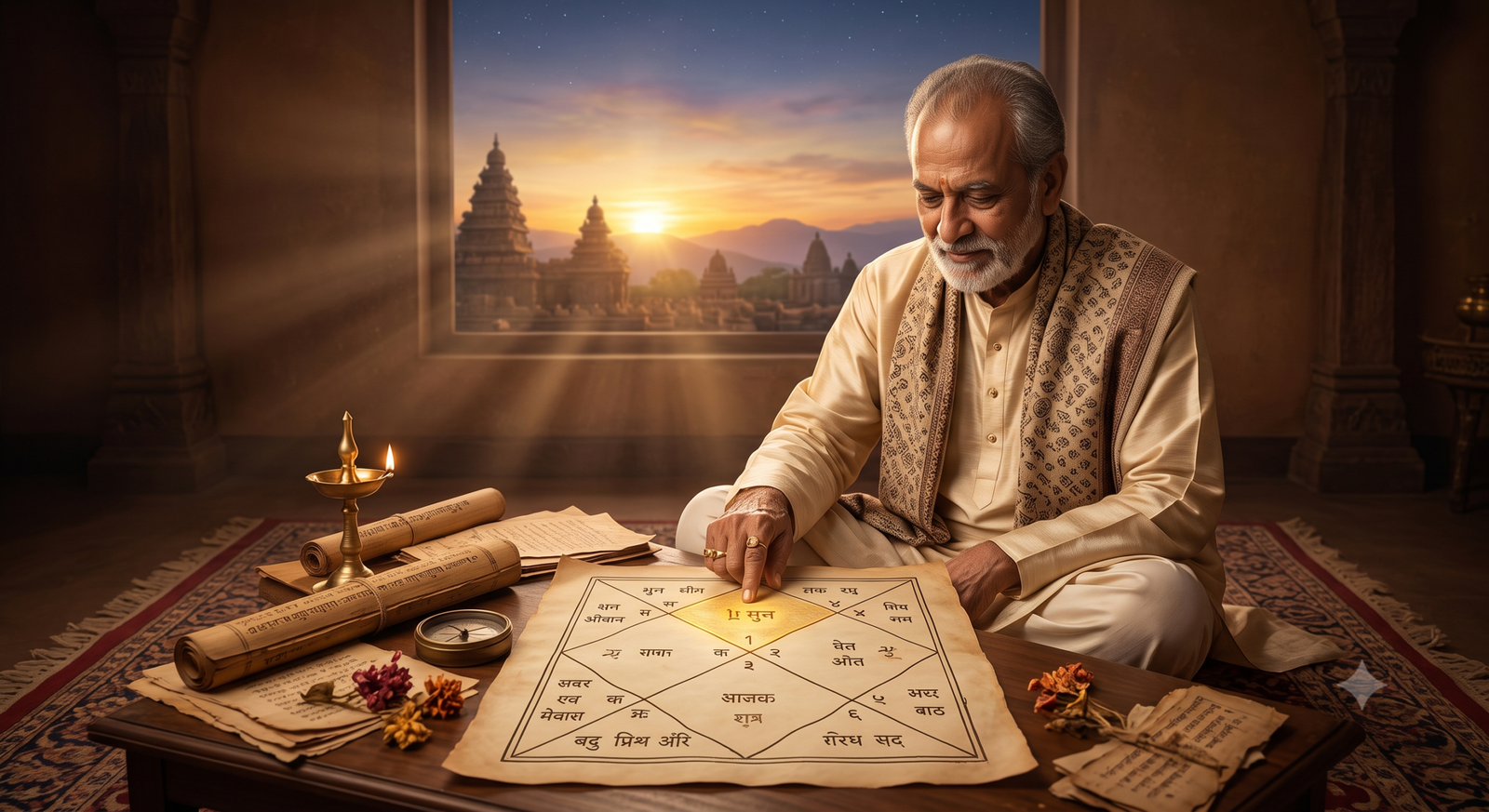
Introduction: Why Every Kundli Reading Starts With Lagna
Ask any Vedic astrologer where to begin reading a birth chart. The answer is always the same: start with the Lagna. Not the Sun sign. Not the Moon sign. The Lagna — also called the Ascendant or rising sign — anchors the entire Kundli. Without it, no other calculation in the chart makes sense.
It’s also one of the most misunderstood terms in astrology. People often confuse it with the Sun sign (used in Western pop astrology) or the Moon sign (used for daily Rashi predictions in India). This guide breaks down what Lagna actually means, how astrologers calculate it, and why both classical and modern astrologers treat it as one of the most important points in a horoscope.
What Is Lagna? The Real Meaning
In Sanskrit, Lagna comes from the root “Sanlagn” (संलग्न), meaning “attached” — something that stays with you for life. Astrologically, the term refers to the zodiac sign rising on the eastern horizon at the exact moment of birth. It marks the union of cosmic energy with human form.
Structurally, the Lagna is the sign rising on the eastern horizon at the time of birth. It serves as the starting point of the horoscope, and the entire chart — including house placements and planetary influences — builds around it.
The Lagna always occupies the 1st house of the Kundli. Every other house, from the 2nd through the 12th, counts forward from it.
Lagna vs. Sun Sign vs. Moon Sign
This is where most beginners get confused. Here’s a simple way to separate the three:
- Sun Sign — reflects the soul and core identity. Western horoscope columns use this.
- Moon Sign (Chandra Rashi) — reflects the mind and emotions. Vedic astrology uses this for daily and monthly predictions.
- Lagna (Ascendant) — reflects the physical body, appearance, and how a person projects themselves to the world.
Many astrologers consider the Lagna especially important. Tradition links it to a person’s physical existence, personality traits, behavior, consciousness, and early life conditions. It helps set the framework through which astrologers interpret the rest of the horoscope.
Why Lagna Changes So Fast — And Why That Matters
The Moon sign stays the same for roughly 2.5 days. The Sun sign stays the same for about a month. The Lagna, by contrast, moves fast.
Earth’s rotation shifts the Lagna approximately every two hours. This makes it highly dependent on the exact birth time.
That’s why astrologers insist on your precise birth time, not just your date of birth. A difference of 15–20 minutes can sometimes shift the Ascendant into a different zodiac sign — and that shift changes the placement of every house in your Kundli.
How Lagna Is Calculated: The Real Astronomy Behind It
Modern Kundli software performs these calculations almost instantly. But understanding the method explains why accurate birth data matters so much.
At a high level, the calculation depends on three main inputs:
- Date of birth — the Sun’s position changes throughout the year.
- Exact time of birth — the most important factor, since the rising sign shifts roughly every two hours.
- Place of birth — latitude and longitude determine the local sky and which sign rises on the eastern horizon.
The Calculation Chain
Traditional and computational methods follow roughly the same logic:
- Convert the local birth time to Universal Time (UT) and derive the Julian Day Number.
- Calculate Greenwich Sidereal Time (GST), then convert it to Local Sidereal Time (LST) using the birth longitude.
- Use the LST, birth latitude, and the obliquity of the ecliptic (about 23.44°) to calculate the tropical Ascendant degree.
- Subtract the Ayanamsha — the gap between the tropical and sidereal zodiacs — to arrive at the sidereal Lagna used in a Vedic Kundli. Vedic astrology commonly uses the Lahiri Ayanamsha, currently around 24°.
Classical Vedic texts describe similar astronomical methods for related concepts. The Brihat Parashara Hora Shastra, for example, explains how to calculate the closely related Bhava Lagna using the time elapsed since sunrise and the Sun’s position at that moment.
Today, ephemeris-based astrology software automates this entire chain. That’s why online Kundli generators can produce a Lagna almost instantly — as long as you enter the birth time and place correctly.
The Lagna Lord (Lagnesha): Why It Matters
Every Lagna sign has a ruling planet, called the Lagnesha or Ascendant Lord.
Astrologers weigh this planet’s strength, house placement, and aspects carefully when interpreting a chart. Traditional Vedic astrology links the Lagna Lord to a person’s nature, life direction, vitality, stability, and personal strength.
The relationship works both ways. A strong Lagna and Lagna Lord generally point to stability and strength in classical interpretation. A weak or afflicted Lagna Lord often points to greater challenges instead.
For example, classical interpretation sometimes links a Lagna Lord in the 6th or 8th house to health-related challenges. It links placement in the 12th house to greater struggle or expenditure. Keep in mind: these are traditional astrological associations, not scientific medical or life predictions.
Why Lagna Is Structurally the Most Important House
Beyond tradition, the Lagna plays a unique role in the geometry of the chart. It sits at the intersection of two major house groupings:
- It’s the first of the four Kendra (angular) houses: 1st, 4th, 7th, and 10th.
- It’s also the first of the three Dharma Trikona houses: 1st, 5th, and 9th.
This dual role gives the 1st house a distinctive structural place in the horoscope. It anchors both the angular framework and the dharmic framework of the chart at once.
Classical interpretation also frames the Lagna symbolically — as the native’s entrance into the world. That symbolism makes it one of the most personal reference points in a Kundli.
What the Lagna Governs in Predictions
When astrologers analyze a Kundli, they traditionally examine the Lagna and the 1st house for:
- Physical appearance and body constitution — often one of the first factors astrologers consider.
- Personality and outward behavior — how a person presents themselves to the outside world.
- General health and vitality — tradition links a strong, unafflicted Lagna to greater resilience.
- Overall life direction — since every other house gets interpreted relative to the Lagna, it sets the basic framework for reading the horoscope.
One important caveat: traditional astrology doesn’t treat any single Lagna sign as universally “good” or “bad.” The interpretation depends heavily on the planets tied to the Lagna and where they sit.
How to Read Your Lagna Chart: Step by Step
If you already have your Kundli, follow this basic reading sequence:
- Identify the 1st house. The zodiac sign placed here is your Lagna.
- Note the Lagna Lord. Find the planet that rules your Lagna sign.
- Locate the Lagna Lord. Check which house it occupies, and note its condition — exalted, debilitated, or aspected.
- Check planets in the 1st house. Tradition considers planets placed directly here influential on personality and appearance.
- Trace aspects (Drishti). Look at which planets aspect the Lagna or the 1st house.
A simple traditional sequence sums this up well: Lagna → Houses → Planets → Aspects. It gives you a structured way to start interpreting a Kundli instead of jumping straight to individual planetary predictions.
Common Misconceptions About Lagna
“Lagna and Sun Sign are the same thing.” They’re not. The Sun sign depends mainly on the date of birth. The Lagna depends heavily on the exact time and location of birth.
“An unfavorable Lagna means a difficult life.” A Lagna sign alone doesn’t determine whether someone’s life will be positive or difficult. Traditional Vedic interpretation weighs the Lagna together with planetary placements, aspects, the Lagna Lord, and other chart factors.
“Approximate birth time is good enough.” Not always. Since the Lagna can shift every two hours, an inaccurate birth time can produce a different Ascendant — and that means a different house structure for your entire Kundli. Accurate birth details matter most right here.
Conclusion
The Lagna isn’t just one data point among many in a Kundli. It’s the reference frame the entire chart builds around.
It determines which zodiac sign occupies the 1st house. It sets the starting point for every other house. And it provides the foundation for interpreting physical characteristics, personality, vitality, and overall life direction within the traditional Vedic astrology framework.
Whether you’re generating your first Kundli or trying to understand why astrologers insist on an exact birth time, the Lagna is one of the first concepts worth understanding.
External Authority & Reference Backlinks
Wikipedia – Ascendant (Astronomy & Astrology Overview) https://en.wikipedia.org/wiki/Ascendant
Swiss Ephemeris (Astronomical Calculation Software Used by Astrology Engines) https://www.astro.com/swisseph/
Encyclopaedia Britannica – Astrology Background https://www.britannica.com/topic/astrology
Encyclopaedia Britannica – Horoscope https://www.britannica.com/topic/horoscope
NASA Solar System Exploration https://solarsystem.nasa.gov/
Indian Space Research Organisation (ISRO) https://www.isro.gov.in/
Drik Panchang – Planetary Positions Reference https://www.drikpanchang.com/planet/position/
Royal Astronomical Society https://ras.ac.uk/