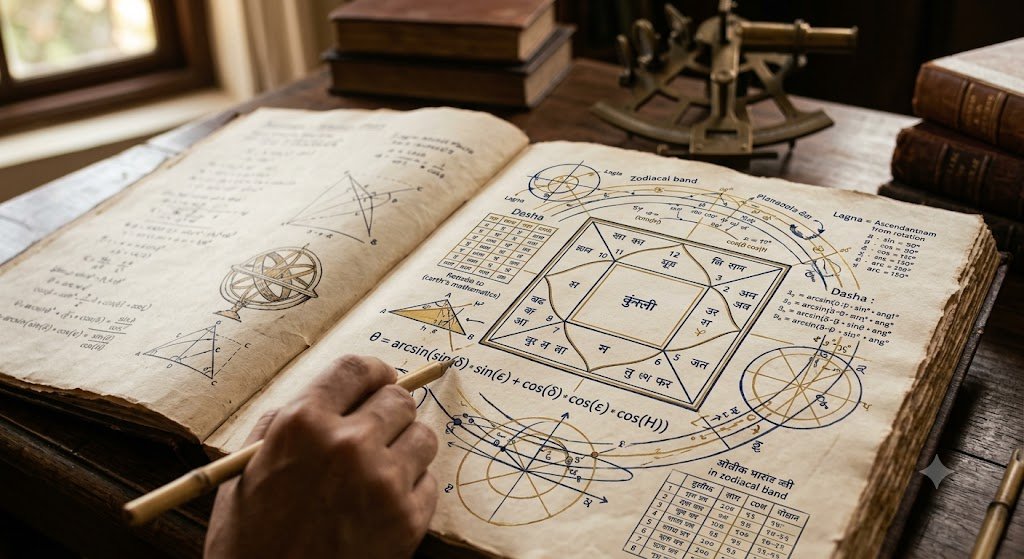
When most people look at a Kundli, they see zodiac signs, houses, planets, Nakshatras and unfamiliar symbols. But before any traditional astrological interpretation begins, a substantial amount of astronomical and mathematical calculation is required to construct the chart.
Your exact date of birth, time of birth and place of birth provide the starting data. From these inputs, a chart-calculation system determines astronomical positions for a particular moment and location and then maps those positions into the framework used by Jyotish or Vedic astrology.
This is why two people born on the same date may not necessarily have identical Kundlis. Differences in birth time and location can affect the calculated Ascendant and house positions.
So, what mathematics is actually hidden inside your Kundli?
Let’s explore it step by step.
1. A Kundli Begins with Three Important Inputs
The basic calculation starts with:
Date of Birth + Exact Time of Birth + Place of Birth
Each has a mathematical purpose.
The date establishes the required astronomical epoch. The time identifies a more precise instant, while the location provides geographical coordinates needed for location-dependent calculations such as the local sky orientation and Ascendant.
Modern astronomical systems similarly calculate the apparent or geometric position of celestial bodies as a function of time, observer location, coordinate system and reference frame.
NASA’s Jet Propulsion Laboratory, for example, operates the Horizons ephemeris system, which can generate the positions and other astronomical quantities of planets, the Moon, Sun and other Solar System bodies for specified times and observing locations.
This demonstrates an important principle behind chart computation:
Celestial positions are numerical quantities that can be calculated for a specified time and coordinate system.
2. The 360° Circle Behind Your Kundli
One of the simplest pieces of mathematics behind a Kundli is geometry.
The zodiac is treated as a complete circle:
360°
This circle is divided into 12 Rashis, giving:
360° ÷ 12 = 30°
Therefore, every Rashi occupies 30 degrees of zodiacal longitude.
For example:
0°–30° = first sign
30°–60° = second sign
60°–90° = third sign
…and the pattern continues until the full 360° circle is completed.
This means that a planet’s position isn’t merely described as being “in a sign.” Underneath that description is a numerical longitude.
A calculated planetary position might, for example, be represented as:
127.42°
A chart system can mathematically determine which 30-degree zodiac segment contains that longitude.
This is one reason degrees matter so much in detailed Kundli calculations.
3. Planetary Positions Come from Ephemerides
How does a Kundli calculator know where Jupiter, Saturn, Mars, Venus or Mercury was when you were born?
This is where ephemerides become important.
An ephemeris provides calculated positions of astronomical objects over time.
NASA/JPL’s Horizons system, for example, provides highly accurate ephemerides for Solar System objects and can output observational coordinates, Cartesian state vectors and orbital elements.
Modern planetary ephemerides are built using sophisticated astronomical observations and dynamical models.
For Kundli software, an astronomical calculation engine or ephemeris can therefore provide the underlying planetary-position data required before astrological rules are applied.
Astronomy calculates position. Astrology interprets that position.
That distinction is important.
The mathematics used to determine a planet’s location can be astronomically rigorous, while conclusions about personality, relationships, career or future events belong to the traditional astrological interpretation system rather than established astronomical science.
4. Longitude Turns Numbers into Zodiac Positions
Suppose a calculation produces a planetary longitude somewhere between:
0° and 360°
That number can be converted into a Rashi and a degree within that Rashi.
A simplified mathematical idea is:
Sign Number = floor(Longitude ÷ 30)
Then:
Degree within the Sign = Longitude mod 30°
For example, imagine a hypothetical planetary longitude of:
128°
Dividing by 30 gives:
128 ÷ 30 = 4 remainder 8
That tells the chart-calculation system that the object lies 8 degrees into the relevant 30-degree zodiac segment.
Real astronomical and Kundli calculations involve additional coordinate conventions and corrections, but this simple example reveals the mathematical structure underneath the familiar chart.
5. Why Birth Time Can Change Your Kundli
People often wonder why astrologers ask for an accurate birth time.
The answer is partly astronomical.
Earth rotates approximately once every 24 hours. Consequently, the orientation of the sky relative to a specific geographical location changes continuously.
This becomes especially important when calculating the Lagna or Ascendant.
The Ascendant is connected to the intersection of the ecliptic with the local eastern horizon at the relevant time and place.
Therefore, calculating it requires more than knowing which planets were present on a particular date.
The calculation involves factors such as:
- Birth time
- Geographical longitude
- Geographical latitude
- Time-zone conversion
- Local astronomical time
- Earth’s rotation
- Ecliptic and horizon geometry
This is why changing the birth location or birth time can change important components of a chart.
6. Time-Zone Conversion Is Part of the Calculation
Imagine someone is born at:
10:30 AM in India
Astronomical ephemerides commonly work with standardized time systems rather than simply taking the local clock reading at face value.
The local civil time therefore needs to be interpreted with the appropriate time zone and converted into the time standard required by the calculation engine.
For India, Indian Standard Time is:
UTC + 5 hours 30 minutes
In a simplified example:
10:30 AM IST → 05:00 UTC
The exact handling of historical time zones, calendar conventions and astronomical time scales can become more complex, especially for older dates.
A reliable Kundli calculation system therefore needs to handle time correctly before calculating planetary positions.
7. Geographic Coordinates Matter
Birthplace isn’t included merely as a city name.
Behind a place such as:
Guwahati, Delhi, Mumbai, London or New York
are geographical coordinates:
Latitude + Longitude
Astronomical calculations use observer location when determining how the sky appears from a particular place.
NASA/JPL Horizons similarly allows the observing location or coordinate centre to be specified when generating observer-based ephemerides.
So mathematically:
Same time + different geographical location = potentially different local sky geometry
This is particularly important for Ascendant and house calculations.
8. The Mathematics Behind the Lagna
The Lagna, commonly called the Ascendant, is one of the most important components in many Jyotish traditions.
It changes as Earth rotates.
Determining it involves spherical astronomy rather than simply looking up a planet in a table.
Conceptually, a calculation needs information about:
Time → Earth’s rotational orientation → Local Sidereal Time → Local horizon → Ecliptic intersection
The resulting ecliptic longitude can then be mapped to a zodiac sign and degree.
This helps explain why even relatively small differences in recorded birth time can sometimes affect a chart, especially when the Ascendant is near a sign boundary.
9. Sidereal vs Tropical Zodiac – A Mathematical Difference
Another fascinating part of Kundli mathematics is the choice of zodiac reference.
Most modern Western astrology uses the tropical zodiac, while Jyotish commonly uses a sidereal zodiac.
Both divide the zodiac into twelve 30-degree sections, but they use different reference conventions for where the zodiac begins.
The difference is related to precession, the slow change in Earth’s rotational-axis orientation over long periods.
Therefore, a planet can have one zodiac longitude under a tropical framework and a different zodiac longitude under a sidereal framework.
The adjustment between the two is commonly discussed in Jyotish as Ayanamsha.
So a simplified conceptual relationship is:
Sidereal Longitude = Tropical Longitude − Ayanamsha
The exact value depends on the selected Ayanamsha convention.
This is one reason two astrology programs can occasionally show different chart placements even when the same birth information is entered.
10. Nakshatras Add Another Mathematical Layer
Jyotish doesn’t only divide the zodiac into 12 Rashis.
A commonly used system also divides the 360° zodiac into 27 Nakshatras.
Therefore:
360° ÷ 27 = 13°20′
Each Nakshatra spans:
13 degrees 20 minutes
Each Nakshatra is further divided into four Padas.
So:
13°20′ ÷ 4 = 3°20′
This produces another elegant mathematical structure:
360° → 27 Nakshatras → 108 Padas
This is why knowing the precise longitude of the Moon can be important when determining the Moon’s Nakshatra and Pada.
11. Planetary Degrees Matter More Than Just Planetary Signs
A basic horoscope might say:
Mars is in one Rashi.
A detailed astronomical calculation provides much more precision:
Mars = sign + degree + arcminute + potentially finer precision
Astronomical systems commonly express angular positions numerically, often in decimal degrees or degrees, minutes and seconds.
The familiar relationship is:
1 degree = 60 arcminutes
and
1 arcminute = 60 arcseconds
So:
1 degree = 3,600 arcseconds
This angular precision allows chart software to determine exactly where an astronomical body falls relative to the selected zodiac framework.
12. House Calculations Add More Geometry
A Kundli contains 12 houses, but houses and zodiac signs are not mathematically identical concepts.
House calculation depends on the chart system being used.
Location and time become especially important because houses relate the celestial sphere to the local horizon and meridian.
Different astrological traditions and software may use different house-calculation methods. Therefore, two programs can potentially produce differences if their settings are not identical.
When comparing two Kundli calculations, check:
Birth data + time zone + coordinates + zodiac type + Ayanamsha + house system + ephemeris
rather than assuming one result must automatically be wrong.
13. Computers Have Transformed Kundli Calculation
Historically, astronomical and astrological calculations could require tables, almanacs and substantial manual work.
Modern software can perform many of these calculations almost instantly.
A simplified computational workflow looks like this:
Birth Details
↓
Time Conversion
↓
Geographical Coordinates
↓
Astronomical Time Calculation
↓
Ephemeris Data
↓
Planetary Longitudes
↓
Sidereal/Tropical Conversion
↓
Lagna & House Calculations
↓
Rashi & Nakshatra Mapping
↓
Kundli Generation
The computer isn’t eliminating mathematics.
It is performing the mathematics faster.
14. Can Two Kundli Calculators Give Different Results?
Yes.
Even when the birth information is identical, results may differ because software can use different:
- Ephemeris datasets
- Ayanamsha settings
- House systems
- Coordinate conventions
- Time-zone databases
- Calculation precision
- Rounding rules
- Treatment of nodes such as Rahu and Ketu
Therefore, transparent calculation settings are important in any serious digital Kundli platform.
15. Mathematics Does Not Mean Astrological Predictions Are Scientifically Proven
This distinction is essential.
Astronomy can calculate the position of celestial objects using mathematics, observations and physical models. NASA/JPL’s planetary ephemerides, for example, are used for applications including spacecraft navigation, mission planning and astronomical research.
A Kundli can use astronomical position calculations as inputs.
However:
Accurately calculating where Mars was located does not scientifically establish that Mars determines someone’s personality, marriage, career or future.
Those interpretations belong to astrology and its traditional belief systems.
Understanding this difference actually makes the mathematics behind Kundli generation more interesting because we can separate two layers:
Astronomical Calculation → Astrological Interpretation
The first concerns measurable celestial positions. The second concerns the traditional meanings assigned to those positions.
16. Why Accurate Birth Details Matter
If you use a digital Kundli calculator, accuracy starts with accurate input.
Whenever possible, provide:
Correct date of birth
Accurate birth time
Correct birthplace
A wrong time zone, incorrect location or inaccurate birth time can alter calculations that depend strongly on time and geographical position.
This is particularly relevant to the Lagna and house structure.
17. The Hidden Mathematical Structure of Your Kundli
A Kundli may look like a simple chart, but underneath it lies a chain of calculations involving:
360-degree geometry
Planetary longitudes
Ephemerides
Geographical coordinates
Time conversion
Earth’s rotation
Sidereal time
Precession
Ayanamsha
Rashi divisions
Nakshatra divisions
House calculations
That is the fascinating mathematical side of Kundli generation.
Before a chart can be interpreted, numbers must first be converted into positions.
Explore Your Kundli with KundliTime
KundliTime can position itself around a simple idea: help users explore the calculations, astronomical positions and traditional Jyotish interpretations behind their birth charts in a clearer digital format.
Rather than viewing a Kundli as a mysterious collection of boxes and symbols, understanding the calculations underneath it can make the chart easier to explore.
Your birth chart begins with three simple pieces of information:
Date. Time. Place.
Behind them lies an intricate combination of time, angles, coordinates, planetary motion and mathematical calculation.
And that is the mathematics hidden inside your Kundli.