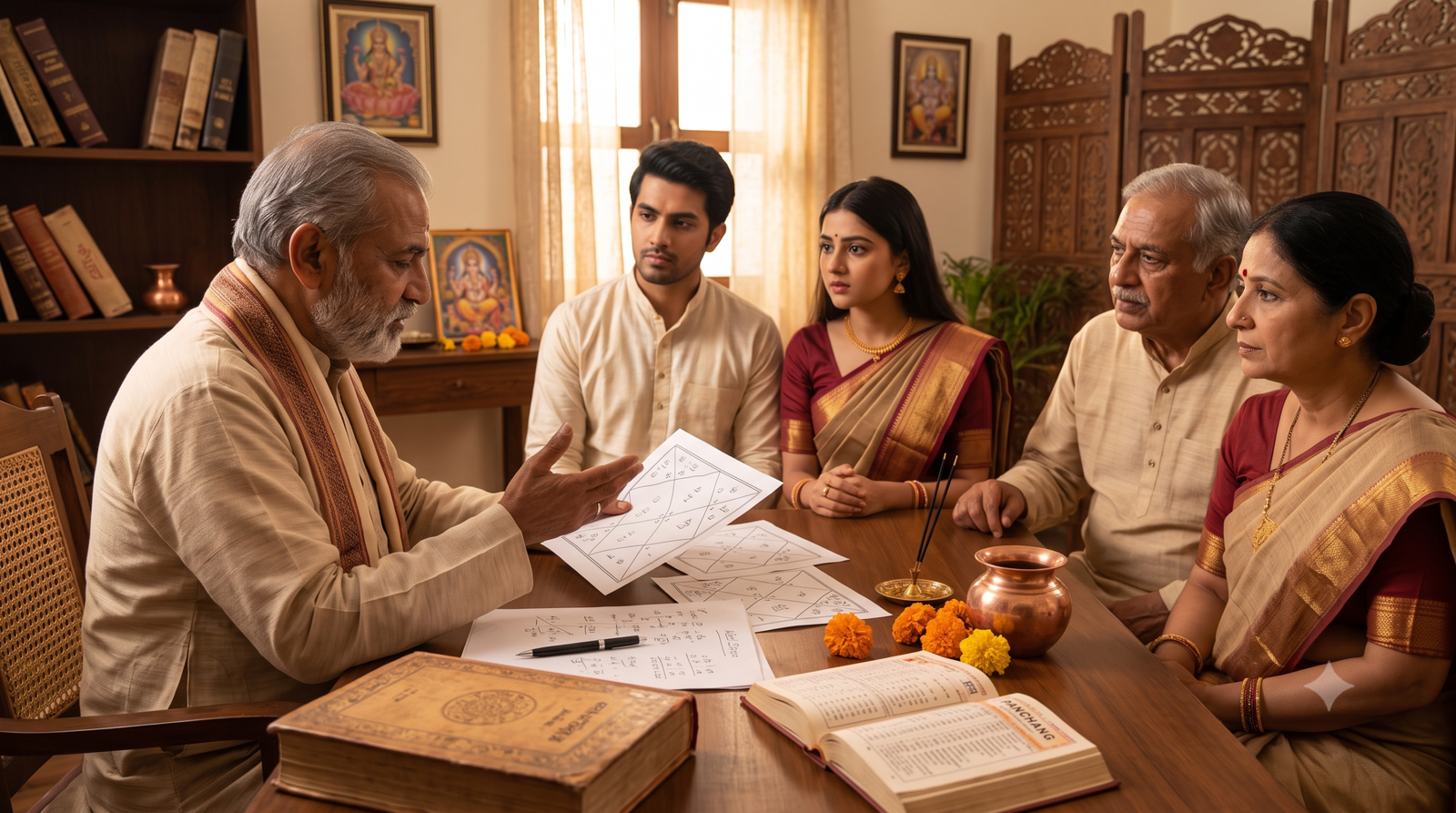
Nadi Dosha occurs in Kundli matching when both partners have the same Nadi: Aadi, Madhya, or Antya. Astrologers determine Nadi from the Moon’s birth Nakshatra. In the Ashtakoota matching system, the couple receives 0 out of 8 points for Nadi Koota when both partners have the same Nadi.
Some traditional interpretations describe exceptions that may cancel Nadi Dosha. These include having the same Rashi but different Nakshatras, or the same Nakshatra but different Padas. The rules can vary across astrological traditions, so a complete chart analysis is important.
Many families become concerned when a Kundli matching report shows Nadi Dosha. However, it is worth understanding how the score works, what the dosha traditionally means, and which cancellation rules different astrologers follow before making a decision.
This guide explains the main concepts, calculation steps, traditional interpretations, and commonly discussed exceptions.
What Is Nadi Dosha?
In the Ashtakoota system, also known as Guna Milan, astrologers compare eight factors when assessing marriage compatibility. These factors contribute to a maximum score of 36 points.
Nadi Koota is one of these eight factors. It carries 8 points, making it the highest-weighted individual factor in the system.
The basic scoring rule is:
- Different Nadis: 8 out of 8 points. No Nadi Dosha is indicated.
- Same Nadi: 0 out of 8 points. Nadi Dosha is indicated under the basic scoring rule.
Traditional astrology links Nadi with a person’s constitution and progeny. However, these interpretations are cultural beliefs and should not be treated as scientifically established predictions.
It is also important to distinguish Nadi Dosha from Nadi astrology. Nadi astrology is a separate tradition associated with palm-leaf readings. It is not the same as Nadi Dosha in Kundli matching. MyPalmLeaf explains this distinction in its discussion of Nadi astrology and Nadi Dosha.
Nadi is determined by the Moon’s Nakshatra at birth, not by the Sun’s position. Accurate birth details therefore matter when generating a Kundli. An incorrect birth time or place can affect the calculated chart and, in some cases, the Nakshatra or Pada.
For more information about Nakshatras, see the Wikipedia article on Nakshatras.
The Three Nadis and Their Nakshatras
Traditional Kundli matching divides the 27 Nakshatras into three groups. Each group contains nine Nakshatras and corresponds to one of the three Nadis.
| Nadi | Traditional Ayurvedic Association | Nakshatras |
|---|---|---|
| Aadi (Adi) | Vata, associated with air | Ashwini, Ardra, Punarvasu, Uttara Phalguni, Hasta, Jyeshtha, Mula, Shatabhisha, Purva Bhadrapada |
| Madhya | Pitta, associated with heat and bile | Bharani, Mrigashira, Pushya, Purva Phalguni, Chitra, Anuradha, Purva Ashadha, Dhanishtha, Uttara Bhadrapada |
| Antya | Kapha, associated with water and phlegm | Krittika, Rohini, Ashlesha, Magha, Swati, Vishakha, Uttara Ashadha, Shravana, Revati |
This classification appears in several traditional Kundli matching resources, including AstroSage’s Nadi Dosha report and Astroyogi’s Nadi Dosh guide.
To understand the Nakshatras and their subdivisions, see the Wikipedia article on Nakshatras.
How to Find Nadi Dosha in Kundli Matching
You can follow these steps to understand how Nadi Dosha is identified during Kundli matching.
Step 1: Collect Accurate Birth Details
You need the birth date, time, and place for both partners.
Accurate details help ensure that the Kundli calculation identifies the correct planetary positions, Moon sign, Nakshatra, and Pada.
Step 2: Find Each Partner’s Moon Nakshatra
Use a Kundli calculator or consult an astrologer to identify the Moon’s Nakshatra in each person’s birth chart.
You may also need the following details:
- Moon Nakshatra
- Nakshatra Pada
- Rashi, or Moon sign
Step 3: Identify Each Partner’s Nadi
Use the table above to identify whether each partner belongs to Aadi, Madhya, or Antya Nadi.
Compare the results using these basic rules:
- Aadi + Madhya: No Nadi Dosha under the basic rule.
- Aadi + Antya: No Nadi Dosha under the basic rule.
- Madhya + Antya: No Nadi Dosha under the basic rule.
- Aadi + Aadi: Nadi Dosha indicated.
- Madhya + Madhya: Nadi Dosha indicated.
- Antya + Antya: Nadi Dosha indicated.
Different Nadis receive 8 out of 8 points for Nadi Koota, while matching Nadis receive 0 out of 8 points under the basic scoring method.
Step 4: Check for Cancellation Rules
Do not stop the analysis after seeing a Nadi Dosha result.
Some traditional systems recognise exceptions that may cancel or modify the interpretation. The most commonly discussed rules involve the partners’ Rashis, Nakshatras, and Padas.
Because different traditions apply these rules differently, confirm which method your astrologer follows.
Step 5: Examine the Complete Horoscope
Nadi Koota is only one part of Kundli matching. Astrologers may also examine:
- Bhakoot and Gana Koota
- The Navamsa chart
- The seventh house and its lord
- Mangal Dosha
- Other planetary placements and aspects
A complete assessment considers the overall chart rather than treating one matching factor as the sole basis for a marriage decision.
Worked Examples
The following examples illustrate the basic scoring method and commonly discussed cancellation rules.
| Partner A | Partner B | Nadi Comparison | Basic Result |
|---|---|---|---|
| Rohini (Antya) | Bharani (Madhya) | Different Nadis | No Nadi Dosha under the basic rule; 8/8 points |
| Ashwini (Aadi) | Hasta (Aadi) | Same Nadi | Nadi Dosha indicated; 0/8 points. Check whether an exception applies. |
| Krittika (Antya, Taurus) | Rohini (Antya, Taurus) | Same Nadi and Rashi, different Nakshatras | Nadi Dosha indicated by the basic score; some traditions recognise a cancellation rule. |
These examples demonstrate why it is useful to examine both the initial score and any applicable exceptions.
Effects of Nadi Dosha
Traditional astrology associates Nadi Dosha with several possible concerns. These interpretations vary between sources and should not be treated as proven outcomes.
Common traditional interpretations include:
- Health: Some interpretations associate Nadi Dosha with concerns about the couple’s health or constitution.
- Progeny: Certain traditions connect Nadi Dosha with concerns about having children or children’s health.
- Marital harmony: Some astrologers associate it with misunderstandings or difficulties in a relationship.
Some modern astrology resources also associate particular tendencies with each Nadi.
| Nadi | Traditional Association | Interpretations Found in Some Sources |
|---|---|---|
| Aadi (Vata) | Air | Irregular routines or worry |
| Madhya (Pitta) | Heat and bile | Heat-related concerns or conflict |
| Antya (Kapha) | Water and phlegm | Sluggishness or lack of motivation |
These descriptions reflect traditional interpretations, not established medical or psychological findings.
If you have concerns about your health or your partner’s health, consult a qualified medical professional. If you are planning to have children and want to understand hereditary health risks, ask your doctor whether genetic screening is appropriate. For example, thalassemia screening can help identify carrier status.
ETV Bharat has also discussed the importance of thalassemia testing for couples who practise Kundli matching.
Nadi Dosha Cancellation Rules
Some traditional astrological systems recognise rules known as Nadi Dosha Bhanga or Nadi Dosha Parihar. These rules may allow an astrologer to consider Nadi Dosha cancelled or less significant in certain circumstances.
The three commonly discussed rules involve the relationship between the partners’ Rashis, Nakshatras, and Padas.
Important: Not every astrological tradition accepts every cancellation rule. The following explanations describe commonly discussed interpretations, not universal rules.
1. Same Rashi, Different Nakshatras
Some traditions consider Nadi Dosha cancelled when both partners have the same Moon sign but different Nakshatras.
For example, Krittika and Rohini can both fall in Taurus.
Under the basic Nadi Koota scoring rule, the partners may still receive 0 out of 8 points if they have the same Nadi. However, some astrologers apply this exception when interpreting the complete match.
2. Same Nakshatra, Different Rashis
Another commonly discussed exception applies when both partners have the same Nakshatra but different Moon signs.
For example, Mrigashira spans Taurus and Gemini:
- Padas 1 and 2 fall in Taurus.
- Padas 3 and 4 fall in Gemini.
Some traditions treat this difference as a reason to cancel Nadi Dosha.
3. Same Nakshatra, Different Padas
Some astrologers also recognise an exception when both partners have the same Nakshatra but different Padas.
For example:
- Partner A has the Moon in Rohini Pada 1.
- Partner B has the Moon in Rohini Pada 3.
Some traditions consider the different Padas relevant to the cancellation assessment. Others apply additional conditions, so this rule should not be treated as universal.
AstroShade, Jagannath Hora, and Astro Nidan discuss Nadi Dosha cancellation rules and related interpretations.
Nadi Dosha Cancellation Checklist
Use this checklist as a starting point when reviewing a matching report.
| Combination | Commonly Discussed Interpretation |
|---|---|
| Same Nadi, same Rashi, different Nakshatras | Considered cancelled in some traditions |
| Same Nadi, same Nakshatra, different Rashis | Considered cancelled in some traditions |
| Same Nadi, same Nakshatra, different Padas | Considered cancelled in some traditions |
| Same Nakshatra and same Pada | Requires careful assessment under the tradition being followed |
Always confirm the applicable rules with an astrologer who can explain the calculation method and any conditions attached to the exception.
Other Exceptions and Differences Between Traditions
Beyond the three commonly discussed rules, some astrologers apply additional exceptions. These interpretations are not universally accepted.
1. Friendly Rashi Lords or Navamsa Lords
Some authorities suggest that compatibility between the lords of the Moon signs or Navamsa signs may influence the interpretation of Nadi Dosha.
The exact conditions vary between sources.
2. Moon Sign Lord
One source, Vivaha Kautuhala, is cited in discussions of a rule involving Moon signs ruled by Venus, Jupiter, or Mercury.
According to this interpretation, certain Moon sign placements may provide an exception to Nadi Dosha. For more information, see Ashish Desai’s discussion of Nadi Dosha cancellation.
3. Nakshatras With Special Exceptions
Some sources list particular Nakshatras for which Nadi Dosha may not apply under specific conditions.
These lists include Krittika, Rohini, Mrigashira, Ardra, Pushya, Shravana, Uttara Bhadrapada, and Revati.
Because the rules vary, verify the exact conditions before applying this exception to a matching report.
4. Other Marriage Indicators
Some astrologers consider benefic aspects, the strength of the seventh house, and other marriage-related factors when assessing a chart.
They may interpret these factors as reducing the importance of Nadi Dosha in the overall match. The conditions for doing so differ across traditions.
Why Do Astrologers Disagree About Cancellation?
Astrologers do not always agree on whether a particular rule cancels Nadi Dosha.
For example, some accept different Padas as a cancellation condition, while others apply additional restrictions. Some sources also discuss Vedha, or restrictions associated with both partners having the same Pada.
Astro Subhash’s blog discusses these restrictions. Such differences help explain why two astrologers may assess the same Kundli combination differently.
Some discussions of Nadi Dosha refer to the Brihat Parashara Hora Shastra. Interpretations of traditional texts and the authenticity of some passages are also debated. For background, see the Wikipedia article on Brihat Parashara Hora Shastra.
Nadi Dosha Remedies
If an astrologer identifies Nadi Dosha and does not recognise a cancellation rule, some families choose to follow traditional remedies.
Commonly suggested practices include the following.
1. Nadi Dosha Nivaran Puja
Some astrologers recommend a Nadi Dosha Nivaran or Nivarana Puja, performed by a qualified priest.
Astroyogi and GaneshaSpeaks also discuss chanting the Maha Mrityunjaya Mantra as a traditional spiritual practice associated with wellbeing.
2. Charity (Daan)
Some traditions recommend donating food, clothes, or other essential items.
AstroTalk discusses charity as a possible traditional remedy. The specific practice may depend on the astrologer’s guidance and the family’s customs.
Before following an online recommendation, consult a trusted local pandit who understands your tradition.
Be cautious of expensive promises. Avoid paying large sums for secret remedies, guaranteed results, or elaborate special pujas presented as the only way to solve a problem.
These practices belong to religious and cultural traditions. They should not replace medical advice or be treated as scientifically proven ways to change health or relationship outcomes.
A Practical and Balanced Approach
If your Kundli matching report shows Nadi Dosha, consider the following steps before making a decision.
1. Verify the Birth Details
Check both partners’ birth dates, times, and places. Incorrect information can affect the calculated chart and the matching result.
2. Review Possible Cancellation Rules
Ask whether any recognised exception applies to the partners’ Rashis, Nakshatras, or Padas.
Do not assume that a cancellation rule applies automatically. The conditions depend on the tradition being followed.
3. Consider the Complete Horoscope
Nadi is only one of the eight Kootas in Ashtakoota matching. Other factors may also influence the overall interpretation.
Read our guide to Bhakoot Dosha for more information.
Internal link: {{INTERNAL_LINK: Bhakoot Dosha guide}}
4. Seek a Second Opinion if Needed
Families may follow different traditions and reach different conclusions about the same combination.
If you receive conflicting advice, consider consulting an experienced astrologer who can explain the reasoning behind each interpretation.
5. Do Not Replace Medical Screening With Astrology
Kundli matching is a traditional compatibility practice, not a medical test.
If you have concerns about hereditary conditions or future children’s health, consult a qualified medical professional. Consider genetic screening when your doctor recommends it.
6. Make the Final Decision Together
Marriage decisions involve more than a matching score. Communication, mutual respect, shared expectations, personal values, and informed consent are also important.
Discuss the concerns openly with your partner and family. Use astrological guidance, if it matters to you, as one part of a broader decision.
Check Your Match on KundliTime
To review your matching result, you can use the {{INTERNAL_LINK: Free Kundli Matching tool}}. The tool includes Nadi Dosha checking functionality and can help you understand the basic matching result.
For questions about cancellation rules or a personalised interpretation, consult an experienced astrologer.
Frequently Asked Questions
What Is Nadi Dosha in Kundli Matching?
Nadi Dosha is indicated under the basic Ashtakoota matching rule when both partners have the same Nadi: Aadi, Madhya, or Antya. The Nadi is determined from the Moon’s birth Nakshatra, and the couple receives 0 out of 8 points for Nadi Koota.
How Do I Check Nadi Dosha in My Kundli?
Find the Moon Nakshatra for both partners and identify the corresponding Nadi.
If both partners have the same Nadi, the basic matching method indicates Nadi Dosha. If their Nadis differ, they receive 8 out of 8 points for Nadi Koota.
You can use a Kundli matching tool or consult an astrologer to review the result and any possible exceptions.
How Many Points Is Nadi Dosha Worth?
Nadi Koota carries 8 out of the 36 total points in the Ashtakoota matching system. It has the highest individual weight among the eight Kootas.
Can Nadi Dosha Be Cancelled?
Some traditional systems recognise cancellation rules. These may involve the same Rashi with different Nakshatras, the same Nakshatra with different Rashis, or the same Nakshatra with different Padas.
Not every tradition accepts every exception, so check the rules used in your assessment.
Can Two People With the Same Nadi Get Married?
Yes. A shared Nadi does not, by itself, establish that a marriage will fail or that a couple should not marry.
Some astrologers assess cancellation rules and the complete horoscope before giving an interpretation. The couple should also consider compatibility, communication, personal values, and their own preferences.
Which Nadi Dosha Is Considered the Most Severe?
There is no universal agreement across astrological sources. Some sources describe Aadi Nadi as more severe, but this is not a consistent rule followed by every tradition.
Does Nadi Dosha Really Affect Children?
Some traditional astrological interpretations associate Nadi Dosha with progeny and health. However, these associations are not scientifically established predictions.
If you are concerned about future children’s health, consult a qualified medical professional about appropriate screening and genetic counselling.
What Is the Best Remedy for Nadi Dosha?
Some traditional astrologers recommend Nadi Dosha Nivaran Puja, chanting the Maha Mrityunjaya Mantra, or charity.
The suggested practice depends on the tradition and the astrologer’s interpretation. First, ask whether a cancellation rule applies, and avoid anyone who promises guaranteed results in exchange for large payments.
Is Nadi Dosha the Same as Bhakoot Dosha?
No. Nadi Dosha and Bhakoot Dosha are different factors in Ashtakoota matching.
Nadi Koota carries 8 points, while Bhakoot Koota carries 7 points. Both are considered in the traditional matching system.
Is Nadi Dosha the Same as Nadi Astrology?
No. Nadi Dosha is part of traditional Kundli matching. Nadi astrology is a separate tradition associated with palm-leaf readings.
The two practices have different methods and purposes.
Conclusion
Nadi Dosha is one factor in traditional Kundli matching, but its basic score should not be the only consideration when assessing a relationship.
Keep these points in mind:
- Nadi Dosha is indicated under the basic matching rule when both partners have the same Nadi based on their Moon Nakshatras.
- Nadi Koota carries 8 out of the 36 Ashtakoota matching points.
- Some traditions recognise cancellation rules involving the Rashi, Nakshatra, and Pada.
- Different astrological traditions may apply different exceptions and interpretations.
- A complete matching assessment considers other chart factors rather than relying on Nadi Dosha alone.
- Astrology should never replace medical advice, genetic screening, or informed personal decisions.
If you are concerned about Nadi Dosha in your matching report, consult an experienced astrologer who can explain the method and its limitations. Discuss the decision openly with your partner and family, and consider all relevant aspects of compatibility.
Disclaimer: This article is for informational purposes only. Astrology is a cultural and traditional practice, not a scientifically established method for predicting health or relationship outcomes. It should not replace medical advice or other professional guidance.
Sources and Further Reading
- Nadi Dosh report, AstroSage
- Nadi Dosh, Astroyogi
- Nadi Dosha: Effects and Remedies, AstroTalk
- Nadi Dosha, GaneshaSpeaks
- Nadi Dosha in Kundli Matching, AstroShade
- Nadi Dosha cancellation rules, Jagannath Hora
- Naadi Dosha cancellation, Ashish Desai
- Nadi Dosha in Marriage Matching, MyPalmLeaf
- Nakshatra, Wikipedia
- Brihat Parashara Hora Shastra, Wikipedia
- Matching Kundlis Before Marriage Is Common, But Thalassemia Testing Is Just As Important, ETV Bharat