
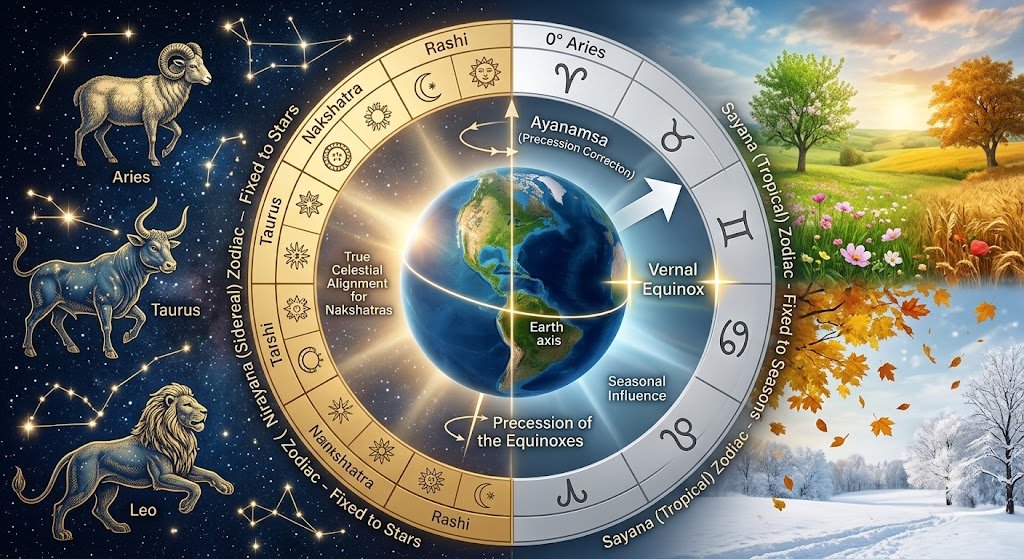
People exploring their birth charts often notice that their Vedic zodiac sign differs from the sign shown in Western astrology. Someone identified as an Aries in a Western horoscope may appear as Pisces in a Vedic Kundli. This difference does not usually result from a calculation error. It happens because the two traditions use different reference systems for dividing the zodiac.
Most modern Western astrology uses the tropical zodiac, which is anchored to the seasons and equinoxes. Vedic astrology, commonly known as Jyotish, generally uses a sidereal zodiac adjusted in relation to the background stars.
Understanding this distinction is essential when generating a digital Kundli, interpreting planetary placements or comparing a Western birth chart with a Vedic chart on Kundli Time.
What Is the Zodiac?
From an astronomical perspective, the zodiac is a region of the sky surrounding the ecliptic—the apparent annual path of the Sun as seen from Earth. The Moon and the planets also appear close to this path.
Astrological traditions divide the ecliptic into 12 equal signs:
- Aries
- Taurus
- Gemini
- Cancer
- Leo
- Virgo
- Libra
- Scorpio
- Sagittarius
- Capricorn
- Aquarius
- Pisces
Each astrological sign covers exactly 30 degrees, creating a complete 360-degree zodiac.
These signs should not be confused with astronomical constellations. The visible constellations have unequal sizes and irregular boundaries, whereas astrological signs are equal mathematical divisions.
What Is the Tropical Zodiac?
The tropical zodiac anchors its starting point—the beginning of Aries—to the March equinox. This is the point where the Sun crosses the celestial equator moving northward.
In the tropical system:
- Aries begins at the March equinox
- Cancer begins at the June solstice
- Libra begins at the September equinox
- Capricorn begins at the December solstice
Because its reference points are linked to Earth’s seasonal cycle, the tropical zodiac remains aligned with equinoxes and solstices rather than maintaining a fixed relationship with the background stars.
This system is used by most contemporary Western astrologers. When a newspaper or popular horoscope website describes someone born in late March as an Aries, it is generally using the tropical zodiac.
What Is the Sidereal Zodiac?
The word “sidereal” comes from a Latin term relating to stars. A sidereal zodiac attempts to keep its 12 equal signs aligned to a defined stellar reference rather than continually anchoring the beginning of Aries to the moving March equinox.
Like the tropical zodiac, it contains 12 signs of 30 degrees each. It does not reproduce the unequal boundaries of the visible astronomical constellations.
In most Vedic calculations, the difference between the tropical and sidereal zodiac is handled through a correction known as ayanamsha.
The Sidereal Ephemeris information published by Astrodienst explains that the tropical zodiac begins at the March equinox, while sidereal systems use a zodiac based on fixed-star references. It also identifies Lahiri as a commonly used ayanamsha in Indian astrology.
Precession of the Equinoxes: The Astronomical Reason Behind the Difference
Earth does not rotate with its axis pointing in exactly the same direction forever. Its axis slowly changes orientation, much like the motion of a spinning top. This motion is called axial precession.
According to NASA’s explanation of precession, Earth’s axis completes one precessional cycle in approximately 26,000 years. The European Southern Observatory’s zodiac animation gives a similar cycle of around 25,800 years.
Because of axial precession, the equinox points gradually shift relative to the background stars. The March equinox therefore does not remain in the same stellar position across thousands of years.
The tropical zodiac moves with the equinox. A sidereal zodiac applies an adjustment intended to preserve its relationship with a stellar reference. Over many centuries, this has created a substantial difference between tropical and sidereal planetary longitudes.
What Is Ayanamsha in Vedic Astrology?
Ayanamsha is the angular difference between the tropical and sidereal zodiacs at a particular time.
A simplified sidereal calculation can be represented as:
Sidereal longitude = Tropical longitude − Ayanamsha
Suppose a planet has a tropical longitude of 10 degrees in Aries. If the chosen ayanamsha is approximately 24 degrees, subtracting that value shifts the planet into the previous sign, Pisces.
This is why a person’s Sun sign, Moon sign, ascendant or planetary placements may differ between Vedic and Western charts.
The precise ayanamsha depends on the calculation system and date. It changes slowly because of precession.
Why There Is More Than One Ayanamsha
There is no single sidereal zero point accepted by every astrologer. Different schools define the starting point of the sidereal zodiac using different stellar or historical references.
Common ayanamsha systems include:
- Lahiri or Chitrapaksha
- Raman
- Krishnamurti
- Fagan-Bradley
- Yukteswar
- True Chitra
- Pushya-Paksha
Lahiri ayanamsha is widely used in Indian Vedic astrology, but other traditions may select a different value. Even a small difference can become important when a planet, ascendant or Nakshatra lies near a boundary.
The Astrodienst guide to ayanamshas provides a detailed overview of the multiple reference systems used in sidereal astrology.
When comparing charts, always confirm which ayanamsha each platform or astrologer uses. Two charts labelled “sidereal” can still show small differences.
Why Vedic Astrology Traditionally Prefers the Sidereal Zodiac
Vedic astrology places significant emphasis on the relationship between calculated planetary longitudes, Rashis and Nakshatras. A sidereal framework helps maintain those calculations within a zodiac defined relative to selected stellar reference points.
The main traditional reasons include:
Connection with Nakshatras
Nakshatras, often translated as lunar mansions, are central to many branches of Vedic astrology. The zodiac is divided into 27 Nakshatras, each covering 13 degrees and 20 minutes.
Nakshatras are used in traditional calculations involving:
- Vimshottari Dasha
- Birth-star identification
- Muhurta
- Compatibility analysis
- Transit interpretation
- Naming traditions
- Planetary strength and symbolism
Because Nakshatras are understood through stellar reference divisions, Vedic astrologers generally use them alongside a sidereal zodiac.
Continuity of Jyotish Calculations
Vedic astrology includes interconnected systems such as Rashi charts, divisional charts, Dashas, yogas and planetary transits. The sidereal zodiac forms a common computational framework for these methods.
Changing from a sidereal to a tropical zodiac would not merely change the Sun sign. It could shift the ascendant, Moon sign, planetary house positions, Nakshatras and timing interpretations used throughout the Kundli.
Emphasis on Planetary Positions
Western popular astrology often emphasises the Sun sign. Vedic astrology generally gives substantial importance to:
- Lagna or ascendant
- Moon sign or Chandra Rashi
- Nakshatra
- Planetary houses
- Planetary aspects
- Divisional charts
- Dasha periods
- Transits
Therefore, the difference between tropical and sidereal calculations can influence many parts of a Vedic birth-chart interpretation.
Sidereal Zodiac vs Astronomical Constellations
It is common to hear that the sidereal zodiac shows the “actual constellation positions.” This statement needs clarification.
A sidereal astrology chart still divides the ecliptic into 12 equal 30-degree signs. Astronomical constellations do not all occupy 30 degrees. Some are much larger or smaller, and the modern astronomical zodiacal region also intersects Ophiuchus.
Therefore:
- The tropical zodiac consists of 12 equal signs tied to equinoxes and solstices.
- The sidereal zodiac consists of 12 equal signs tied to a defined stellar reference.
- Astronomical constellations are irregularly shaped regions defined for scientific sky mapping.
The sidereal zodiac is more star-referenced than the tropical zodiac, but it is still an astrological coordinate system—not an exact map of modern constellation boundaries.
Why Your Vedic and Western Zodiac Signs May Be Different
The current separation between common tropical and sidereal calculations is close to 24 degrees, although the exact amount depends on the date and ayanamsha.
Since each zodiac sign covers 30 degrees, many tropical planetary positions move into the previous sign after the ayanamsha is subtracted.
For example:
- Tropical Aries may become sidereal Pisces.
- Tropical Taurus may become sidereal Aries.
- Tropical Libra may become sidereal Virgo.
- Tropical Capricorn may become sidereal Sagittarius.
Not everyone’s sign changes. A planet positioned in the later degrees of a tropical sign may remain in that sign after adjustment.
This difference can affect more than the Sun. Your Moon, ascendant, Mercury, Venus, Mars and other planetary placements may also move.
Tropical and Sidereal Zodiac Comparison
| Feature | Tropical Zodiac | Sidereal Zodiac |
|---|---|---|
| Primary reference | March equinox and seasons | Defined stellar reference |
| Commonly used in | Western astrology | Vedic and some Western sidereal astrology |
| Aries begins | At the March equinox | At a sidereal zero point |
| Precession adjustment | Not required for its seasonal framework | Applied through ayanamsha |
| Number of signs | 12 | 12 |
| Size of each sign | 30 degrees | 30 degrees |
| Same as constellations? | No | No |
| Common Indian setting | Less common | Lahiri and other ayanamshas |
Neither system is “wrong” simply because it uses a different starting point. They are different symbolic frameworks with different historical and interpretive traditions.
How Kundli Time Uses Birth Details
Kundli Time is a digital astrology platform where users can create a Kundli using their birth details and explore personalised traditional astrological interpretations.
A birth-chart calculation typically requires:
- Date of birth
- Exact time of birth
- Place of birth
The birth location is used to determine geographical coordinates and local time adjustments. Birth time is particularly important for calculating the ascendant and house placements.
A small error in birth time can change the ascendant or divisional-chart positions, especially near a boundary. Users should therefore enter the most reliable birth information available.
Through Kundli Time, users can generate a digital Kundli and explore personalised insights. The platform also provides access to consultations with astrologers.
What to Check When Generating a Vedic Kundli
Before comparing charts from different websites or applications, check the following settings:
- Zodiac type: sidereal or tropical
- Ayanamsha used
- Birth time and time zone
- Daylight-saving adjustment, where relevant
- Birth-location coordinates
- House system
- Node calculation: true or mean Rahu and Ketu
- Chart style: North Indian, South Indian or East Indian
Different settings can produce different results even when the same birth details are entered.
Does the Sidereal Zodiac Make Vedic Astrology Scientific?
The mathematics used to calculate celestial positions can be based on astronomy. Planetary longitudes, precession, local time and geographical coordinates can be calculated with high precision.
However, the interpretation of those positions as indicators of personality, compatibility or future events belongs to astrology. Astrology is not accepted by the modern scientific community as a validated method of predicting personal events.
This distinction is important:
- Astronomy scientifically measures celestial objects and their motion.
- Astrology assigns symbolic or traditional meanings to calculated positions.
- Accurate astronomical calculations do not independently prove astrological predictions.
Kundli Time should be used as a platform for cultural, spiritual and personal reflection, not as a substitute for qualified medical, legal, financial or mental-health advice.
Which Zodiac Should You Use?
The appropriate zodiac depends on the tradition you want to study.
Choose the tropical zodiac if you are exploring:
- Modern Western astrology
- Western Sun signs
- Seasonal symbolism
- Tropical natal charts
- Western transit interpretations
Choose a sidereal zodiac if you are exploring:
- Vedic astrology or Jyotish
- Janam Kundli
- Lagna and Chandra Rashi
- Nakshatras
- Vimshottari Dasha
- Vedic compatibility matching
- Traditional Indian transit analysis
Avoid switching randomly between systems within the same interpretation. Each tradition has developed its techniques around its own reference framework.
Explore Your Sidereal Birth Chart with Kundli Time
The difference between Vedic and Western zodiac signs becomes easier to understand once you recognise that they use different celestial reference points.
The tropical zodiac begins Aries at the March equinox and remains connected to the seasonal year. The sidereal zodiac applies an ayanamsha to maintain alignment with a defined stellar reference. Because Earth’s axis slowly precesses, the two zodiacs have separated over time.
Vedic astrology generally uses the sidereal zodiac because it supports the traditional calculation of Rashis, Nakshatras, Dashas, divisional charts and planetary transits.
Visit Kundli Time to create your digital Kundli using your date, time and place of birth. Check the calculation settings and use accurate birth details when exploring your Vedic birth chart.
Frequently Asked Questions
Why is my Vedic zodiac sign different from my Western sign?
Most Western astrology uses the tropical zodiac, while Vedic astrology generally uses a sidereal zodiac. The ayanamsha adjustment can move a planet into the previous sign.
What is ayanamsha?
Ayanamsha is the angular difference between tropical and sidereal zodiac positions at a given time.
Which ayanamsha is commonly used in India?
Lahiri or Chitrapaksha ayanamsha is widely used, although Raman, Krishnamurti and several other systems also exist.
Does the sidereal zodiac match the constellations exactly?
No. Sidereal astrology uses 12 equal signs of 30 degrees, while astronomical constellations have unequal sizes and modern scientific boundaries.
Is Vedic astrology always sidereal?
Most mainstream Vedic astrology uses a sidereal zodiac. However, individual practitioners may follow different approaches or ayanamshas.
Is tropical astrology inaccurate?
Not within its own framework. Tropical astrology intentionally anchors its signs to the equinoxes and seasons rather than attempting to keep them aligned with a stellar reference.
Can my ascendant change between tropical and sidereal charts?
Yes. Applying the ayanamsha can shift the ascendant into the previous sign, particularly when it is not in the later degrees of its tropical sign.
Can Kundli Time generate a digital Kundli?
Yes. Kundli Time allows users to create a digital Kundli using their birth details and explore personalised astrological insights.
Disclaimer: Astrology is a traditional belief and interpretive practice, not a scientifically validated method for predicting life outcomes. Content generated through Kundli Time should be used for personal, cultural or spiritual reflection and not for medical, legal, financial or other high-stakes decisions.
Backlinks
- NASA – Precession of Earth’s Axis
- European Southern Observatory – Earth’s Precession and Zodiac Signs
- Astrodienst – Ayanamshas in Sidereal Astrology
- Astrodienst – Lahiri Sidereal Ephemeris
- Astrodienst – Sidereal and Tropical Chart Methods
- International Astronomical Union – Moving Constellations
- University of Rochester – Precession of Earth’s Rotation Axis
- Merriam-Webster – Precession of the Equinoxes