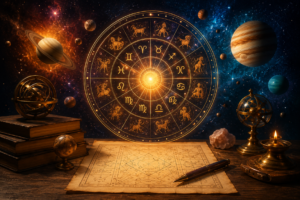

Astrology has influenced cultures for thousands of years. Many people consult horoscopes, birth charts and Janam Kundlis to reflect on personality, relationships, career choices and important life events. In India, Vedic astrology—often known as Jyotish—continues to hold cultural and spiritual importance.
But popularity and tradition do not automatically make a practice scientifically proven. When astrology is examined using controlled experiments, repeatable observations and measurable predictions, the available evidence does not support its claims as a reliable scientific system.
This does not mean that astrology has no cultural, historical or personal value. It means that astrology and science answer questions through fundamentally different methods. Understanding this distinction allows people to explore astrology thoughtfully without confusing symbolic interpretation with verified scientific fact.
What Is Astrology?
Astrology is a traditional system that interprets the positions and movements of celestial bodies as symbolically connected with human personality, relationships and events.
A typical astrological reading may consider:
- Date of birth
- Exact time of birth
- Place of birth
- Planetary positions
- Zodiac signs
- Houses
- Ascendant or Lagna
- Nakshatras
- Planetary aspects
- Dasha periods
- Transits
- Planetary combinations or Yogas
In Vedic astrology, these elements are organised into a Janam Kundli or birth chart. Astrologers interpret the chart according to established traditions, techniques and schools of thought.
The astronomical calculations used to determine planetary positions can be mathematically precise. However, the accuracy of those calculations does not, by itself, prove that planetary positions can reliably predict personality or future events.
What Makes a Subject Scientific?
Science is not simply a collection of calculations, charts or technical terminology. It is a method for investigating claims using evidence.
A scientific claim should generally be:
- Clearly defined
- Measurable
- Testable
- Capable of being proven wrong
- Evaluated under controlled conditions
- Repeatable by independent researchers
- Supported by consistent evidence
- Revised when better evidence becomes available
For example, if a method claims that astrologers can accurately match birth charts with personality profiles, researchers should be able to test that claim under controlled conditions. If the results consistently perform no better than chance, the hypothesis is not scientifically supported.
Astrology and Astronomy Are Different
Astrology and astronomy share historical roots, but they are now very different disciplines.
Astronomy is the scientific study of:
- Stars
- Planets
- Galaxies
- Comets
- Asteroids
- Black holes
- Space
- Cosmic radiation
- The physical universe
Astronomers use mathematics, physics, observation, telescopes, satellites and repeatable evidence to investigate the universe.
Astrology uses celestial positions as part of a symbolic interpretative system connected with human life and earthly events.
NASA clearly distinguishes between the two, explaining that it studies astronomy rather than astrology. Its educational explanation of the constellations and the zodiac also discusses how ancient cultures divided the path of the Sun into astrological signs.
Therefore, astronomy is recognised as a science, while astrology is generally classified by the scientific community as a belief system or pseudoscience.
What Does Scientific Research Say About Astrology?
Researchers have conducted controlled studies to investigate whether astrologers can produce results that exceed chance.
One widely discussed experiment was physicist Shawn Carlson’s double-blind test, published in the scientific journal Nature in 1985. Astrologers attempted to match natal charts with personality profiles under controlled conditions. The results did not show performance significantly better than chance.
The experiment was designed with input from astrologers to make the testing procedure relevant to astrological practice. Nevertheless, it did not provide evidence supporting the tested astrological hypothesis.
This does not prove that every astrological tradition, interpretation or personal experience is meaningless. However, it does mean that the central predictive claim examined in the experiment was not supported under controlled conditions.
Readers interested in evaluating whether astrology follows the scientific method can also explore the University of California Museum of Paleontology’s educational discussion, Astrology: Is It Scientific?.
Why Can Astrological Readings Feel Accurate?
Many people report that astrological descriptions feel surprisingly personal. Psychology offers several possible explanations for this experience.
The Barnum or Forer Effect
The Barnum effect is the tendency to interpret broad personality descriptions as uniquely applicable to ourselves.
Psychologist Bertram Forer demonstrated this effect in a classroom experiment published in 1949. Participants completed a personality assessment and were then given what they believed was a personalised description. In reality, everyone received the same general description, yet many participants rated it as highly accurate.
The original study is indexed by the US National Library of Medicine as The Fallacy of Personal Validation.
Statements may feel deeply personal when they include adaptable phrases such as:
- You value independence but also want acceptance.
- You sometimes feel confident and sometimes question yourself.
- You have abilities that have not been fully used.
- You enjoy social interaction but occasionally need privacy.
- You can be practical, although emotions sometimes influence you.
These statements can apply to many people, but readers naturally connect them with their individual memories and experiences.
Confirmation Bias
Confirmation bias occurs when people notice information that supports an existing belief while giving less attention to contradictory information.
For example, a person may remember the horoscope predictions that appeared accurate but forget predictions that did not happen. Over time, remembered matches can create the impression of greater accuracy than the complete record would support.
A more objective test would require recording every prediction in advance, defining what qualifies as success and comparing the results with chance.
Selective Interpretation
Astrological language may be symbolic, flexible or open to interpretation. Different individuals can connect the same statement with different experiences.
This flexibility can make a reading emotionally meaningful, but it also makes scientific testing more difficult. Scientific predictions need clearly defined outcomes so researchers can determine objectively whether the prediction succeeded or failed.
Self-Fulfilling Behaviour
Sometimes, receiving a prediction can influence behaviour.
If someone is told that a particular period is favourable for professional growth, they may become more confident, apply for opportunities or work more consistently. A positive outcome may follow because behaviour changed—not necessarily because a planet caused the event.
Likewise, a negative prediction may increase anxiety or hesitation and influence decisions.
Is There a Proven Physical Mechanism?
For astrology to function as a scientific causal system, researchers would expect a measurable mechanism explaining how celestial positions influence personality and specific life events.
Several forces operate in the universe, including gravity and electromagnetic radiation. However, science has not identified a mechanism through which distant planets and zodiac constellations create the detailed personality traits or personal outcomes described by astrological systems.
The Sun and Moon unquestionably affect Earth in measurable ways. Sunlight supports life and influences climate, while the Moon contributes significantly to ocean tides. These observable physical effects are different from evidence that planetary arrangements determine an individual’s career, compatibility, personality or future.
What About the Accuracy of Birth Charts?
A birth chart can represent calculated planetary positions for a particular time and location. Modern astrology platforms can generate these charts rapidly using astronomical datasets and software.
It is important to separate two different questions:
- Were the celestial positions calculated correctly?
- Are the interpretations derived from those positions scientifically validated?
Software may calculate planetary longitude, local time, houses or other chart elements accurately according to the selected astrological system. That computational accuracy does not validate claims about personality or future events.
In simple terms, a system can calculate its inputs correctly while the conclusions drawn from those inputs remain scientifically unproven.
Why Has Astrology Remained Popular?
Astrology continues to attract people because it can provide:
- A structure for self-reflection
- Cultural and family continuity
- Symbolic language for personality
- A sense of identity
- Conversation and social connection
- Emotional reassurance
- A framework for uncertainty
- Spiritual exploration
- Stories that help organise life experiences
Human beings naturally look for patterns and meaning. Astrology offers an organised narrative connecting personal experiences with a larger cosmic framework.
Its cultural persistence should be acknowledged respectfully, even while its scientific claims are evaluated critically.
Vedic Astrology and Cultural Tradition
Vedic astrology has a long-standing place in Indian cultural and religious traditions. Kundlis may be consulted for marriage compatibility, naming ceremonies, festivals, career decisions and the selection of auspicious times.
These practices can carry family, spiritual and cultural meaning independently of scientific validation.
The key is to distinguish between statements such as:
- “Astrology is part of my cultural or spiritual tradition.”
- “Astrology helps me reflect on my life.”
- “Astrological predictions have been scientifically proven.”
The first two describe personal experience and belief. The third is an empirical claim requiring strong scientific evidence, which is currently lacking.
Respecting a tradition does not require presenting it as proven science. Similarly, questioning its scientific basis does not require dismissing its cultural significance.
Can Astrology Be Used for Self-Reflection?
Astrology can be approached as a reflective or symbolic tool rather than an evidence-based predictive system.
A birth-chart interpretation may encourage questions such as:
- What qualities do I value in myself?
- How do I respond to uncertainty?
- What patterns appear in my relationships?
- Which personal goals need more attention?
- How do my beliefs influence my decisions?
- Which interpretation feels relevant, and why?
Used this way, astrology can act as a prompt for introspection. However, insights should be evaluated alongside real experiences, credible information and practical circumstances.
Astrology should not replace qualified professional advice in areas such as:
- Healthcare
- Mental health
- Legal matters
- Investments
- Financial planning
- Education
- Employment
- Safety
- Relationships involving abuse or coercion
Important decisions should be based on evidence, professional guidance and informed personal judgement.
Can AI Make Astrology Scientific?
Artificial intelligence can make astrology platforms faster, more consistent and easier to use. AI-supported systems may help:
- Generate birth charts
- Organise chart information
- Explain astrological terminology
- Compare traditional interpretations
- Present readings in accessible language
- Offer reflective prompts
- Personalise the user experience
However, AI does not scientifically validate astrology. An AI system learns patterns from data and content provided to it. If the underlying astrological claims have not been scientifically established, generating them with advanced technology does not turn them into scientific facts.
AI can improve delivery and accessibility, but it should not be used to exaggerate certainty or create fear.
How KundliTime Can Present Astrology Responsibly
KundliTime can help users explore online Janam Kundli information, chart components and traditional astrological interpretations in a convenient digital format.
For responsible use, astrological platforms should:
- Explain that readings are interpretative
- Avoid guaranteed predictions
- Avoid fear-based messaging
- Protect birth details and personal data
- Distinguish traditions from scientific evidence
- Avoid medical, legal and financial claims
- Encourage professional advice for serious decisions
- Explain that interpretations may differ
- Give users control over stored information
- Communicate the limitations of AI-generated content
Suggested disclaimer:
Astrological content is provided for cultural, spiritual, informational and self-reflection purposes. Astrology is not scientifically proven to predict personality or future events and should not replace professional medical, legal, financial or mental-health advice.
Astrology, Belief and Evidence Can Be Discussed Together
Astrology does not currently have reliable scientific evidence supporting its ability to predict personality or future events. Controlled studies have generally failed to demonstrate performance beyond chance, and no accepted physical mechanism explains its central claims.
At the same time, astrology remains culturally important and personally meaningful to many people. These two ideas do not have to be treated as mutually hostile.
A balanced conclusion is possible:
- Astronomy is a scientific discipline.
- Astrology is a traditional interpretative belief system.
- Birth-chart calculations can be mathematically accurate.
- Astrological interpretations are not scientifically validated predictions.
- Psychological effects can help explain why readings feel personal.
- Cultural and reflective value is different from scientific proof.
- Important decisions should rely on evidence and appropriate professional advice.
Explore Astrology with Curiosity and Critical Thinking
Astrology can be explored as culture, tradition, symbolism or a tool for personal reflection. The healthiest approach combines curiosity with critical thinking.
KundliTime can make birth-chart concepts easier to access and understand, but users should treat interpretations as possibilities for reflection—not guaranteed descriptions or certain forecasts.
By clearly separating facts, beliefs and evidence, people can engage with astrology in a way that respects tradition while remaining honest about what science has—and has not—demonstrated.