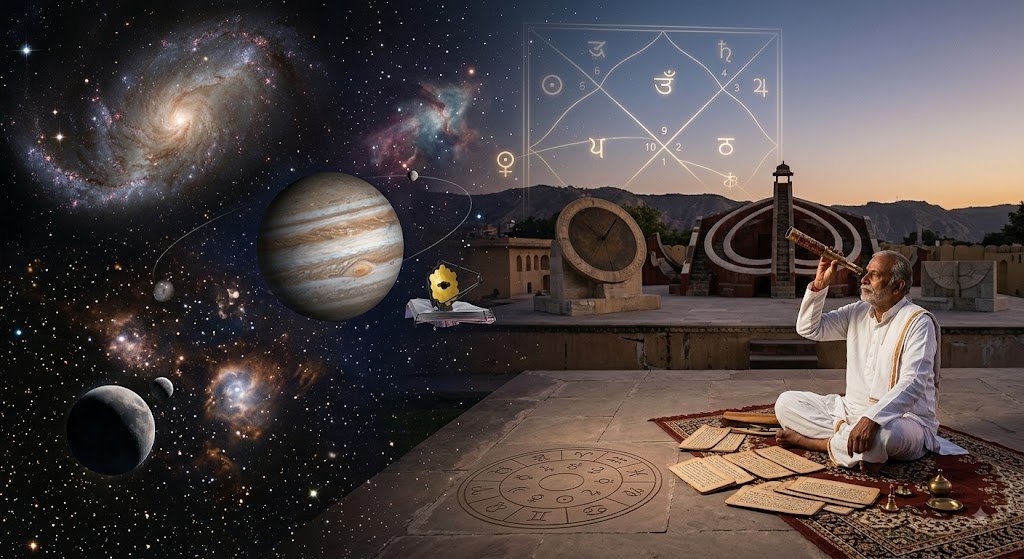
NASA’s research has significantly expanded our scientific understanding of planets, moons, eclipses, orbital motion and the structure of the solar system. At the same time, Vedic astrology—also known as Jyotish—uses the observed positions of celestial bodies within a traditional system for interpreting birth charts and planetary periods.
Because both astronomy and Vedic astrology refer to the Sun, Moon, planets, constellations and celestial coordinates, people often assume that NASA’s discoveries scientifically validate astrology. That conclusion is inaccurate.
NASA studies celestial objects through observation, mathematics, physics and testable scientific methods. Vedic astrology is a traditional interpretive system that assigns symbolic meaning to selected celestial positions. NASA does not endorse astrological predictions.
The genuine relationship is therefore not one of scientific confirmation. Astronomy supplies increasingly precise knowledge about where celestial bodies are located and how they move. Astrology applies its own traditional framework to those positions.
Kundli Time helps users explore this distinction while understanding how astronomical calculations can contribute to generating a Vedic birth chart.
Astronomy and Vedic Astrology Are Not the Same
Astronomy is a natural science concerned with celestial objects, physical processes and the wider universe. Astronomers study questions such as:
- How do planets orbit the Sun?
- What causes eclipses?
- How do stars form and evolve?
- What are planets made of?
- How far away are celestial objects?
- How does Earth’s axis change over time?
- How do gravity and orbital mechanics work?
These questions can be examined using telescopes, spacecraft, mathematics, spectroscopy, computer models and repeatable observations.
Vedic astrology uses the calculated positions of celestial bodies as inputs within a traditional framework involving:
- Twelve rashis or zodiac signs
- Twelve houses
- Twenty-seven nakshatras
- Planetary aspects
- Planetary dignity
- Dashas
- Transits
- Yogas
- The lunar nodes, Rahu and Ketu
- Divisional charts
- Ayanamsha
The astronomical position of a planet can be calculated, checked and reproduced. Its astrological interpretation belongs to a separate belief and cultural tradition and is not established by NASA’s measurements.
What NASA Actually Studies
NASA investigates Earth, the Sun, planets, moons, asteroids, comets, exoplanets and the wider universe. Its work involves scientific observation and exploration rather than horoscope interpretation.
According to NASA’s Solar System Exploration resources, our solar system contains the Sun, eight planets, officially recognised dwarf planets, hundreds of moons and thousands of asteroids and comets.
NASA missions help scientists study matters such as:
- Planetary atmospheres
- Surface composition
- Magnetic fields
- Gravity
- Orbital behaviour
- Climate
- Solar activity
- Potentially habitable environments
- Asteroids and comets
- Exoplanets orbiting other stars
These findings can improve astronomical models and celestial calculations. They do not demonstrate that planetary positions determine personality, relationships, career outcomes or future events.
The Shared Foundation: Observing the Sky
Astronomy and astrology have intertwined historical roots because early societies carefully observed the sky for calendars, navigation, agriculture and seasonal change.
Ancient observers recorded:
- Sunrise and sunset
- Moon phases
- Solstices and equinoxes
- Planetary movement
- Eclipses
- Seasonal star patterns
- The apparent path of the Sun
- The movement of planets against background stars
Modern astronomy developed these observations into a physical science governed by mathematical models and empirical testing. Vedic astrology preserved a traditional symbolic system connected with celestial cycles.
The two fields therefore share some observational vocabulary, but they differ fundamentally in purpose and method.
How Planetary Positions Are Calculated
A Kundli or birth chart begins with the positions of selected celestial objects for a specific date, time and location.
Modern astronomical calculations can determine the apparent geocentric positions of:
- The Sun
- The Moon
- Mercury
- Venus
- Mars
- Jupiter
- Saturn
Vedic astrology additionally uses Rahu and Ketu, which are not physical planets. They represent the two points where the Moon’s orbital path intersects the ecliptic.
To calculate a birth chart, software typically needs:
- Exact date of birth
- Accurate birth time
- Birthplace
- Geographic latitude and longitude
- Time zone
- Daylight-saving adjustment, where applicable
- Planetary ephemeris
- Selected ayanamsha
- House-calculation method
Astronomical data supports the calculation stage. The subsequent assignment of astrological meaning comes from the rules and traditions of Jyotish.
Why the Exact Birth Time Matters
Earth rotates continuously, causing the sky’s orientation relative to a location to change throughout the day. As a result, the ascendant and house positions can change noticeably within a relatively short period.
An incorrect birth time may affect:
- Lagna or ascendant
- House cusps
- Planetary house placement
- Divisional charts
- Nakshatra pada near a boundary
- Dasha calculations in close cases
- The overall astrological interpretation
Users should therefore avoid presenting an estimated birth time as exact. If the recorded time is uncertain, that limitation should remain clear when using Kundli Time or consulting an astrologer.
NASA, Planetary Orbits and Kundli Calculations
Planets do not move through the sky at uniform apparent speeds when viewed from Earth. Their observed positions result from Earth’s movement, each planet’s orbit and the viewing geometry between them.
NASA’s explanation of Kepler’s laws of planetary motion describes planets as travelling around the Sun in elliptical orbits. A planet’s apparent position from Earth must therefore be calculated using orbital models rather than assuming uniform movement around a simple circle.
Modern ephemerides can provide highly precise positions for celestial bodies at specific times. Astrology software can use astronomical algorithms or ephemeris datasets to place the traditional grahas within a chart.
This means astronomy improves the accuracy of positional calculation. It does not verify the astrological interpretation applied to that position.
Understanding the Ecliptic and Zodiac
The ecliptic is the apparent annual path of the Sun across the sky. It also corresponds to the plane of Earth’s orbit projected onto the celestial sphere.
The major planets appear near this path because the planets formed from a broadly flattened disc and orbit in approximately the same plane.
NASA’s explanation of the ecliptic and zodiac notes that the planets remain within a relatively narrow strip of the sky. The traditional zodiac constellations lie along this region.
Astrological systems divide this path into twelve equal signs of 30 degrees each:
- Aries
- Taurus
- Gemini
- Cancer
- Leo
- Virgo
- Libra
- Scorpio
- Sagittarius
- Capricorn
- Aquarius
- Pisces
These equal astrological signs should not be confused with astronomical constellations. Actual constellations occupy unequal areas of the sky and do not fit into twelve identical 30-degree sections.
What Is the Precession of the Equinoxes?
One of the most important astronomical concepts connected with Vedic astrology is axial precession.
Earth’s rotational axis does not point in exactly the same direction forever. It slowly changes orientation in a motion often compared to the wobble of a spinning top. A complete precessional cycle takes roughly 26,000 years.
NASA’s reference-system guidance explains that astronomical coordinate systems account for this long-term precessional movement.
As a result, the equinox point gradually shifts relative to the background stars. NASA’s educational page on precession explains that the spring equinox was once located in the constellation Aries and later moved into Pisces.
Precession is an established astronomical phenomenon. Its existence is not evidence that astrological predictions are scientifically proven.
Tropical and Sidereal Zodiacs
Precession helps explain why Western and Vedic astrology can assign different zodiac signs to the same person.
Tropical Zodiac
Most Western astrology uses the tropical zodiac. It anchors zero degrees Aries to the March equinox and connects the zodiac with Earth’s seasonal cycle.
Because the tropical framework remains tied to the equinox, its signs gradually shift relative to the background stars as precession continues.
Sidereal Zodiac
Vedic astrology generally uses a sidereal zodiac intended to maintain a relationship with a stellar reference frame.
The difference between the tropical and sidereal starting points is expressed through an offset called the ayanamsha. Different schools may use different ayanamsha values, meaning two Vedic astrology programs can occasionally produce slightly different chart boundaries.
NASA measures and explains precession, but it does not select an astrological ayanamsha or declare one astrological zodiac system correct.
Does NASA Say That Zodiac Signs Have Changed?
Online posts sometimes claim that NASA changed the zodiac or introduced a thirteenth astrological sign. This is misleading.
NASA can explain:
- The true astronomical positions of constellations
- Precession of Earth’s axis
- The Sun’s apparent path through the sky
- The unequal sizes of constellations
- The astronomical constellation Ophiuchus
NASA does not operate the rules of Western or Vedic astrology and therefore does not redefine anyone’s horoscope.
Astrological signs are defined within their respective systems. Astronomical constellations are officially mapped regions of the sky. Confusion arises when the two are treated as identical.
The Moon’s Importance in Astronomy and Vedic Astrology
NASA studies the Moon’s orbit, geology, phases, gravity and relationship with Earth. Vedic astrology gives the Moon a central interpretive role connected with the mind, emotions, habits and personal experience.
The scientific and astrological roles must be separated.
Astronomically, the Moon:
- Orbits Earth
- Reflects sunlight
- Produces observable phases
- Contributes strongly to tides
- Follows an orbit tilted relative to the ecliptic
- Passes through different apparent positions against the stars
- Helps create eclipse geometry
NASA’s Moon Essentials visualisation illustrates how the Moon’s orbital plane is tilted by about five degrees relative to the ecliptic.
In Vedic astrology, the Moon’s sidereal longitude helps determine:
- Chandra Rashi or Moon sign
- Janma Nakshatra
- Nakshatra pada
- Starting point of Vimshottari Dasha
- Selected transit interpretations
- Certain compatibility calculations
Astronomy determines the Moon’s position. Astrology assigns traditional meaning to that position.
Moon Phases and the Panchang
Moon phases result from the changing geometry among the Sun, Earth and Moon. As the Moon travels around Earth, we see different proportions of its illuminated hemisphere.
NASA’s visualisations of Moon phases and libration show how the Moon’s appearance and viewing angle change throughout its orbit.
Traditional Indian calendrical systems use the angular separation between the Sun and Moon to calculate tithi. Panchang calculations may also include:
- Vara
- Tithi
- Nakshatra
- Yoga
- Karana
These calendrical calculations are based on observable celestial cycles. Their use for choosing auspicious times belongs to the traditional system of Muhurta and is not validated by NASA.
Rahu and Ketu: Astronomical Points, Not Physical Planets
Rahu and Ketu are commonly called shadow planets in Vedic astrology, but they are not physical objects.
Astronomically, they correspond to the lunar nodes:
- Ascending node: where the Moon crosses the ecliptic from south to north
- Descending node: where it crosses from north to south
Eclipses can occur when a new or full Moon takes place near these nodes. NASA’s explanation of eclipse geometry notes that eclipses require an alignment involving the Moon near the Earth–Sun plane.
Vedic astrology assigns symbolic meanings to Rahu and Ketu and uses them in chart interpretation, dashas and transits. NASA studies the orbital geometry but does not support those symbolic meanings.
How Eclipses Connect Astronomy with Traditional Jyotish
Solar and lunar eclipses can be predicted through orbital mathematics.
A solar eclipse occurs when the Moon passes between Earth and the Sun under the required alignment. A lunar eclipse occurs when the Moon moves through Earth’s shadow.
Because the Moon’s orbit is tilted, eclipses do not occur every new and full Moon. They occur during eclipse seasons when the Sun is near the lunar nodes.
Vedic astrology interprets eclipses within a traditional framework involving the Sun, Moon, Rahu and Ketu. Scientific astronomy explains how and when eclipses happen, while astrology separately assigns them symbolic significance.
The Twenty-Seven Nakshatras and the Sky
Vedic astrology divides the ecliptic into 27 nakshatra segments. Each segment covers 13 degrees and 20 minutes.
The Moon travels through approximately one nakshatra during each day of its sidereal cycle, although its actual speed varies.
Nakshatras are used in calculations involving:
- Birth-star identification
- Dasha starting points
- Compatibility
- Muhurta
- Planetary interpretation
- Naming traditions
- Transit analysis
Nakshatra divisions are not the same as modern constellation boundaries. They form a traditional equal-segment system associated with prominent stars or star groups.
Astronomical computation can identify the Moon’s longitude. The astrology system then maps that longitude to the corresponding nakshatra and applies its traditional interpretation.
Apparent Retrograde Motion
Vedic astrology gives importance to Vakri or retrograde planets. From Earth, a planet can sometimes appear to reverse its usual direction against the background stars.
The planet does not physically reverse its orbit. Retrograde motion is an apparent effect produced by the relative orbital movement of Earth and the other planet.
Astronomical models can calculate precisely when a planet appears:
- Direct
- Stationary
- Retrograde
Vedic astrology interprets these apparent states according to its own rules. NASA’s orbital research explains the physical geometry but does not validate claims about the effect of retrograde planets on human behaviour or events.
What NASA’s Findings Can Contribute to Astrology Software
Scientific astronomy can support the calculation layer of digital astrology platforms through accurate information about:
- Planetary positions
- Lunar positions
- Orbital motion
- Earth’s rotation
- Precession
- Nutation
- Time standards
- Coordinate systems
- Eclipses
- Sunrise and sunset
- Geographic location
- Julian dates
A platform such as Kundli Time can use reliable astronomical calculations to generate a technically consistent chart.
The software must then apply specifically defined astrological settings, such as:
- Sidereal or tropical zodiac
- Ayanamsha
- House system
- True or mean lunar nodes
- Dasha method
- Divisional-chart rules
- Geographic and time-zone data
Users should understand that precise input calculations do not automatically make the interpretations scientifically proven.
Where Astronomy Ends and Astrology Begins
The distinction can be summarised clearly:
| Question | Astronomy | Vedic astrology |
|---|---|---|
| Where was Jupiter at a particular time? | Calculated scientifically | Uses that calculated position |
| Why do eclipses occur? | Explained through orbital geometry | Assigns traditional symbolism |
| What is axial precession? | A measurable movement of Earth’s axis | Addressed through sidereal calculations and ayanamsha |
| Are Rahu and Ketu physical planets? | No, they are lunar nodes | Treated as significant grahas |
| Can planetary positions predict a career or marriage? | Not established scientifically | Interpreted within Jyotish tradition |
| Does NASA validate astrology? | No | NASA data may inform astronomical calculations |
This separation allows readers to appreciate astronomy and engage with Vedic astrology without misrepresenting NASA’s scientific work.
How Kundli Time Connects Ancient Tradition with Modern Calculation
Kundli Time is positioned as a digital astrology platform that helps users explore birth charts and Vedic astrological concepts through modern technology.
A digital Kundli platform can process birth details to calculate:
- Ascendant
- Planetary longitudes
- Zodiac placements
- House positions
- Moon sign
- Nakshatra
- Divisional charts
- Dashas
- Selected planetary combinations
- Current transits
Modern software makes these calculations faster and more accessible. However, users should verify that their date, time, location, time zone and selected astrological settings are correct.
AI-generated astrological explanations should also be read critically. Artificial intelligence can organise and explain traditional rules, but it does not transform astrology into a scientifically validated forecasting method.
Important Questions to Ask an Astrology Platform
Before relying on an online Kundli, check:
- Which ayanamsha is being used?
- Are lunar nodes calculated as true or mean?
- How is the birthplace converted into coordinates?
- Is the historic time zone handled correctly?
- Does the platform account for daylight-saving time?
- Which house and dasha systems are applied?
- Can users review the calculated planetary degrees?
- Are interpretations presented as guidance or certainty?
- How is personal birth data stored and protected?
- Can users delete their information?
Transparency is particularly important because birth date, birth time and location are personal information.
Does NASA Prove Vedic Astrology?
No. NASA’s scientific findings do not prove Vedic astrology.
NASA provides evidence-based knowledge about celestial objects, orbital motion, precession, eclipses and space. Vedic astrology uses selected celestial positions within a traditional interpretive framework.
Statements such as “NASA has proved astrology” or “NASA confirmed ancient horoscopes” should not be published without direct, authoritative evidence. They can misrepresent NASA’s work and weaken the credibility of the article.
A more accurate statement is:
Modern astronomy can provide precise celestial calculations that astrology software may use, while astrological interpretation remains a separate traditional practice.
Can Astronomy Make a Kundli More Accurate?
Astronomy can make the calculated planetary positions more precise. Whether the subsequent prediction is “accurate” is a different question.
Three distinct issues should not be confused:
- Input accuracy: Was the birth date, time and location entered correctly?
- Calculation accuracy: Were planetary positions and chart divisions computed correctly?
- Interpretive validity: Do the astrological meanings reliably predict personality or events?
The first two can be checked mathematically. The third is an interpretive and evidentiary question not established by NASA’s research.
Frequently Asked Questions
Does NASA recognise Vedic astrology?
NASA does not endorse Vedic astrology or horoscope prediction. It studies celestial objects and physical processes using scientific methods.
Does NASA provide planetary data used in Kundli calculations?
Astronomical organisations publish information and models concerning celestial motion. Astrology software may use astronomical algorithms or ephemerides to calculate positions, but the interpretation is separate.
What is the most important connection between NASA and Vedic astrology?
The strongest connection is astronomical calculation. Research into orbits, coordinate systems, precession, the Moon and eclipses improves knowledge of celestial positions.
Why is my Vedic zodiac sign different from my Western sign?
Most Vedic astrology uses a sidereal zodiac, while most Western astrology uses the tropical zodiac. Precession creates an increasing offset between their reference points.
Are Rahu and Ketu real planets?
No. They are the ascending and descending nodes of the Moon’s orbit. Vedic astrology treats them as symbolically important grahas.
Did NASA add Ophiuchus as a new zodiac sign?
NASA did not change any astrological system. Ophiuchus is an astronomical constellation along the Sun’s apparent path, but astrological systems define their zodiac signs according to their own frameworks.
Can Kundli Time predict the future scientifically?
Astrological predictions are not scientifically validated by NASA. Kundli Time should be used for traditional, cultural, spiritual or reflective exploration rather than as a substitute for professional decisions.
Explore Vedic Astrology Responsibly with Kundli Time
NASA’s discoveries help humanity understand the physical universe with extraordinary precision. Vedic astrology represents a long-standing interpretive tradition built around observed celestial cycles.
The two meet at the level of sky observation and positional calculation—but they separate when astrology assigns meaning to those positions.
Kundli Time can help users explore rashis, nakshatras, dashas and birth-chart placements through modern calculation and accessible explanations. The responsible approach is to respect the tradition while clearly distinguishing it from scientific astronomy.
Astrology should not replace qualified medical, legal, financial or mental-health guidance. Major life decisions should be based on reliable evidence, professional advice and personal circumstances.
Authoritative External Resources
- NASA Solar System Exploration
- NASA: The Path of the Sun and the Ecliptic
- NASA: Precession of Earth’s Axis
- NASA: Orbits and Kepler’s Laws
- NASA: Moon Essentials
- NASA: Why Eclipses Happen
- NASA: Astronomical Reference Systems
Disclaimer: Astrology is a traditional interpretive practice and is not scientifically validated by NASA. This article is provided for educational and cultural purposes only.