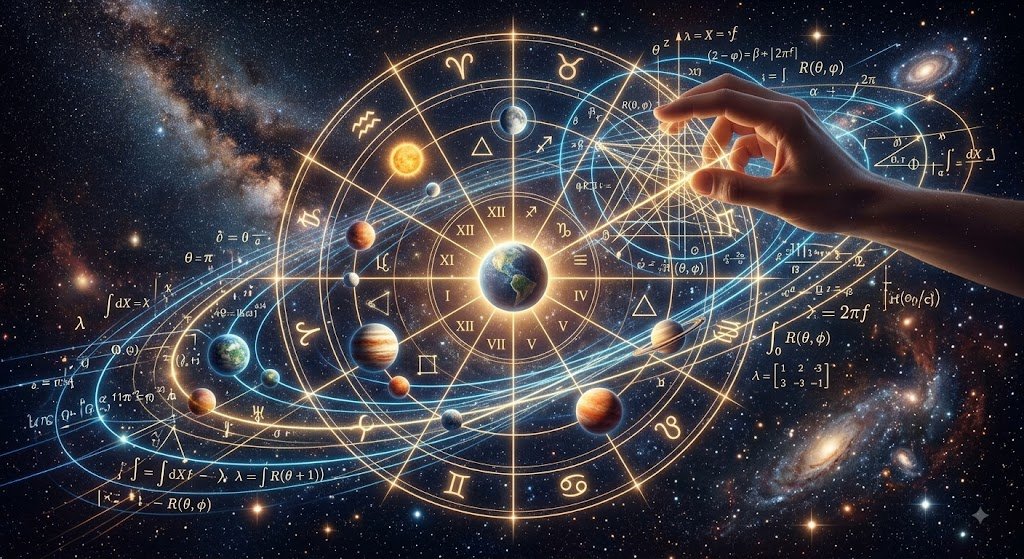
A birth chart may appear to be a simple diagram containing planets, zodiac signs, houses and degrees. However, its creation involves a detailed combination of astronomical data, time conversion, coordinate geometry and mathematical algorithms.
Before any astrological interpretation begins, a birth-chart calculator must determine where the Sun, Moon and planets were positioned at the exact moment of birth. In addition, it must calculate the Ascendant, house divisions, lunar nodes and other chart components. Therefore, the accuracy of the birth date, time and location plays an important role in the final result.
Modern platforms such as KundliTime make these complex calculations accessible by converting basic birth information into a structured digital Kundli. Nevertheless, understanding the process behind the chart can help users interpret its technical details more confidently.
What Is an Astronomical Birth-Chart Algorithm?
An astronomical birth-chart algorithm is a sequence of calculations that transforms birth information into a map of celestial positions.
First, the system converts the recorded birth time into a universal astronomical time. Next, it calculates the positions of the Sun, Moon and planets using an ephemeris. Afterward, it transforms those positions into zodiacal longitudes. Finally, the system calculates the Ascendant, houses, nakshatras and other required chart elements.
A complete calculation generally includes:
- Birth-date and time validation
- Time-zone conversion
- Geographic coordinate identification
- Julian Date calculation
- Planetary ephemeris evaluation
- Coordinate-system transformation
- Tropical or sidereal zodiac conversion
- Ascendant and house calculations
- Nakshatra and pada identification
- Lunar-node and aspect calculations
As a result, a birth chart is not generated by randomly assigning symbols. Instead, it begins with a mathematical representation of the sky for a specified time and location.
Information Required to Calculate a Birth Chart
A reliable birth-chart calculation requires three essential details:
- Exact date of birth
- Accurate local time of birth
- Place of birth
The location is converted into geographic latitude and longitude. Meanwhile, the local clock time is interpreted according to the time zone applicable to that location.
Historical time-zone information may also be necessary. For example, some countries have changed their official time zones or daylight-saving policies over the years. Therefore, software must apply the rule that was valid on the person’s date of birth rather than relying only on the location’s current time zone.
Step 1: Converting Local Birth Time into UTC
Astronomical calculations require a shared time standard. Consequently, the local birth time is normally converted into Coordinated Universal Time, or UTC.
The basic relationship is:
UTC=Local Time−UTC Offset
For example, India follows Indian Standard Time, which is UTC+5:30. Therefore, a birth recorded at 10:00 AM IST corresponds to 4:30 AM UTC.
Although this conversion looks simple, a professional calculation must also consider:
- Daylight-saving time
- Historical time-zone changes
- Births close to midnight
- Incomplete civil-time records
- Differences between calendar systems
Otherwise, an incorrect UTC value may affect every calculation that follows.
Step 2: Calculating the Julian Date
After converting the birth time into a universal standard, the algorithm expresses that instant as a Julian Date.
A Julian Date is a continuous count of days and fractions of a day. Unlike ordinary calendars, it avoids the irregular lengths of months and years. Therefore, it is convenient for calculating time intervals and evaluating planetary positions.
According to the United States Naval Observatory, Julian Dates are widely used as time variables in astronomical software.
A simplified Gregorian-calendar formula is:
JD=⌊365.25(Y+4716)⌋+⌊30.6001(M+1)⌋+D+B−1524.5
In this equation:
- Y represents the adjusted year
- M represents the adjusted month
- D contains the day and fractional time
- B applies the Gregorian calendar correction
However, professional birth-chart software should use a properly tested calendar-conversion routine. The US Naval Observatory also provides a technical guide to converting Gregorian calendar dates into Julian Dates.
Step 3: Finding the Positions of the Planets
Once the astronomical time is known, the system calculates the positions of the Sun, Moon and planets.
For this purpose, software may use an ephemeris. An ephemeris contains data or mathematical models describing the positions and movements of celestial bodies over time.
NASA’s SPICE system, for example, uses specialised data files to organise information about planetary ephemerides, reference frames, body orientations and time conversion. Although individual astrology platforms may use different astronomical libraries, the fundamental requirement remains the same: the planetary positions must be evaluated for the correct moment.
A celestial position may initially be represented as a three-dimensional vector:
r=(x,y,z)
Afterward, the vector is transformed into a suitable coordinate system. For birth-chart purposes, one of the most important values is ecliptic longitude—the angular position of a celestial body along the ecliptic.
A simplified longitude calculation is:
λ=atan2(y,x)
The result is then normalised to a value between 0∘ and 360∘.
Step 4: Selecting the Correct Astronomical Reference Frame
A planetary coordinate has meaning only when its reference frame is clearly defined.
For instance, the position of a planet may be measured relative to the centre of the Sun, the centre of Earth or the Solar System’s barycentre. Similarly, its coordinate axes may refer to a standard epoch such as J2000 or to the equator and equinox of the calculation date.
NASA’s documentation on astronomical reference frames explains how celestial positions depend on the selected origin, orientation and evaluation time.
Birth charts generally use geocentric positions, which represent celestial bodies as viewed from Earth. However, software must still consistently apply its selected coordinate and correction conventions.
Step 5: Accounting for Precession and Nutation
Earth’s rotational axis does not remain fixed permanently. Instead, its direction changes gradually over long periods through a phenomenon known as precession.
In addition, smaller periodic movements are described as nutation. These changes affect the astronomical position of the equator and equinox.
Astropy’s astronomical coordinate documentation explains that precession represents the smooth, long-term variation, whereas nutation refers to smaller periodic components.
Therefore, an astronomical engine must use clearly defined epochs and transformation models. Otherwise, coordinates calculated for different reference dates may not be directly comparable.
Step 6: Tropical and Sidereal Zodiac Calculations
After determining the ecliptic longitude of each celestial body, the algorithm maps those positions into a zodiac system.
Tropical Zodiac
The tropical zodiac places 0∘ Aries at the March equinox. Consequently, its starting point remains connected to the seasonal equinox.
A tropical planetary position can be represented as:
λtropical
Sidereal Zodiac
The sidereal zodiac applies an angular correction commonly called ayanamsha. This correction accounts for the difference between the tropical equinox and the selected sidereal reference.
The simplified conversion is:
λsidereal=λtropical−ayanamsha
If the answer is less than zero, 360∘ is added to normalise the result.
However, several ayanamsha conventions are used in Vedic astrology. Therefore, two Kundli calculators may display slightly different planetary degrees even when both start with accurate astronomical positions.
For this reason, users should check which ayanamsha is selected before comparing charts.
Step 7: Assigning Planets to Zodiac Signs
The zodiac divides the 360∘ ecliptic into twelve sections of 30∘ each.
The sign index can be calculated as:
Sign Index=⌊30∘λ⌋
Meanwhile, the degree within the sign is:
Degree Within Sign=λmod30∘
For example, a planetary longitude of 47∘ lies within the second section of the zodiac. Since the second section begins at 30∘, the planet would be displayed at 17∘ of the second zodiac sign.
Thus, the familiar sign-and-degree notation is derived directly from a continuous 360∘ longitude.
Step 8: Calculating Local Sidereal Time
The Ascendant and houses depend on Earth’s rotation. Therefore, the system must determine how the celestial sphere was oriented relative to the birthplace at the birth moment.
For this calculation, astronomical software uses sidereal time.
The US Naval Observatory’s explanation of sidereal time notes that it depends on both Earth’s axial rotation and its movement around the Sun.
The algorithm first calculates Greenwich sidereal time. Next, it adjusts the result according to the longitude of the birthplace:
LST=GST+Geographic Longitude
Here, LST means local sidereal time, while GST means Greenwich sidereal time.
As a result, the system can determine which celestial coordinates were crossing the local horizon and meridian.
Step 9: Calculating the Ascendant
The Ascendant, also known as the rising sign, is the point of the zodiac that intersects the eastern horizon at a specific time and place.
Its calculation requires:
- Local sidereal time
- Geographic latitude
- Obliquity of the ecliptic
- Exact birth time
- Selected astronomical conventions
Contrary to simplified methods, the Ascendant cannot be determined merely by dividing a day into twelve equal periods.
Earth rotates by approximately 15∘ per hour relative to the sky. However, zodiac signs do not all rise at an identical rate from every geographic latitude. Therefore, the Ascendant requires a proper geometric calculation involving the horizon and ecliptic.
Consequently, even a small birth-time difference can noticeably change the Ascendant degree. Furthermore, a larger error may change the rising sign completely.
Step 10: Calculating the Midheaven and Houses
The Midheaven is associated with the intersection of the local meridian and the ecliptic. Together with the Ascendant, it provides an important reference for constructing many house systems.
However, houses are not calculated identically in every astrological tradition. Common systems include:
- Whole Sign
- Equal House
- Placidus
- Porphyry
- Koch
- Sripati
- Other Bhava-based methods
For example, Whole Sign houses assign an entire zodiac sign to each house. In contrast, quadrant-based systems calculate intermediate cusps using additional astronomical and geometric relationships.
Therefore, two charts may show the same planetary degrees but place a planet in different houses. Before comparing charts, users should confirm that both calculators use the same house system.
Step 11: Calculating Rahu and Ketu
In Vedic astrology, Rahu and Ketu correspond to the lunar nodes. Astronomically, these are the two points where the Moon’s orbital plane intersects the ecliptic.
The ascending node is the point where the Moon crosses from south to north. Meanwhile, the descending node is located approximately 180∘ away.
Birth-chart software may calculate either:
- Mean lunar nodes
- True lunar nodes
Mean nodes use an averaged model. On the other hand, true nodes include short-period variations in the calculated motion.
As a result, the selected node method can create small differences between two Kundlis. Nevertheless, Rahu and Ketu remain opposite each other in the standard chart calculation.
Step 12: Calculating Nakshatras and Padas
A commonly used Vedic system divides the zodiac into 27 nakshatras.
Each nakshatra covers:
27360∘=13∘20′
The Moon’s sidereal longitude is used to identify its nakshatra:
Nakshatra Index=⌊13∘20′λMoon⌋
Furthermore, every nakshatra is divided into four padas. Each pada covers:
3∘20′
Therefore, accurate lunar longitude is essential for determining the nakshatra and pada. If the Moon is close to a boundary, even a small difference in birth time, ayanamsha or ephemeris settings may affect the result.
Step 13: Measuring Planetary Aspects
After calculating all planetary longitudes, the software can measure the angular separation between two celestial bodies.
A useful formula is:
Δ=min(∣λ1−λ2∣,360∘−∣λ1−λ2∣)
The result may then be compared with predefined aspect angles.
For example, commonly used Western aspects include:
- Conjunction: approximately 0∘
- Sextile: approximately 60∘
- Square: approximately 90∘
- Trine: approximately 120∘
- Opposition: approximately 180∘
However, Vedic astrology may use sign-based or planet-specific aspects. Consequently, the interpretation algorithm must follow the rules of the selected astrological system.
Why Accurate Birth Time Is Important
Planetary positions do not all change at the same rate.
For example, slower-moving planets change very little during a single day. The Moon, however, moves more noticeably. Meanwhile, the Ascendant and house cusps are especially sensitive because they depend directly on Earth’s rotation.
An inaccurate birth time may affect:
- Ascendant degree
- Rising sign near a boundary
- House cusps
- Planetary house placement
- Divisional charts
- Nakshatra pada
- Time-sensitive astrological calculations
Therefore, users should enter the recorded birth time as precisely as possible. If the time is uncertain, the chart should not be treated as more precise than the available information allows.
Why Two Birth-Chart Calculators May Show Different Results
Two platforms may produce different charts even when the same birth information is entered.
This can happen because they use different:
- Ephemerides
- Ayanamsha conventions
- Time-zone databases
- House systems
- Coordinate corrections
- Lunar-node methods
- Geographic coordinates
- Rounding rules
- Geocentric or topocentric settings
For instance, one platform may use true lunar nodes, whereas another may use mean nodes. Similarly, one calculator may use Whole Sign houses, while another uses Sripati houses.
Therefore, users should compare the settings before assuming that one of the charts is incorrect.
How KundliTime Simplifies Complex Birth-Chart Calculations
Calculating a birth chart manually requires astronomical data, mathematical formulas and careful management of time and coordinate systems. Consequently, the complete process can be difficult for someone without specialised knowledge.
KundliTime simplifies this experience by transforming birth information into an organised digital Kundli. Instead of performing every calculation manually, users can enter their date, time and place of birth and review the generated chart.
A transparent birth-chart platform should clearly display:
- Entered birth information
- Geographic coordinates
- Zodiac type
- Ayanamsha setting
- House system
- Planetary degrees
- Ascendant degree
- Nakshatra and pada
- Lunar-node method
As a result, users can better understand the settings applied to their chart and compare the results with other systems when necessary.
Astronomy and Astrology Are Not the Same
Therefore, the astronomical calculation of a planet’s position should not be confused with scientific validation of an astrological prediction. Current scientific evidence does not establish that birth-chart placements determine personality or predict future events.
Nevertheless, many people engage with astrology as a cultural tradition, spiritual practice or tool for personal reflection. This distinction allows readers to appreciate the mathematics behind the chart while understanding the status of its interpretations.
Explore the Mathematics Behind Your Kundli
A birth chart begins with a specific moment and location on Earth. First, the local birth time is converted into a universal astronomical standard. Next, the algorithm evaluates planetary positions and transforms them into the selected zodiac system. Afterward, it calculates the Ascendant, houses, nakshatras, nodes and angular relationships. Finally, it presents the results in a structured chart.
Thus, a simple-looking Kundli is supported by several interconnected calculations involving astronomy, timekeeping and geometry.
KundliTime makes this complex process easier to explore. Therefore, users can generate a personalised birth chart and learn how their recorded birth moment corresponds to a calculated map of the sky.
Explore KundliTime today to discover the astronomical calculations behind your birth chart.