
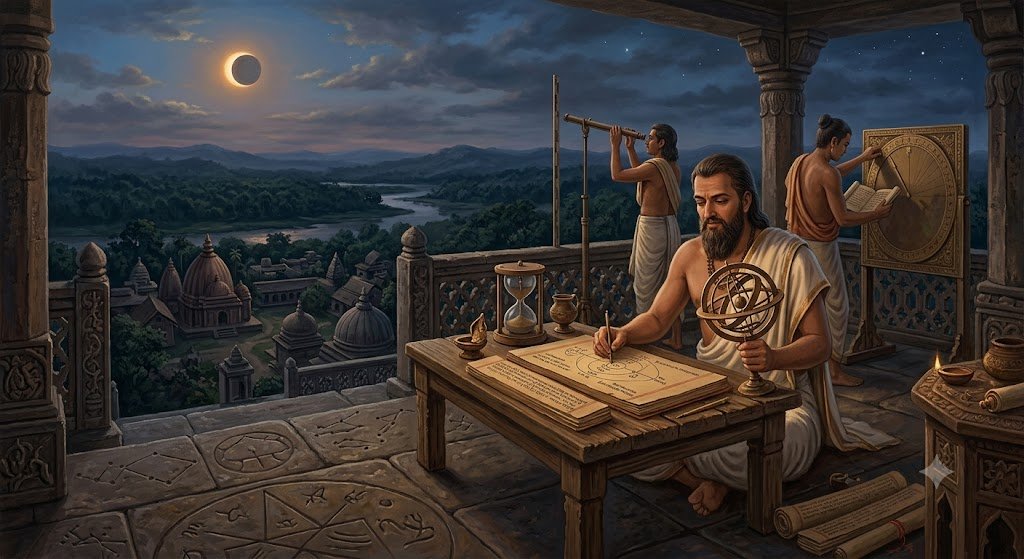
More than 1,500 years before modern telescopes, computers and space observatories, Indian mathematician-astronomers were developing mathematical methods for tracking celestial objects and calculating astronomical events.
Among the most influential was Aryabhata, born in 476 CE. His surviving masterpiece, the Āryabhaṭīya, was composed around 499 CE and became one of the foundational works of classical Indian mathematical astronomy. The text combines mathematics, time-reckoning, planetary calculations, spherical astronomy and detailed methods related to solar and lunar eclipses.
What makes Aryabhata especially important is that he did not treat eclipses merely as mysterious celestial events. He described them using the relative positions of the Sun, Moon and Earth, the Moon’s orbital nodes, Earth’s shadow, geometry, angular measurements and mathematical calculation.
So, how did Aryabhata understand eclipses, and how could astronomers in ancient India calculate them without telescopes or computers?
The answer lies in an extraordinary combination of observation, mathematics and astronomy.
Who Was Aryabhata?
Aryabhata was one of the most important mathematician-astronomers of classical India. Historical sources place his birth in 476 CE, and his career is associated with Kusumapura, usually identified with the region of present-day Patna.
The Biographical Encyclopedia of Astronomers describes the Āryabhaṭīya as the earliest preserved scientific-period Indian astronomical work bearing the name of an individual author.
Aryabhata’s work addressed topics that today belong to several mathematical and astronomical disciplines, including arithmetic, algebra, trigonometry, planetary motion, time calculation and spherical astronomy.
His Āryabhaṭīya survives as a remarkably compact text of about 118 verses. MacTutor notes that its final section contains approximately 50 verses dealing with the celestial sphere and eclipses.
That compactness is important. Ancient astronomical texts were often written as concise Sanskrit verses intended to encode computational procedures that teachers and commentators could explain in greater detail.
Aryabhata’s Scientific Explanation of Eclipses
One of Aryabhata’s best-known astronomical contributions was his physical explanation of eclipses.
In the Gola section of the Āryabhaṭīya, he states that the Moon obscures the Sun during a solar eclipse, while Earth’s shadow obscures the Moon during a lunar eclipse. The surviving translation of verse 37 makes this physical explanation explicit.
This is fundamentally the same geometric principle used to explain eclipses today.
Solar Eclipse
A solar eclipse occurs when the Moon passes between Earth and the Sun so that the Moon blocks part or all of the Sun from the observer’s location.
In simplified form:
Sun → Moon → Earth
Lunar Eclipse
A lunar eclipse occurs when Earth lies between the Sun and Moon and the Moon enters Earth’s shadow.
In simplified form:
Sun → Earth → Moon
Aryabhata therefore understood that eclipses were predictable consequences of astronomical geometry.
What About Rahu and Ketu?
Indian mythology contains the famous story of Rahu associated with the swallowing of the Sun or Moon during an eclipse.
It would be misleading, however, to frame ancient Indian culture as simply moving from “myth to science” at one particular moment. Mythological, ritual and mathematical astronomical traditions could coexist.
What is historically important about Aryabhata is that his computational astronomy did not require a supernatural mechanism to calculate an eclipse.
MacTutor notes that Aryabhata explained solar and lunar eclipses through physical astronomical causes rather than the traditional Rahu explanation.
In mathematical astronomy, “nodes” also became critically important. In later Indian astrological terminology, Rahu and Ketu are associated with the two lunar nodes, but astronomically these are geometric intersection points, not physical planets.
The Crucial Discovery: Eclipses Do Not Happen Every Month
If every new moon places the Moon roughly between Earth and the Sun, why isn’t there a solar eclipse every month?
And if every full moon puts Earth roughly between the Sun and Moon, why don’t we get a lunar eclipse every month?
The answer is the inclination of the Moon’s orbit.
The Moon’s orbital path is tilted relative to the ecliptic—the apparent annual path of the Sun across the celestial sphere.
The two places where the Moon’s orbital plane intersects the ecliptic are called the lunar nodes.
An eclipse is possible only when the required new-moon or full-moon alignment happens sufficiently close to one of these nodes.
Aryabhata explicitly incorporated this condition.
Verse 38 of the Āryabhaṭīya states, in effect, that a solar eclipse occurs when the Moon near a node comes into conjunction with the Sun, while a lunar eclipse occurs when the Moon enters Earth’s shadow around opposition.
This is a critical step from simply observing eclipses to calculating when they can occur.
Step 1: Calculate the Positions of the Sun and Moon
To predict an eclipse, an astronomer first needs to know where the Sun and Moon will be at a particular time.
Aryabhata’s astronomical system contained procedures for computing planetary positions and periods.
The Āryabhaṭīya included rules relating to planetary motions and time-reckoning, allowing astronomers to estimate celestial longitudes for future dates.
This meant that the astronomer did not have to wait for an eclipse to appear.
From previously established cycles and mathematical parameters, future configurations could be calculated.
That is the essence of astronomical prediction.
Step 2: Determine Conjunction or Opposition
The next question was whether the Sun and Moon were positioned appropriately.
For a solar eclipse, astronomers looked for a conjunction—essentially a new moon configuration.
For a lunar eclipse, they looked for opposition—essentially a full moon configuration.
But conjunction or opposition alone was not enough.
The Moon also had to be sufficiently close to one of its orbital nodes.
This combination of lunar phase + node proximity determined whether an eclipse was possible.
Step 3: Calculate the Moon’s Latitude
Astronomers then needed to know how far north or south of the ecliptic the Moon would be.
This angular distance is known as lunar latitude.
If the Moon passed too far above or below the required alignment, there would be no eclipse even at new or full moon.
If its latitude was sufficiently small, the discs or shadows could overlap.
This allowed eclipse calculation to become a problem in geometry.
Step 4: Calculate Earth’s Shadow
For a lunar eclipse, knowing that the Moon would pass near opposition was not enough.
Astronomers also needed an estimate of the size of Earth’s shadow at the Moon’s distance.
Aryabhata provided mathematical procedures for doing exactly this.
Verses 39 and 40 of the Gola section deal with calculating the length of Earth’s shadow and its diameter at the Moon’s orbit. The surviving translation shows that Aryabhata related the dimensions and distances of the Sun and Earth geometrically to determine the shadow.
This is an impressive example of mathematical modelling.
An astronomer could conceptually represent:
the Sun’s diameter,
Earth’s diameter,
their relative distance,
the narrowing shadow cone behind Earth,
and the Moon’s movement through that shadow.
The eclipse could then be treated as a calculable geometric event.
Step 5: Calculate How Much of the Moon Would Be Eclipsed
Aryabhata went further than simply asking whether an eclipse would happen.
He provided methods for estimating its magnitude and duration.
In verse 41, a geometric relationship involving the combined radii of the Moon and Earth’s shadow, along with the Moon’s latitude, is used to determine the half-duration of an eclipse.
In modern mathematical notation, the underlying geometry resembles a chord/intersection problem: the path of the Moon through a circular shadow depends on how far its trajectory passes from the shadow’s centre.
A central passage produces a longer and potentially deeper eclipse.
A grazing passage produces a shorter and shallower eclipse.
The same geometric principle still applies today, although modern astronomy uses vastly more accurate orbital models and computational methods.
Step 6: Convert Angular Motion into Time
Knowing the geometry gives angular distances.
But observers want to know:
When will the eclipse begin?
When will maximum eclipse occur?
How long will it last?
When will it end?
Aryabhata’s procedure connected eclipse geometry with the daily relative motions of the Sun and Moon.
Verse 41 indicates that the angular result can be converted to time using their motions.
Conceptually:
distance to travel ÷ relative angular speed = time
That principle is fundamental throughout astronomy.
By combining orbital position, geometry and motion, ancient astronomers could calculate approximate contact times.
Solar Eclipse Prediction Was More Complicated
Solar eclipses create an additional problem.
A lunar eclipse can be observed across a large portion of Earth’s night side, but a total solar eclipse is visible only along a relatively narrow path.
Therefore, knowing that the Sun and Moon are aligned geocentrically does not automatically tell you exactly what an observer at a particular location will see.
The observer’s position on Earth matters.
This introduces parallax.
The Āryabhaṭīya discusses astronomical quantities used for calculating eclipse parallax. Its treatment of the observer’s vertical circles, the ecliptic and related sine quantities formed part of this local correction process.
This represents a significant level of sophistication.
Aryabhata’s eclipse astronomy was not merely:
“A new moon is coming, therefore there might be an eclipse.”
It involved calculations concerning location, angular position and apparent geometry.
Trigonometry Made Eclipse Calculation Possible
One of the mathematical tools behind Indian astronomy was trigonometry.
Aryabhata provided a sequence of sine values in the Āryabhaṭīya. These trigonometric methods were essential for calculating angular relationships on the celestial sphere.
This connection between astronomy and mathematics is extremely important.
Ancient astronomers needed to transform observations of the sky into numerical quantities.
Trigonometry allowed them to relate:
celestial longitude,
latitude,
altitude,
angular distance,
declination,
the horizon,
and the ecliptic.
In other words, eclipse prediction was not an isolated trick.
It belonged to a much larger mathematical system for modelling the sky.
Aryabhata and Earth’s Rotation
Another remarkable aspect of Aryabhata’s astronomy was his explanation of the apparent daily movement of the sky.
He argued that the apparent westward motion of the stars could be understood through Earth’s own rotation.
MacTutor records his view that the apparent rotation of the heavens results from Earth’s axial rotation.
This was an unusually insightful idea for his period.
However, it is important not to exaggerate the claim.
Aryabhata’s surviving planetary model should not simply be described as equivalent to the modern heliocentric solar system. Historians continue to debate aspects of its interpretation, and Cambridge’s history of astronomy cautions that there is no firm evidence for attributing a fully heliocentric model to him.
His contribution is remarkable enough without adding modern ideas that the historical evidence cannot securely support.
Did Aryabhata Know That the Moon Shines by Reflected Light?
Aryabhata’s astronomical tradition also recognised that the Moon and planets shine through reflected sunlight, rather than producing light in the same manner as the Sun.
MacTutor explicitly attributes this understanding to Aryabhata.
That concept naturally supports a shadow-based explanation of lunar phases and eclipses.
If the Sun illuminates the Moon, then the relative positions of the Sun, Earth and Moon determine which portions are illuminated or shadowed.
Again we see the same pattern:
observation → geometric model → mathematical prediction.
Could Aryabhata Really Predict the Exact Date of an Eclipse?
The word “prediction” needs some historical context.
Aryabhata did not possess atomic clocks, telescopes, satellite observations or modern numerical orbital integrations.
His parameters were therefore not as precise as those used by NASA or contemporary observatories.
But his methods did provide a genuine mathematical framework for calculating:
when eclipse conditions would occur,
whether the Moon would be close enough to a node,
the dimensions of Earth’s shadow,
the amount of obscuration,
and approximately how long the eclipse would last.
The table of contents of the surviving Āryabhaṭīya translation shows dedicated procedures for the time of eclipses, Earth’s shadow, eclipse duration, total obscuration and amount obscured at a given time.
That clearly places Aryabhata within a tradition of predictive mathematical astronomy.
A Fascinating Observation About Eclipse Visibility
Aryabhata even discussed the practical visibility of small solar eclipses.
Verse 47 states that a very small obscuration of the Sun—about one-eighth of its diameter in the traditional interpretation—might not be perceptible because of the Sun’s brightness.
This shows awareness of an important distinction:
a mathematically calculated eclipse and an easily visible eclipse are not necessarily the same thing.
Astronomers had to think not only about celestial geometry but also about observation.
The Structure Behind Ancient Indian Eclipse Prediction
The complete procedure can be understood as a chain of reasoning:
Predict the Sun’s position → calculate the Moon’s position → determine conjunction or opposition → check proximity to a lunar node → calculate lunar latitude → determine apparent disc or shadow sizes → calculate overlap → account for motion → estimate eclipse magnitude and duration → apply local corrections for solar eclipses.
That is recognisably scientific computation.
The numerical constants and models have changed dramatically since Aryabhata’s time, but the broader logic remains familiar to a modern astronomer.
Why Was the Āryabhaṭīya So Important?
Aryabhata’s influence did not end with his own lifetime.
His work became a major point of reference for later Indian mathematicians and astronomers.
Bhaskara I, writing roughly a century later, produced an extensive commentary on the Āryabhaṭīya. Modern scholarship describes his commentary as one of the earliest surviving Sanskrit works offering detailed mathematical reasoning around Aryabhata’s methods.
Later astronomers, including Brahmagupta and scholars of the Kerala astronomical tradition, continued developing mathematical astronomy.
Centuries later, Nīlakaṇṭha Somayājī’s Tantrasaṅgraha, composed around 1501, contained entire chapters devoted to lunar eclipses, solar eclipses and related calculations.
The history of Indian astronomy was therefore not based on one isolated genius.
It was a long computational tradition in which astronomers criticised, commented upon and improved earlier models.
Astronomy and Mathematics Grew Together in India
Aryabhata is important not merely because he studied the sky.
His work demonstrates how mathematical development and astronomy reinforced one another.
Astronomical problems required better methods for:
angles,
geometry,
arithmetic,
algebra,
interpolation,
time measurement,
and trigonometry.
In turn, mathematical innovation enabled astronomers to model increasingly complicated phenomena.
The Indian Academy of Sciences repository describes Aryabhata as a pioneering figure who systematically organised mathematical and astronomical knowledge into sections dealing with mathematics, time reckoning, astronomical data and the celestial sphere.
Eclipse calculation provides one of the clearest examples of this relationship.
Ancient Astronomy Was Not the Same as Modern Astronomy
It is tempting to say that Aryabhata “knew everything modern astronomy knows.”
That would be historically inaccurate.
Ancient astronomical models contained approximations, parameters and cosmological assumptions that modern astronomy has replaced.
Modern eclipse calculations use extremely accurate observations of:
Earth’s rotation,
the Moon’s changing orbital velocity,
orbital eccentricity,
gravitational perturbations,
topography of the lunar surface,
the observer’s geographic coordinates,
Earth’s shape,
and many additional corrections.
Yet judging Aryabhata by whether he possessed 21st-century astrophysics misses the point.
The extraordinary achievement was developing a mathematical predictive system with the observational tools available in the fifth century.
Mythology, Astrology and Astronomy in Ancient India
Ancient Indian intellectual traditions did not always separate disciplines into the modern categories of astronomy, astrology, mathematics, calendrics and religious practice.
Astronomical calculations had practical importance for calendars and the determination of significant dates.
At the same time, mathematical astronomers could develop models based on geometry and observation.
This is why historical interpretation should avoid presenting Indian knowledge as either purely mystical or entirely equivalent to modern science.
The reality was much richer.
Aryabhata’s eclipse calculations demonstrate a strong tradition of mathematical astronomy operating within the larger cultural world of ancient India.
Why Aryabhata’s Eclipse Science Still Matters
Aryabhata’s work matters today for several reasons.
First, it demonstrates the sophistication of mathematical astronomy in classical India.
Second, it shows how careful observation can be transformed into numerical prediction.
Third, it illustrates the deep historical connection between Indian mathematics and astronomy.
Fourth, it reminds us that scientific understanding develops over generations. Aryabhata’s calculations were studied, criticised and improved by later astronomers rather than simply accepted permanently.
Finally, his work offers an important lesson about science itself.
An eclipse may appear dramatic and mysterious.
But once the movements involved are measured, its occurrence can be understood through mathematics.
From Ancient Calculations to Modern Eclipse Prediction
Today’s astronomers can predict eclipses centuries into the future with extraordinary precision.
Computers calculate the orbital motion of Earth and Moon, while satellite measurements improve knowledge of their positions.
Interactive maps can show exactly where totality will occur and even estimate contact times to the second.
Aryabhata worked in a radically different technological world.
Yet some of the central questions were the same:
Where will the Moon be?
Where will the Sun be?
Will they align?
How close is the Moon to a node?
How large will the overlap be?
How quickly are the bodies moving relative to one another?
How will the observer’s location change what is seen?
Those questions connect the Āryabhaṭīya to the continuing history of astronomical science.
Final Thoughts
Aryabhata and the science of eclipse prediction in ancient India represent one of the most fascinating intersections of mathematics, astronomy and history.
Writing around 499 CE, Aryabhata explained solar eclipses through the Moon obscuring the Sun and lunar eclipses through the Moon entering Earth’s shadow. He recognised the importance of lunar nodes, calculated the dimensions of Earth’s shadow, used trigonometric techniques and developed procedures for estimating eclipse magnitude and duration.
His calculations were not modern astrophysics, nor should they be presented as such.
Their significance is greater when understood accurately.
More than fifteen centuries ago, an Indian astronomer was showing that seemingly mysterious events in the sky could be studied through observation, geometry, trigonometry and computation.
That is why Aryabhata remains not merely a celebrated figure of Indian history, but one of the important names in the global history of mathematical astronomy.
External Backlinks
- MacTutor – Aryabhata: Biography and Mathematical Astronomy
Aryabhata – MacTutor History of Mathematics - Max Planck Institute – Biographical Encyclopedia of Astronomers: Aryabhata I
Aryabhata I – Biographical Encyclopedia of Astronomers - The Āryabhaṭīya – English Translation by Walter Eugene Clark
The Aryabhatiya of Aryabhata – English Translation - Indian Academy of Sciences – Aryabhata’s Achievements in Mathematics and Astronomy
Aryabhata I’s Achievements in Ancient Indian Mathematics and Astronomy - Cambridge University Press – Solar Eclipses in India’s Cultural and Political History
Solar Eclipses in India’s Cultural and Political History - Springer – Tantrasaṅgraha of Nīlakaṇṭha Somayājī
Tantrasaṅgraha – Indian Mathematical Astronomy