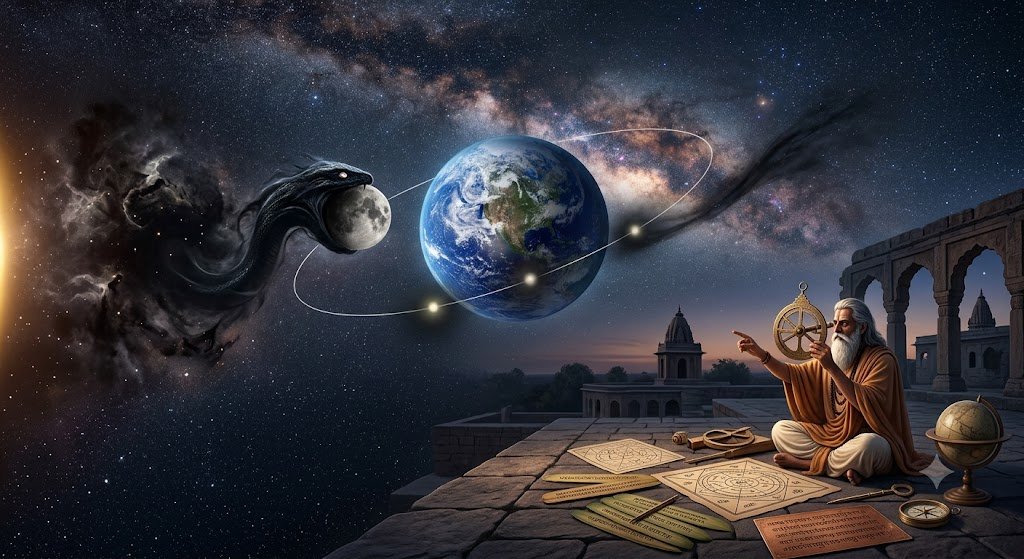
For thousands of years, humans have looked at the sky to understand cosmic patterns, seasons, eclipses, and the mysteries of life. In Indian astronomy and Vedic astrology, Rahu and Ketu hold a unique position among the Navagrahas (nine celestial influencers). They are often called “shadow planets”, but unlike Mars, Jupiter, or Saturn, they are not physical planets. Instead, they represent two important astronomical points known as the lunar nodes.
The fascinating connection between ancient Vedic knowledge and modern astronomy makes Rahu-Ketu one of the most interesting topics where mythology, mathematics, and celestial science come together.
What Are Rahu and Ketu According to Astronomy?
From an astronomical perspective, Rahu and Ketu are not actual planets with mass, surfaces, or gravitational fields. They are mathematical points created by the intersection of two celestial paths:
- The Moon’s orbit around Earth
- The apparent path of the Sun around Earth, known as the ecliptic
The point where the Moon crosses the ecliptic while moving upward is called the Ascending Lunar Node (Rahu), while the point where it crosses downward is called the Descending Lunar Node (Ketu).
These two points are always opposite each other in the sky, separated by approximately 180 degrees.
Why Are Rahu and Ketu Called Shadow Planets?
The term “shadow planet” comes from their connection with eclipses.
Ancient astronomers observed that solar and lunar eclipses occurred when the Sun, Moon, and Earth aligned near these points. Since Rahu and Ketu appeared to “cover” or create darkness over the Sun and Moon, they became symbolically known as shadow planets.
In Vedic mythology, Rahu is represented as the head of a celestial serpent and Ketu as its body. The symbolic story explains the repeating cycle of eclipses, where the shadow appears to temporarily consume the Sun or Moon.
Modern astronomy explains this phenomenon through orbital geometry rather than mythology.
The Scientific Explanation Behind Solar and Lunar Eclipses
An eclipse occurs only when the Sun, Earth, and Moon align closely with the lunar nodes.
Solar Eclipse
A solar eclipse happens when:
- The Moon comes between Earth and the Sun
- The Moon’s shadow falls on Earth
- The alignment occurs near Rahu or Ketu
Lunar Eclipse
A lunar eclipse happens when:
- Earth comes between the Sun and Moon
- Earth’s shadow falls on the Moon
- The Moon passes near the opposite lunar node
Without the lunar nodes, predicting eclipses would be much more difficult.
Rahu and Ketu’s 18.6-Year Astronomical Cycle
One of the most interesting scientific facts about Rahu and Ketu is their movement cycle.
The lunar nodes slowly move backward through the zodiac and complete one cycle in approximately 18.6 years. This cycle is related to the precession of the Moon’s orbit.
Ancient Indian astronomers carefully observed these patterns and incorporated them into astronomical calculations and astrological traditions.
Rahu and Ketu in Vedic Astrology
While astronomy describes Rahu and Ketu as lunar nodes, Vedic astrology interprets them as powerful symbolic forces influencing human experiences.
In traditional Vedic astrology:
Rahu Represents:
- Ambition
- Material desires
- Innovation
- Foreign connections
- Technology
- Sudden changes
- Unconventional thinking
Rahu is often associated with exploring unknown areas and breaking traditional boundaries.
Ketu Represents:
- Spiritual growth
- Detachment
- Inner wisdom
- Introspection
- Past experiences
- Liberation
Ketu is often connected with self-discovery and moving beyond material attachments.
Astrologers study Rahu and Ketu placements in a birth chart to interpret symbolic life patterns and personal tendencies.
The Connection Between Ancient Knowledge and Modern Science
One of the most remarkable aspects of Rahu and Ketu is how ancient civilizations developed methods to understand celestial movements without modern telescopes.
Indian astronomical traditions studied:
- Planetary movements
- Lunar cycles
- Eclipse calculations
- Seasonal changes
- Celestial coordinates
The identification of lunar nodes shows the importance of mathematical astronomy in understanding the relationship between the Sun, Earth, and Moon.
Are Rahu and Ketu Real Planets?
Scientifically, the answer is no.
Rahu and Ketu are not physical planets like:
- Mercury
- Venus
- Earth
- Mars
- Jupiter
- Saturn
They are astronomical points in space.
However, their importance comes from their role in eclipse prediction and their symbolic significance in Vedic astrology.
Why Rahu-Ketu Still Fascinate People Today
Even in the modern technological era, Rahu and Ketu continue to attract interest because they represent a bridge between:
- Ancient astronomy
- Modern astrophysics
- Cultural traditions
- Mathematical calculations
- Spiritual interpretations
They remind us that early civilizations developed sophisticated methods to observe and understand the universe.
KundliTime AI: Exploring Astrology Through Modern Technology
With advancements in Artificial Intelligence, astrology platforms are entering a new era. AI-powered astrology tools can help analyze birth charts, planetary positions, and traditional interpretations faster and more efficiently.
Platforms like KundliTime AI combine modern technology with traditional astrological concepts to provide personalized insights based on birth details and celestial calculations.
By using technology responsibly, users can explore astrology while also understanding the astronomical foundation behind celestial concepts like Rahu and Ketu.
Final Thoughts
Rahu and Ketu are among the most fascinating examples of how humans have interpreted the universe throughout history.
From a scientific perspective, they are the North and South Lunar Nodes, essential for understanding eclipses and Moon-related orbital patterns.
From a Vedic astrology perspective, they are powerful symbolic forces representing transformation, desires, spirituality, and personal evolution.
The story of Rahu-Ketu shows how astronomy and ancient wisdom have always been connected through humanity’s curiosity about the cosmos.
Explore your celestial journey with KundliTime AI — where ancient astrology meets modern technology.
External References & Recommended Backlinks
- NASA – Solar and Lunar Eclipse Information
https://science.nasa.gov/eclipses/ - NASA – Moon Facts and Orbital Information
https://science.nasa.gov/moon/ - European Space Agency – Understanding the Moon
https://www.esa.int/Science_Exploration/Space_Science/Moon - Encyclopaedia Britannica – Lunar Nodes
https://www.britannica.com/science/lunar-node - International Astronomical Union (IAU)
https://www.iau.org/