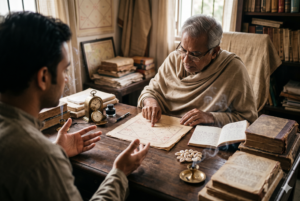

To find an auspicious muhurat, start by checking the day’s Panchang. This includes the Tithi, Nakshatra, Yoga, Karana, and weekday. Next, check for periods traditionally considered unsuitable, such as Chaturmas, Kharmas, and Venus or Jupiter combustion. Then choose a suitable time that avoids Rahu Kaal and falls within a favourable Choghadiya or Abhijit Muhurat, where appropriate. For weddings, astrologers may also compare the proposed date with the couple’s birth charts.
What Is a Muhurat?
A muhurat, also spelled muhurta, is a time window selected according to traditional Vedic astrology principles for starting an activity.
The aim is to choose a moment considered auspicious for the occasion. Families have traditionally used muhurats for weddings, naming ceremonies, housewarmings, vehicle or property purchases, and business launches.
Today, many online Panchang tools calculate auspicious time windows for different locations. This makes it easier to check a date without interpreting a printed calendar. Understanding the basic principles can also help you ask better questions when consulting a pandit or astrologer.
Important note: Muhurat selection is a religious and cultural practice. Its rules can vary across regions, families, and traditions. Use this guide for general information, and confirm important dates with a trusted local priest or astrologer.
The Five Panchang Elements Behind Every Muhurat
The word Panchang means “five limbs.” A traditional Panchang uses five elements to describe the quality of a particular day and time.
| Element | Meaning | Why It Matters |
|---|---|---|
| Tithi | The lunar day within a fortnight | Some Tithis are traditionally preferred for particular ceremonies. |
| Vara | The weekday | Each weekday is associated with a planet and has traditional interpretations. |
| Nakshatra | The lunar mansion occupied by the Moon, among 27 Nakshatras | Nakshatra selection is an important part of many marriage muhurat calculations. |
| Yoga | A combination calculated from the positions of the Sun and Moon | Certain Yogas are traditionally avoided for specific activities. |
| Karana | Half of a Tithi | Some Karanas are considered unsuitable for particular ceremonies. |
These five elements help astrologers narrow down possible dates and times.
You can use the Drik Panchang tool to review Panchang details for a specific date and city.
Periods to Check Before Choosing a Date
Before selecting a muhurat, check whether the date falls within a period that your family or tradition considers unsuitable for the event.
Here are some commonly discussed periods:
- Chaturmas: A traditional four-month period associated with Lord Vishnu’s cosmic rest. Many communities avoid weddings during this period. The wedding season traditionally resumes after Dev Uthani, also called Prabodhini Ekadashi.
- Adhik Maas and Kshaya Maas: These terms relate to adjustments in the Hindu lunar calendar. Certain ceremonies may be restricted during these periods, depending on the tradition.
- Pitru Paksha: A period dedicated to remembering and honouring ancestors. Many families avoid weddings and other auspicious celebrations during this time.
- Kharmas: A period associated with the Sun’s transit through Sagittarius in many North Indian traditions. Some communities avoid weddings and other major ceremonies during this period.
- Shukra Asta and Guru Asta: These refer to the traditional astrological combustion of Venus and Jupiter. Since both planets have associations with marriage in Vedic astrology, many traditions avoid weddings during these periods.
- Eclipses: Some traditions avoid starting important activities during solar and lunar eclipses.
The rules are not identical across all traditions. For example, Drik Panchang discusses specific solar sign placements when explaining marriage muhurat rules in the Muhurta Chintamani tradition. Its detailed marriage-date guide explains these considerations further.
Always check the rules that apply to your family and location before finalising a date.
How to Find a Marriage (Vivah) Muhurat
Marriage muhurat selection often involves more checks than choosing a time for an ordinary business activity. Traditional methods consider the wedding date, the ceremony’s timing, and the couple’s birth charts.
Follow these steps to understand the process.
1. Check the Marriage Season
First, check whether the proposed date falls within a period when your tradition permits weddings.
Many communities avoid marriage ceremonies during Chaturmas, Kharmas, Adhik Maas, and periods when Venus or Jupiter is combust.
Compare more than one reliable Panchang or muhurat source before choosing a date. For example, SmartPuja publishes guides listing potential Vivah Muhurat dates for 2026.
2. Check the Nakshatra
Nakshatra selection is an important part of traditional marriage muhurat calculations.
The following Nakshatras are commonly listed as suitable for marriage:
- Rohini
- Mrigashira
- Magha
- Uttara Phalguni
- Hasta
- Swati
- Anuradha
- Moola
- Uttara Ashadha
- Uttara Bhadrapada
- Revati
Some traditions also consider specific charanas, or quarters, within a Nakshatra. This is one reason a local pandit may recommend a more detailed calculation.
3. Review the Tithi and Weekday
Some Tithis are traditionally preferred for weddings, while others are avoided.
Commonly preferred Tithis include:
- Dwitiya
- Tritiya
- Panchami
- Saptami
- Ekadashi
- Trayodashi
Chaturthi, Navami, and Chaturdashi are often treated as unsuitable for marriage because they belong to the Rikta category in many traditional systems.
Weekdays also matter. Monday, Wednesday, Thursday, and Friday are commonly preferred, while Tuesday is often avoided.
However, not every Panchang uses exactly the same rules. Drik Panchang, for example, treats Tithi and weekday as less restrictive filters than some other factors. As a result, its calendar may show dates that stricter systems exclude.
4. Check Yoga and Karana
Yoga and Karana help astrologers assess the proposed time more closely.
Vishti, also known as Bhadra, is commonly avoided for weddings. Shakuni, Chatushpada, and Nagava are also traditionally treated as unsuitable for certain ceremonies.
Some Yogas may also be excluded from marriage muhurat calculations. Check the complete Panchang for the selected time rather than relying only on the date.
5. Select a Suitable Lagna
Lagna refers to the Ascendant, or the zodiac sign rising on the eastern horizon at a particular time.
Many traditional marriage muhurat guides recommend Gemini, Virgo, or Libra Ascendants. However, the preferred Lagna can vary according to the calculation method and the couple’s charts.
Because the Ascendant changes throughout the day, the exact ceremony time matters. A qualified astrologer can help narrow down a suitable time window.
6. Compare the Date With the Couple’s Birth Charts
A generally favourable date may not meet every traditional requirement for a particular couple.
Astrologers may consider:
- Kundli matching (Guna Milan): A traditional method of comparing birth charts.
- Mangal Dosha: A chart factor considered in some marriage compatibility assessments.
- Chandrabalam: A traditional assessment involving the Moon’s position in relation to a person’s birth Moon.
- Tarabalam: A calculation based on the relationship between a person’s birth Nakshatra and the Nakshatra on the proposed date.
You can consult Drik Panchang’s Chandrabalam information for the relevant date. For a personalised assessment, an astrologer may also compare both partners’ charts.
7. Consider Regional Traditions
Some rules apply only in particular regions or traditions.
For example, many North Indian communities avoid weddings during Holashtak, the eight-day period before Holi. Some sources also restrict weddings during Singhast Guru, a period associated with Jupiter in Leo.
These restrictions are not universal. Ask your family priest which rules apply before rejecting or selecting a date.
How to Find a Muhurat for Starting a Business
Business muhurats are traditionally used for activities such as opening a shop, registering a company, signing a lease, entering a contract, or launching a product.
The selection process may be less restrictive than a wedding muhurat, although customs vary.
Here is a practical way to approach it.
1. Choose a Suitable Day
Start by checking the weekday and Tithi. Some traditions recommend specific combinations for trade, financial activities, and new ventures.
Dwitiya, Tritiya, Panchami, Saptami, Dashami, Ekadashi, and Trayodashi are commonly listed among the preferred Tithis for business-related activities.
Check whether your family or local tradition follows any additional restrictions.
2. Find a Favourable Choghadiya
Choghadiya divides the day and night into time periods with traditional classifications.
The following periods are commonly preferred:
- Amrit: Traditionally considered highly favourable for many activities.
- Shubh: Often selected for ceremonies and auspicious beginnings.
- Labh: Associated with gain and commonly preferred for business or financial activities.
Udveg, Rog, and Kaal are generally treated as unfavourable. Char is usually considered neutral and may be suitable for activities such as travel.
Check the Choghadiya timings for your city because they depend on local sunrise and sunset.
3. Check Rahu Kaal
Rahu Kaal is a daily period that many traditions recommend avoiding when starting important activities.
It is commonly considered when scheduling a shop opening, signing a contract, or beginning a new venture. Some Panchang systems also identify Yamaganda and Gulika Kaal as periods to review.
Use a local Panchang to find the correct timings for your chosen date.
4. Consider Abhijit Muhurat
Abhijit Muhurat is a daytime period traditionally associated with auspicious beginnings. It generally falls around local noon and lasts approximately 48 minutes.
A rough estimate places it about 24 minutes before to 24 minutes after local noon. However, the exact timing should come from a Panchang rather than a simple estimate.
Some traditions advise avoiding Abhijit Muhurat on Wednesday. Check the method you follow before relying on it.
5. Consider the Business Owner’s Horoscope
Some traditional approaches also consider the business owner’s birth chart and the weekday’s ruling planet.
A personalised calculation may help narrow down the options if the event is important to you.
What if the date cannot be changed?
If a contract signing, registration, or opening must happen on a fixed date, look for the most suitable available time on that day. A local Panchang or astrologer can help you compare the available options.
How to Find a Griha Pravesh Muhurat
Griha Pravesh is a traditional housewarming ceremony performed when a family enters a new home. Many families treat it as an important milestone and select a muhurat for the occasion.
Some traditions classify Griha Pravesh into three types:
- Apoorva: Entering a new home for the first time.
- Sapoorva: Returning to a home after renovation or a prolonged absence.
- Dwandva: Re-entering a home after a calamity.
The following factors are commonly considered when selecting a Griha Pravesh muhurat.
1. Check the Season
Many traditions prefer particular seasons for housewarming ceremonies. They may avoid Chaturmas, Adhik Maas, Pitru Paksha, and eclipse periods.
Some guides associate Griha Pravesh with Uttarayan, a traditional six-month period linked to the Sun’s northward movement.
The exact rules can vary. Check a calendar prepared for your location instead of relying on a general seasonal rule.
2. Review the Nakshatra
Rohini, Mrigashira, Uttara Phalguni, Chitra, and Anuradha are commonly listed among the Nakshatras preferred for Griha Pravesh.
The final selection may depend on the complete Panchang and the tradition your family follows.
3. Check the Tithi
Dwitiya, Tritiya, Panchami, Saptami, Dashami, Ekadashi, and Trayodashi are often considered suitable for housewarming ceremonies.
Treat this as a general guide rather than a universal rule. Verify the selected date using a local Panchang.
4. Choose a Suitable Time
Check Rahu Kaal, Yamaganda, and Gulika Kaal when selecting the ceremony time, according to the tradition you follow.
The exact periods change with the weekday and local sunrise, so use timings calculated for your city.
5. Plan the Ceremony
A traditional Griha Pravesh puja may include Ganesh Puja, Navagraha Puja, a havan, and boiling milk in the new kitchen.
If you live outside India, use a Panchang that calculates timings for your current location. Tithi and Nakshatra can begin or end at different local times, so an Indian calendar may not provide the correct timing for an overseas ceremony.
Abhijit Muhurat, Choghadiya and Rahu Kaal Explained
These three timing systems can help narrow down a suitable time window.
Abhijit Muhurat
Abhijit Muhurat is traditionally described as the eighth daytime muhurta. It generally falls around local noon and lasts about 48 minutes.
The name is associated with victory. Many people consider it for important beginnings, including business launches and contract signings.
You can use local noon as a rough reference, but check a Panchang for the exact window. Some traditions also place restrictions on its use on Wednesday.
Choghadiya
Choghadiya divides the day and night into eight periods each. Each period lasts roughly 90 minutes, although the actual duration changes with the length of daylight and night.
The seven commonly used classifications are:
| Choghadiya | Traditional interpretation |
|---|---|
| Amrit | Highly favourable |
| Shubh | Auspicious |
| Labh | Associated with gain and business |
| Char | Neutral; often associated with travel |
| Udveg | Generally unfavourable |
| Rog | Generally unfavourable |
| Kaal | Generally unfavourable |
Choghadiya is widely used in Gujarat and other parts of western India. Some people consult it when planning business openings, ceremonies, and other activities.
Rahu Kaal, Yamaganda and Gulika Kaal
Rahu Kaal is a daily period that traditional astrology recommends avoiding for certain new beginnings.
It usually lasts around 90 minutes, but the exact timing varies with the weekday and local sunrise. Yamaganda and Gulika Kaal are two other periods that some traditions consider when selecting a muhurat.
For weddings, housewarmings, business openings, and contracts, check the relevant periods in your local Panchang.
Practical tip: If your preferred time falls within a period that your tradition considers unfavourable, compare other available windows. Avoid combining several timing rules by guesswork. A Panchang or knowledgeable astrologer can help you understand which rules take priority in your tradition.
Planning Ahead: Late 2026 Wedding and Griha Pravesh Season
For readers planning an event in late 2026, the timing of Dev Uthani Ekadashi is an important point to verify.
Different Panchang sources may list the observance on different civil dates because they follow different calculation methods or traditions. The original sources cited for this article list 20 November 2026 and 21 November 2026 for different observances. Confirm the date and local Tithi with your preferred Panchang before making a booking.
Wedding Planning
Some wedding calendars list potential dates in late November and December 2026, including 21, 24, 25, and 26 November and dates from 1 to 4 December and 11 to 13 December.
These are indicative dates, not a personalised recommendation. Different sources may produce different lists because their calculation methods and restrictions vary.
Before finalising a wedding date:
- Check at least two reliable muhurat sources.
- Confirm the date with your family priest or astrologer.
- Check the ceremony time for your city.
- Confirm any additional requirements based on the couple’s birth charts.
Traditional calendars may also identify a Kharmas period later in December. Verify its exact dates before planning a ceremony.
Griha Pravesh Planning
Some calendars list housewarming opportunities in late November and December 2026 after the traditional restrictions associated with Chaturmas.
However, the available dates depend on the local Panchang and the tradition you follow. Check the exact Tithi, Nakshatra, and time window before confirming your ceremony.
Business Events
If you plan to open a shop, launch a business, or sign an important agreement, check the Panchang for your chosen date.
Review the available Choghadiya periods, Rahu Kaal, and Abhijit Muhurat where relevant. If your date is fixed, focus on finding a suitable time window on that day.
Plan early: Wedding venues, priests, and caterers can be booked well in advance. Shortlist two or three possible dates and confirm them before sending invitations or paying non-refundable deposits.
A Step-by-Step Muhurat Checklist
Use this checklist when comparing possible dates for a wedding, business opening, or Griha Pravesh.
-
Define the event. Decide what you are planning and whether the date or time is flexible.
-
Check restricted periods. Review Chaturmas, Kharmas, Adhik Maas, Pitru Paksha, planetary combustion, and eclipses where relevant to your tradition.
-
Review the Tithi and Nakshatra. Check which combinations your tradition prefers for the event.
-
Check Yoga and Karana. Look for combinations traditionally avoided for the ceremony.
-
Consider the birth charts. For a wedding, this may include Kundli matching, Chandrabalam, and Tarabalam.
-
Choose a suitable time. Consider the Lagna for a wedding and relevant Choghadiya or Abhijit Muhurat timings for other activities.
-
Check unfavourable periods. Review Rahu Kaal and any other periods relevant to your tradition.
-
Verify the local timings. Use a Panchang calculated for your city and time zone.
-
Confirm the final date. Consult a trusted local pandit or astrologer before making important arrangements.
-
Book the practical details. Once the date is confirmed, arrange the venue, priest, catering, and other services.
Common Mistakes to Avoid
1. Using a Generic Date for Every Location
Tithi and Nakshatra timings can change with location and time zone. A date listed on a national calendar may not provide the exact timing needed for your city.
What to do instead: Use a Panchang that calculates timings for your location.
2. Relying on Only One Source
Different Panchang websites may use different calculation methods and selection rules. Their recommended dates may not always match.
What to do instead: Compare at least two sources and ask a knowledgeable astrologer to explain any differences.
3. Ignoring Personal Considerations
A date that meets general muhurat rules may not satisfy every family or individual requirement.
What to do instead: For important ceremonies, discuss any personal or regional considerations with your family priest or astrologer.
4. Forgetting to Check Venus and Jupiter Combustion
Many traditional marriage muhurat systems consider the combustion of Venus and Jupiter because of their astrological associations with marriage.
What to do instead: Check the relevant planetary conditions when reviewing wedding dates.
5. Choosing a Time Without Checking Other Factors
A time described as favourable by one system may conflict with another rule used by your tradition.
What to do instead: Check the complete Panchang rather than relying on a single label such as “auspicious.”
Frequently Asked Questions
What Is the Difference Between a Muhurat and Choghadiya?
A muhurat selection may consider the Tithi, Nakshatra, Yoga, Karana, weekday, and other astrological factors. Choghadiya is a timing system that divides the day and night into eight periods each.
Choghadiya can help narrow down a time window, but it is not the only factor used in every muhurat calculation.
Which Nakshatras Are Commonly Preferred for Marriage?
Rohini, Mrigashira, Magha, Uttara Phalguni, Hasta, Swati, Anuradha, Moola, Uttara Ashadha, Uttara Bhadrapada, and Revati are commonly listed in traditional marriage muhurat guides.
The final choice depends on the method and restrictions followed by your family or astrologer.
Which Weekdays and Tithis Are Commonly Preferred for Weddings?
Monday, Wednesday, Thursday, and Friday are often preferred. Tuesday is commonly avoided in many traditions.
Dwitiya, Tritiya, Panchami, Saptami, Ekadashi, and Trayodashi are among the Tithis frequently listed as suitable. Chaturthi, Navami, and Chaturdashi are often avoided.
These are general guidelines, not universal rules.
Why Do Some Calendars Show No Wedding Dates During Certain Months?
Some traditional calendars exclude periods such as Chaturmas, Kharmas, and other restricted periods from their wedding lists.
The exact dates depend on the calendar system and tradition. Check a reliable Panchang for the relevant year and location.
Can I Perform Griha Pravesh During Chaturmas?
Many traditions avoid Griha Pravesh during Chaturmas, Adhik Maas, Pitru Paksha, and eclipse periods. However, practices can vary.
Consult your family priest or astrologer before deciding on a date.
What Is Abhijit Muhurat? Is It Suitable for Every Activity?
Abhijit Muhurat is a daytime window that generally falls around local noon and lasts about 48 minutes. Many traditions consider it favourable for important beginnings.
However, it is not treated as suitable for every situation in every tradition. Check the complete Panchang before choosing it.
How Can I Find a Muhurat if I Live Outside India?
Use a Panchang that calculates timings for your current city. Tithi, Nakshatra, sunrise, and other time-based details may differ from those shown for India.
Always verify the local date and time before making arrangements.
Do I Need a Pandit if I Can Use an Online Panchang?
An online Panchang can help you review Tithi, Nakshatra, and other timing information. A pandit or astrologer can provide guidance on regional customs, family requirements, and personalised considerations.
For important ceremonies, many families use an online Panchang alongside advice from a trusted local expert.
Sources and Further Reading
- Drik Panchang: How to Choose an Auspicious Marriage Date and Vivah Muhurat
- Drik Panchang: Chandrabalam and Tarabalam Timings
- Dekho Panchang: Abhijit Muhurat, Rahu Kaal and Choghadiya (Panchang website homepage; locate the relevant timing guides on the site.)
- VedPanchang: Muhurat and Panchang Information (Website homepage; use its search or navigation to find the relevant guide.)
- PanchangBodh: Dev Uthani Ekadashi 2026 (Website homepage; verify the exact 2026 article before citing it.)
- SmartPuja: Vivah Muhurat 2026, Marriage Dates and Nakshatras
- The Wedding Focus: Hindu Wedding Dates in 2026 by Panchang
- SmartPuja: Griha Pravesh Muhurat 2026
- Wikipedia: Muhurta