
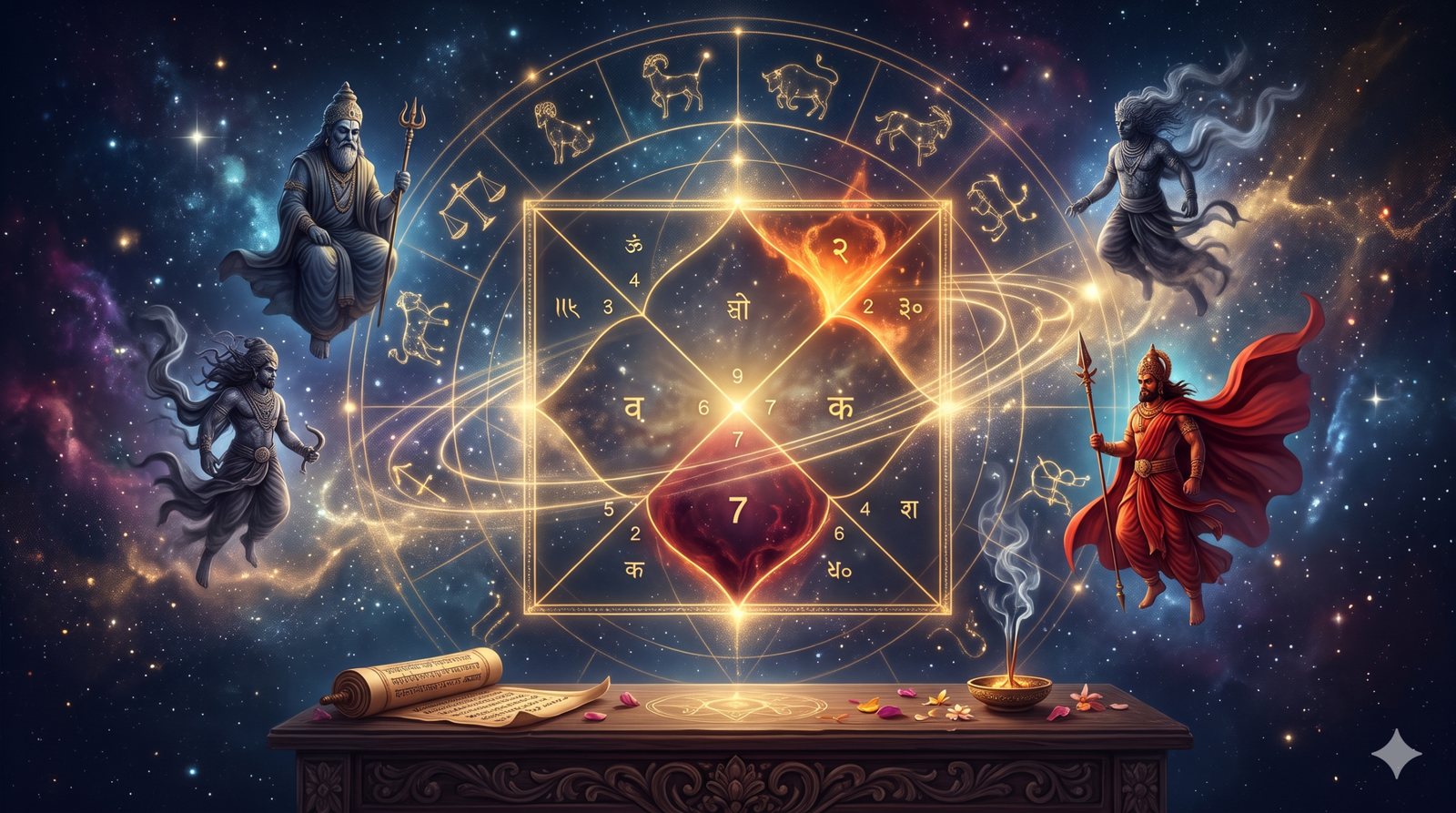
What Are Maraka Houses?
In Vedic astrology, the 2nd and 7th houses of a birth chart (Kundli) are known as Maraka Houses or Maraka Sthanas.
The Sanskrit word Maraka relates to death or the end of life. Astrologers classify these houses as Maraka because they are the 12th houses from the 3rd and 8th houses, which represent longevity.
The lords of these houses, along with certain planets linked to them, are also known as Maraka planets.
However, a Maraka planet does not automatically predict death. Its placement and planetary period may point to a sensitive phase involving health, challenges, or major life changes. Therefore, astrologers must examine the complete birth chart before drawing any conclusions.
What This Guide Covers
- What are Maraka Houses?
- Why are the 2nd and 7th houses considered Maraka?
- What makes a planet a Maraka planet?
- Maraka Lords for all 12 Ascendants
- Understanding Maraka Dasha
- Effects of Maraka Houses in your Kundli
- Traditional remedies and spiritual practices
- Common myths and frequently asked questions
Understanding Maraka Houses
- Maraka Houses: The 2nd and 7th houses are traditionally known as Maraka Sthanas.
- Meaning: Maraka is a Sanskrit term associated with death.
- Why these houses? They are the 12th houses from the 3rd and 8th houses, which relate to longevity.
- Primary Maraka: Astrologers generally consider the 2nd house lord the primary Maraka.
- Secondary Maraka: The 7th house lord generally acts as the secondary Maraka.
- Not a death prediction: A Maraka placement or Dasha does not guarantee death or a specific health outcome.
- Positive significations: The 2nd house represents wealth, speech, and family, while the 7th represents marriage and partnerships.
- Traditional remedies: Practices such as the Mahamrityunjaya Mantra, charity, and worship of one’s Ishta Devata offer traditional spiritual support.
What Are Maraka Houses in Vedic Astrology?
In Vedic astrology, Maraka Houses, also called Maraka Sthanas, are two houses that classical astrology links with serious challenges to longevity.
These houses are:
- 2nd House (Dhana Bhava): This house represents wealth, family, speech, and accumulated resources.
- 7th House (Kalatra Bhava): This house represents marriage, spouse, and partnerships.
The word Maraka comes from Sanskrit and traditionally relates to the concept of death.
Classical Jyotish texts discuss how the lords of the 2nd and 7th houses influence longevity analysis. However, modern astrologers often take a broader approach. They study the complete birth chart instead of making predictions from a single planetary placement.
Some traditional interpretations also link Maraka periods with sensitive phases involving health, medical treatment, hospitalisation, or major life changes. However, these ideas belong to traditional astrology and do not represent scientifically established predictions.
The Brihat Parashara Hora Shastra (BPHS), particularly the chapter referenced in the original research, is an important source for understanding Maraka principles.
Why Are the 2nd and 7th Houses Called Maraka Houses?
The traditional explanation comes from the principle of Bhavat Bhavam. This principle studies the relationship between houses by counting from one house to another.
In Vedic astrology, the 3rd and 8th houses relate to longevity. The 2nd and 7th houses are the 12th houses from them, respectively.
| House Associated with Longevity | 12th House from It | Classification |
|---|---|---|
| 3rd House (Secondary Longevity) | 2nd House | Maraka Sthana |
| 8th House (Primary Longevity) | 7th House | Maraka Sthana |
The 12th house is traditionally known as Vyaya Sthana. It represents loss or expenditure.
Therefore, astrologers connect a house that stands 12th from a longevity-related house with the idea of reducing or draining its significations.
This relationship forms the traditional basis for classifying the 2nd and 7th houses as Maraka Houses.
Is the 2nd House a Stronger Maraka Than the 7th?
Traditionally, astrologers consider the 2nd house lord the primary Maraka and the 7th house lord the secondary Maraka.
However, this classification does not mean the 2nd house lord always produces stronger results.
Instead, astrologers examine several factors:
- Planetary strength and dignity.
- Other house lordships.
- Association with natural malefic planets.
- Planetary aspects and conjunctions.
- The running Mahadasha and Antardasha.
As a result, the complete birth chart plays an important role in this interpretation.
Maraka Planets: What Makes a Planet a Maraka?
A planet can become associated with Maraka results in several ways.
According to the traditional principles covered in the original research, astrologers consider these main categories:
1. Primary Maraka: The 2nd House Lord
The lord of the 2nd house generally acts as the primary Maraka planet.
2. Secondary Maraka: The 7th House Lord
Similarly, the lord of the 7th house generally acts as the secondary Maraka planet.
3. Planets Associated with Maraka Lords
Other planets may also connect with Maraka influences through:
- Conjunction with the 2nd or 7th house lord.
- Planetary aspects on the 2nd or 7th house lord.
- Placement in the 2nd or 7th house.
4. Influence of Natural Malefic Planets
Traditional interpretations also examine natural malefic planets in or connected with Maraka Houses.
For example, Mars, Saturn, Rahu, and Ketu may add challenging influences. Their effects depend on their placements and relationships with the house lords.
5. Other Important Considerations
Some traditional interpretations also discuss these principles:
- Astrologers generally treat the Sun, Moon, and 9th house lord differently from ordinary Maraka planets. However, they must still examine the actual house lordship.
- Traditional astrology sometimes connects Saturn and Rahu with death-related significations.
- If a Maraka period does not coincide with the end of the longevity period described in a classical interpretation, other planetary factors may become relevant.
Furthermore, a Maraka planet may produce different results during different Mahadashas and Antardashas.
For example, astrologers may interpret its sub-period differently within a challenging planetary period than within a supportive one.
Important: These principles come from traditional astrological interpretations. Do not use them to predict someone’s death or medical condition.
Maraka Lords Based on Lagna (Ascendant)
Your Ascendant, also known as Lagna, determines which planets rule your 2nd and 7th houses.
The following table shows the traditional Maraka lords for all 12 Ascendants.
| Lagna (Ascendant) | 2nd Lord (Primary) | 7th Lord (Secondary) | Additional Note |
|---|---|---|---|
| Aries (Mesha) | Venus | Venus | One planet rules both Maraka houses |
| Taurus (Vrishabha) | Mercury | Mars | |
| Gemini (Mithuna) | Moon | Jupiter | |
| Cancer (Karka) | Sun | Saturn | Saturn also rules the 8th house |
| Leo (Simha) | Mercury | Saturn | |
| Virgo (Kanya) | Venus | Jupiter | |
| Libra (Tula) | Mars | Mars | Traditional exceptions appear in some texts |
| Scorpio (Vrishchika) | Jupiter | Venus | Venus also rules the 12th house |
| Sagittarius (Dhanu) | Saturn | Mercury | |
| Capricorn (Makara) | Saturn | Moon | Saturn also rules the Ascendant |
| Aquarius (Kumbha) | Jupiter | Sun | |
| Pisces (Meena) | Mars | Mercury |
This table uses the zodiac signs that rule the 2nd and 7th houses for each Ascendant.
However, some classical texts and commentaries discuss exceptions. For example, the original research cites the Bhavartha Ratnakara for an exception involving Mars for Libra Lagna, even though Mars rules both Maraka Houses.
Therefore, treat this table as a starting point rather than a complete prediction.
What Is the Difference Between Lagna and Moon Sign?
Your Lagna is the zodiac sign that rises on the eastern horizon at the time of your birth.
In contrast, your Moon Sign (Rashi) depends on the zodiac sign occupied by the Moon.
Both represent different reference points in a birth chart.
This guide uses the Lagna-based house system to identify Maraka lords. To find your Ascendant and planetary placements, use an accurately calculated birth chart with your date, exact time, and place of birth.
You can also generate your Free Kundli to identify your Ascendant and planetary placements.
Maraka Dasha: When Can Its Effects Be Activated?
In Vedic astrology, astrologers commonly study planetary periods through the Vimshottari Dasha system.
During a Maraka planet’s Mahadasha or Antardasha, astrologers may give that planet special attention.
First, understand these two terms:
- Mahadasha: The major planetary period.
- Antardasha (Bhukti): The sub-period that operates within a Mahadasha.
Each Mahadasha contains different Antardashas. Astrologers interpret their results by examining the relationship between the planets involved.
In addition, they may study planetary transits during these periods.
For example, traditional Maraka analysis may examine Saturn and Jupiter when they transit the 2nd or 7th house or connect with their lords.
Does Maraka Dasha Mean Danger or Death?
No. A Maraka Dasha does not automatically mean death or serious danger.
Instead, a traditional interpretation requires astrologers to examine several factors together.
1. Longevity Assessment
Classical texts discuss different categories of longevity, including:
- Alpayu: Short lifespan.
- Madhyayu: Medium lifespan.
- Purnayu: Full or longer lifespan.
However, these are traditional astrological classifications. They are not reliable medical or scientific assessments of an individual’s lifespan.
2. Examine the 8th House and Its Lord
The 8th house and its lord play an important role in traditional longevity analysis.
Astrologers also check whether the 8th house lord connects with a Maraka lord and whether either planet faces affliction.
3. Consider Planetary Transits
Transiting planets can provide additional context during a Dasha interpretation.
However, never treat a transit as proof of a future medical event.
4. Check the Strength of the Maraka Planet
A planet’s dignity, strength, and other house lordships can change its interpretation.
For example, a planet may also rule a Kendra or Trikona. In that case, astrologers must consider its additional significations.
5. Consider Ascendant-Specific Conditions
For Aries and Libra Ascendants, one planet rules both the 2nd and 7th houses.
Therefore, traditional interpretations may give that planet additional importance.
Even so, other planetary placements and house lordships can influence the final results.
Remember: Never assume that a particular Dasha predicts death, illness, or a medical emergency. Astrology cannot reliably determine these outcomes.
Effects of Maraka Houses in Your Kundli
Although Maraka Houses have a serious classification in traditional astrology, both houses also represent important parts of everyday life.
Let’s look at their usual significations and the themes astrologers may examine during Maraka-related periods.
1. The 2nd House (Dhana Bhava)
The 2nd house represents:
- Money and accumulated wealth.
- Family and family values.
- Speech and communication.
- Food and eating habits.
- Face, mouth, and throat in traditional body-part associations.
When challenging influences affect the 2nd house or its lord, traditional interpretations may focus on:
- Financial pressure or unexpected expenses.
- Family disagreements.
- Harsh speech or communication difficulties.
- Concerns related to eating habits.
However, a well-supported 2nd house may also contribute to wealth and stability through favourable combinations, including Dhana Yogas.
2. The 7th House (Kalatra Bhava)
The 7th house represents:
- Marriage and spouse.
- Long-term relationships.
- Business partnerships.
- Agreements and public relationships.
During periods of challenging influences on the 7th house, astrologers may examine:
- Changes or pressure in marriage.
- Disagreements in business partnerships.
- Relationship responsibilities.
- Traditional concerns involving the spouse’s well-being.
For example, when Mars rules or occupies the 7th house, astrologers may also consider Kuja Dosha.
However, no single placement should predict relationship failure or a partner’s health.
Effects of Planets in Maraka Houses
The following table summarises common traditional interpretations of planets placed in the 2nd or 7th house.
| Planet | Possible Traditional Themes |
|---|---|
| Saturn | Delays, discipline, and long-term pressure involving family or partnerships |
| Mars | Sharp speech, impulsive behaviour, and Kuja Dosha considerations |
| Rahu / Ketu | Unusual changes involving money, family, or relationships |
| Sun | Ego-related disagreements involving family finances or partnerships |
| Venus / Jupiter / Mercury | Supportive influences may appear, although astrologers must still examine their Maraka house associations |
These interpretations provide only a general overview. The sign, house lordship, planetary strength, aspects, conjunctions, and running Dasha can all change the results.
For further reading, consult the references from the original research, including AstroMedha and Jagannath Hora.
Traditional Remedies for Maraka Periods
Vedic astrology includes several traditional Upayas, or spiritual practices, that people may follow during challenging planetary periods.
These practices generally aim to provide spiritual comfort and encourage discipline.
However, they should never replace medical treatment, professional advice, or practical decision-making.
1. Mahamrityunjaya Mantra
The Mahamrityunjaya Mantra is one of the best-known Shiva mantras in Hindu tradition.
It appears in the Rig Veda (7.59.12). Traditionally, people associate it with protection, spiritual strength, and overcoming fear.
Some traditions recommend chanting it 108 times daily.
2. Worship the Deity Associated with the Planet
Some traditions recommend worshipping the deity associated with the active Dasha planet.
For example, people traditionally associate the Aditya Hridayam Stotra with the Sun.
3. Worship Your Ishta Devata
Regular prayer to your Ishta Devata, or personally chosen deity, is another traditional spiritual practice.
In addition, some people light a diya as part of their daily worship.
4. Charity and Donations
Jyotish traditions commonly recommend charity.
Depending on their belief system, people may donate food, clothing, or other useful items associated with a particular planet.
5. Meditation and Healthy Living
A healthy daily routine can support your general well-being.
For example, regular medical check-ups, adequate sleep, balanced food, and stress management are useful practices regardless of planetary periods.
6. Gemstones
Some astrologers recommend gemstones after examining planetary strength and birth-chart conditions.
However, do not buy a gemstone simply because someone labels a planet as Maraka. Consult a knowledgeable astrologer before following such recommendations.
Also, remember that science has not proven gemstones to be effective remedies.
Common Myths About Maraka Houses
People often misunderstand Maraka Houses and their role in Vedic astrology. Let’s clear up some common myths.
Myth 1: The Dasha of the 2nd or 7th house lord means death.
Fact: A Maraka Dasha does not guarantee death. Traditional interpretations examine several birth-chart factors together.
Myth 2: Maraka planets are always negative.
Fact: These planets can also rule houses linked to wealth, family, marriage, and partnerships. Their results depend on the complete birth chart.
Myth 3: Spiritual remedies can change destiny.
Fact: People follow traditional remedies as spiritual practices and sources of support. However, science has not proven them to be methods of changing future events.
Myth 4: Only astrologers can identify Maraka planets.
Fact: You can identify the traditional Maraka lords from your Ascendant and the rulers of the 2nd and 7th houses. However, interpreting their results requires a broader understanding of the birth chart.
How to Find Your Maraka Houses in 3 Steps
You can identify your Maraka Houses by following these three simple steps.
Step 1: Generate an Accurate Kundli
First, use your date of birth, exact birth time, and birthplace to generate your birth chart.
Step 2: Identify Your Lagna
Next, find your Ascendant and identify the zodiac signs that occupy your 2nd and 7th houses.
Then, use the table above to identify their planetary rulers.
Step 3: Check Your Vimshottari Dasha
Finally, examine your Mahadasha and Antardasha timeline.
Also, note the planets placed in or aspecting the 2nd and 7th houses.
For a more detailed interpretation, consider the complete birth chart and consult an experienced Jyotishi.
Frequently Asked Questions About Maraka Houses
1. What are Maraka Houses in Vedic Astrology?
The 2nd and 7th houses are traditionally known as Maraka Houses. They are the 12th houses from the 3rd and 8th houses, which relate to longevity in Vedic astrology.
2. Which planets are considered Maraka planets?
The lords of the 2nd and 7th houses are the main planets associated with Maraka. Other planets may also connect with them through conjunctions, aspects, or placement in these houses.
3. Is the 2nd house or 7th house a stronger Maraka?
Traditionally, astrologers consider the 2nd house lord the primary Maraka and the 7th house lord the secondary Maraka. However, their actual strength depends on planetary dignity, associations, and other birth-chart conditions.
4. Does Maraka Dasha mean death?
No. Maraka Dasha does not automatically indicate death. Traditional astrology considers longevity classifications, the 8th house, its lord, planetary strength, and transits before interpreting these periods.
Astrology cannot reliably predict an individual’s lifespan or medical outcomes.
5. Are the Sun and Moon Maraka planets?
Traditional interpretations often treat the Sun, Moon, and 9th house lord differently from ordinary Maraka planets.
However, astrologers must still examine actual house lordship. For example, the Sun rules the 2nd house for Cancer Ascendant, so it can have a Maraka association in that chart.
6. Can one planet become the Maraka lord for both houses?
Yes. For Aries Ascendant, Venus rules both the 2nd and 7th houses. Similarly, for Libra Ascendant, Mars rules both houses.
Traditional interpretations may give these planets additional importance.
7. What are the traditional remedies for Maraka Dasha?
Commonly discussed spiritual practices include the Mahamrityunjaya Mantra, worship of the deity associated with the Dasha lord, charity, and prayer to one’s Ishta Devata.
However, understand these practices as spiritual support, not as substitutes for medical care or professional advice.
8. How can I find my Maraka planet?
First, identify your Lagna. Then, find the zodiac signs occupying your 2nd and 7th houses and identify their ruling planets.
You can use the Ascendant-wise table in this article as a starting point.
9. What is the difference between Maraka and Badhaka?
Both concepts appear in traditional Vedic astrology, but astrologers calculate them differently.
- Maraka: Primarily associated with the 2nd and 7th houses.
- Badhaka: Determined by the type of Ascendant sign, whether movable, fixed, or dual.
Therefore, astrologers study Badhaka as a separate area of classical astrological analysis.
Conclusion
Maraka Houses play an important role in traditional Vedic astrology. The 2nd and 7th houses receive this classification because of their relationship with the houses associated with longevity.
The 2nd house represents wealth, family, and speech. Meanwhile, the 7th house represents marriage, partnerships, and relationships.
Although the term Maraka has a serious traditional meaning, it does not guarantee death or illness.
To understand these placements, examine house lords, planetary strength, aspects, conjunctions, and running Dasha together.
Most importantly, approach Maraka analysis with care. Avoid making serious life or health decisions based only on astrological predictions.
Sources and Further Reading
Classical texts and references
- Brihat Parashara Hora Shastra, Wisdomlib
- Brihat Parashara Hora Shastra, Bharatpedia
- BPHS English translation (R. Santhanam), Internet Archive
- Bhavartha Ratnakara, Internet Archive
- Maraka (Hindu astrology), Wikipedia
Maraka and dasha explainers
- Maraka Dashas Explained According to Parashara Siddhanta, HinduTone
- Maraka Planets, Planetary Positions
- Maraka Planet Calculator, PanchangBodh
- How to Read Your Current Antardasha, Satyori
- Mahadasha Guide, Ishvaram
Houses and planets


