
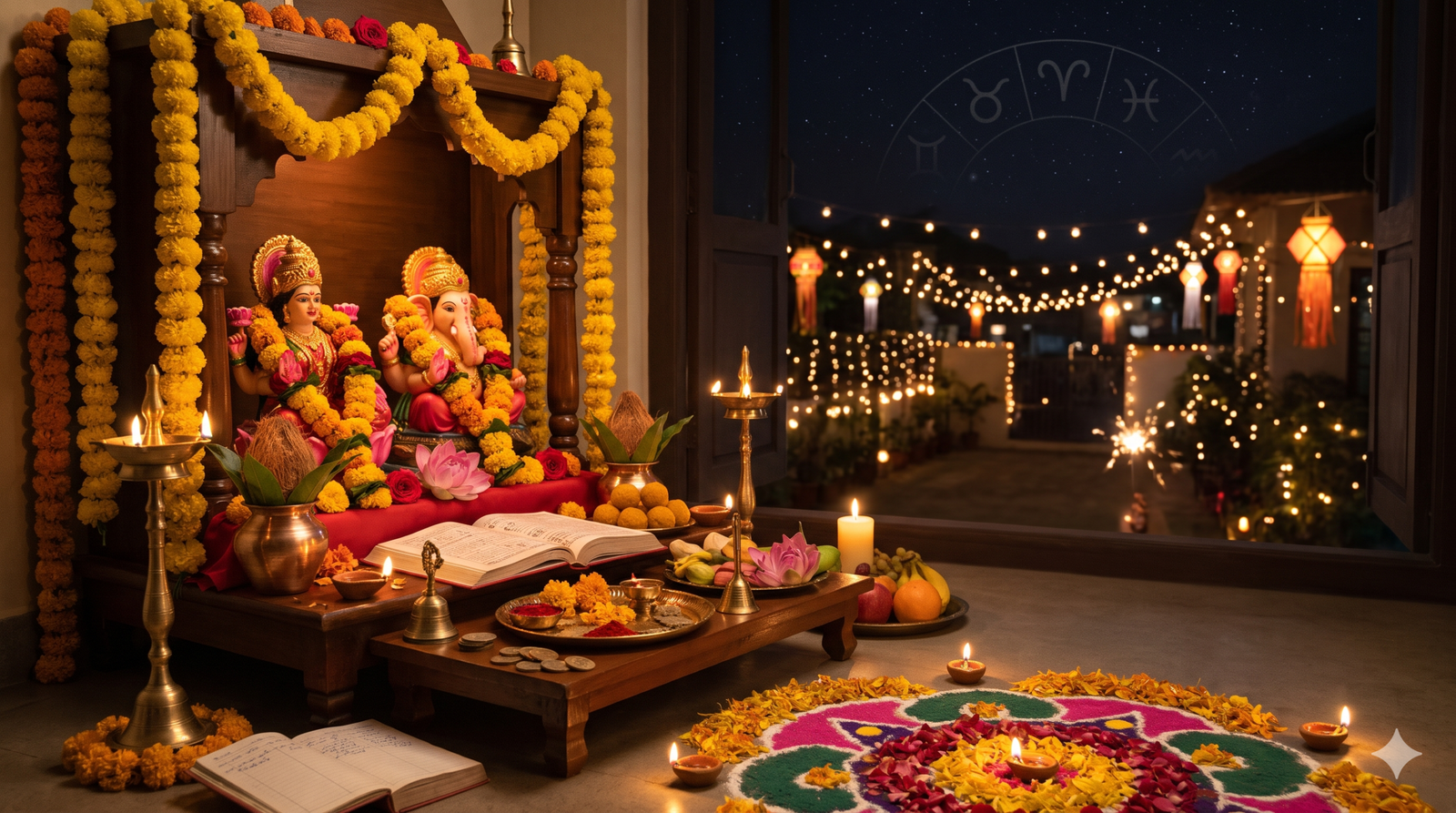
Diwali 2026 falls on Sunday, 8 November, during Kartik Amavasya. In New Delhi, the suggested Lakshmi Puja muhurat is 5:54 PM to 7:50 PM IST, during Vrishabha Kaal. Pradosh Kaal is approximately 5:31 PM to 8:09 PM. Amavasya begins at 11:27 AM on 8 November and ends at 12:31 PM on 9 November.
These timings may vary by location. Please check a local Panchang before performing the puja.
Updated: 5 November 2026 | Read time: 8 minutes
Overview of Diwali 2026
Here are the key details for Diwali 2026:
| Event | Date or Timing |
|---|---|
| Diwali | Sunday, 8 November 2026 |
| Tithi | Kartik Amavasya (New Moon) |
| Lakshmi Puja Muhurat | 5:54 PM to 7:50 PM IST (New Delhi) |
| Pradosh Kaal | Approximately 5:31 PM to 8:09 PM IST (New Delhi) |
| Amavasya Begins | 11:27 AM on 8 November 2026 |
| Amavasya Ends | 12:31 PM on 9 November 2026 |
| Mahanishita Kaal | Approximately 11:39 PM to 12:31 AM |
| Festival Period | Dhanteras (6 November) to Bhai Dooj (10 November) |
| Main Deities | Goddess Lakshmi and Lord Ganesha |
Diwali 2026 falls on a Sunday, which may make it easier for families to perform the main puja together. Dhanteras will take place on Friday, 6 November.
Lakshmi Puja Muhurat 2026
Families traditionally perform Lakshmi Puja in the evening during Pradosh Kaal, the twilight period after sunset.
Panchang providers, such as Drik Panchang, calculate the muhurat by considering three factors:
- Pradosh Kaal
- Amavasya Tithi
- Sthir Lagna
Lakshmi Puja Timings in New Delhi
| Puja Period | Timing |
|---|---|
| Lakshmi Puja Muhurat (Vrishabha Kaal) | 5:54 PM to 7:50 PM IST |
| Pradosh Kaal | Approximately 5:31 PM to 8:09 PM IST |
| Mahanishita Kaal | Approximately 11:39 PM to 12:31 AM |
Lakshmi Puja Timings in Different Cities
The muhurat depends on local sunset and the rising sign. Therefore, timings may differ from city to city.
| Location | Lakshmi Puja Timing (IST) | Source |
|---|---|---|
| New Delhi | 5:54 PM to 7:50 PM | Drik Panchang |
| Ujjain | 6:09 PM to 8:07 PM | Dharmayana Panchang |
| Surat | 6:29 PM to 8:29 PM | Shubh Panchang |
Different Panchangs may use different reference points or round their timings. For this reason, check a reliable Panchang for your own city before performing the puja.
What Time Should My Family Use?
Traditionally, families perform Lakshmi Puja during Pradosh Kaal. Ideally, choose a time that also falls within Vrishabha Lagna.
You can use Choghadiya timings as a general guide. However, local Panchang timings should take priority.
Why Is Diwali on 8 November?
Some calendars may show different dates for Diwali because Amavasya continues across two calendar days.
However, traditional sources such as Dharmasindhu and Nirnayasindhu associate Lakshmi Puja with the day when Amavasya falls during Pradosh Kaal.
In 2026:
- Amavasya begins at approximately 11:27 AM on 8 November.
- Amavasya ends at approximately 12:31 PM on 9 November.
Therefore, Pradosh Kaal falls within Amavasya on 8 November. This is why Lakshmi Puja is observed on that date.
The following day, 9 November, is associated with Govardhan Puja and Balipratipada.
Amavasya Tithi
Amavasya refers to the New Moon night. During this phase, the Sun and Moon share the same longitude, and the Moon is not visible from Earth.
Diwali takes place during Kartik Amavasya in the Hindu calendar. In the Amanta calendar, this falls during Krishna Paksha, the dark half of the lunar cycle.
Celebrating the festival of lights on the darkest night may seem unusual. However, this darkness holds symbolic meaning in Hindu tradition.
Why Is Amavasya Important?
- Light in darkness: Since the Moon is not visible, each diya becomes a symbol of light and hope.
- New beginnings: After Amavasya, the Moon begins to wax again. This marks the start of a new lunar cycle.
- Inner reflection: Some spiritual teachers connect the dark night with ignorance, or avidya. The diya then represents knowledge and awareness.
Astrology of Diwali 2026: Sun and Moon in Libra
According to sidereal (Vedic) astrology, the Sun will be in Libra, also known as Tula Rashi, during Diwali 2026.
The Moon joins the Sun during the New Moon, creating a Sun-Moon conjunction in Libra. According to the Panchang sources cited in the original article, the Moon will also pass through Swati Nakshatra in Libra.
Astrological Themes to Note
- Libra and Venus: Venus (Shukra) rules Libra. Astrologers associate Venus with prosperity, beauty, comfort, and love. These themes connect with the festival’s focus on Goddess Lakshmi.
- Balance: Libra represents balance in traditional astrology. This idea may connect with reflections on wealth, harmony, and responsibility.
- Swati Nakshatra: Rahu rules Swati Nakshatra, while its deity is Vayu, the wind god. Astrologers often associate Swati with independence, trade, and personal progress.
- A new cycle: The Sun-Moon conjunction during Amavasya traditionally represents a fresh start.
A Balanced Astrological View
Some astrologers note that the Sun is traditionally considered debilitated in Libra. This can lead to different interpretations of Diwali’s astrological significance.
However, many festival interpretations focus on Venus, prosperity, and the symbolism of Goddess Lakshmi.
Astrology is a traditional practice and may serve as a tool for reflection. Since every person has a different Kundli, general interpretations do not apply equally to everyone.
Sthir Lagna: Why Vrishabha Is Preferred
Lagna refers to the zodiac sign rising in the eastern sky at a particular time.
The four Sthir, or fixed, Lagnas are:
- Taurus (Vrishabha)
- Leo (Simha)
- Scorpio (Vrishchika)
- Aquarius (Kumbha)
Traditionally, people believe that performing Lakshmi Puja during a fixed Lagna helps preserve prosperity in the home.
During Diwali evening, Vrishabha Lagna often falls within Pradosh Kaal. This is why many householders consider it the preferred time for Lakshmi Puja.
Some families and businesses may also choose Simha Lagna after midnight. Meanwhile, practitioners who follow tantric traditions or Kali worship may observe Mahanishita Kaal.
If you miss the evening muhurat, many priests recommend performing the puja at another suitable time with devotion. You can also consult your family priest for guidance.
Diwali 2026: Five-Day Calendar
The Diwali festival includes several observances across five days.
| Day | Date | Festival or Observance |
|---|---|---|
| 1 | 6 November 2026, Friday | Dhanteras: worship of Dhanvantari, Yama Deepam, and purchase of metals or utensils |
| 2 | 7 November 2026, Saturday | Naraka Chaturdashi or Choti Diwali; Kali Chaudas and Hanuman Puja in some regions |
| 3 | 8 November 2026, Sunday | Diwali and Lakshmi Puja; Kali Puja, Sharda Puja, and Chopda Pujan in some regions |
| 4 | 9 November 2026, Monday | Govardhan Puja or Balipratipada |
| 5 | 10 November 2026, Tuesday | Bhai Dooj |
Festival names and customs vary by region.
For example, Nepal celebrates Tihar, which includes days dedicated to crows, dogs, and cows. In Bengal and parts of eastern India, people celebrate Kali Puja on the same night as Diwali.
Spiritual Significance of Diwali
Diwali has many stories and traditions. Different communities focus on different events, but the festival often represents the victory of light over darkness.
1. Return of Lord Rama
One of the most popular stories links Diwali with Lord Rama’s return to Ayodhya after 14 years of exile and his victory over Ravana.
According to the tradition, the people of Ayodhya lit rows of lamps to welcome him home.
2. Goddess Lakshmi and Samudra Manthan
Another tradition connects Goddess Lakshmi with the churning of the cosmic ocean, known as Samudra Manthan.
People believe that Lakshmi visits clean and brightly lit homes on Diwali night. For this reason, families perform Lakshmi Puja.
Many households worship Lord Ganesha alongside Lakshmi. They seek wisdom and guidance along with prosperity.
3. Krishna and Narakasura
Many regions celebrate the previous day, Naraka Chaturdashi, to mark Lord Krishna’s victory over the demon Narakasura.
4. Return of the Pandavas
Some traditions state that the Pandavas returned from exile on Kartik Amavasya.
5. Jain and Sikh Observances
In Jainism, Diwali marks the day Lord Mahavira attained nirvana.
In Sikhism, people celebrate Bandi Chhor Divas during this period. The observance remembers the release of Guru Hargobind.
The Overall Message of Diwali
These stories share common themes:
- Light over darkness
- Knowledge over ignorance
- Dharma over adharma
Many spiritual teachers also focus on the festival’s inner meaning. Goddess Lakshmi represents more than money. She can also symbolize happiness, grace, and abundance of character.
A popular prayer associated with this theme is:
“Tamaso Ma Jyotir Gamaya”
This means, “Lead me from darkness to light.”
Lakshmi Puja Checklist
This checklist offers a general guide. Rituals vary between families and regions, so follow your family’s customs or consult your priest.
Before the Puja
- Clean your home and create a rangoli at the entrance.
- Place pictures or idols of Lakshmi and Ganesha on a clean platform.
- Prepare diyas, flowers, incense, sweets, fruit, rice, kumkum, and coins.
During the Puja
- Begin by praying to Lord Ganesha.
- Offer prayers to Goddess Lakshmi.
- Light the diyas and chant a mantra, such as Om Shreem Mahalakshmyai Namah.
- Finish with an aarti and offer prasad.
After the Puja
- Place lit diyas near doors, windows, and balconies.
- Share sweets with family members, neighbours, and people in need.
Tip: Focus on gratitude and devotion rather than the number of decorations or offerings.
Frequently Asked Questions
When is Diwali in 2026?
Diwali 2026 falls on Sunday, 8 November, during Kartik Amavasya.
What is the Lakshmi Puja muhurat?
In New Delhi, the suggested Lakshmi Puja muhurat is 5:54 PM to 7:50 PM IST on 8 November 2026.
Timings vary by location. For example, the original article lists Ujjain’s muhurat as approximately 6:09 PM to 8:07 PM.
When does Amavasya begin and end?
In New Delhi, Amavasya begins at approximately 11:27 AM on 8 November and ends at 12:31 PM on 9 November 2026.
What is Pradosh Kaal?
Pradosh Kaal is the twilight period after sunset. It lasts around 2 hours and 24 minutes.
Traditionally, families perform Lakshmi Puja during this period while Amavasya is in effect.
What is Sthir Lagna?
Sthir Lagna refers to a fixed zodiac sign rising in the east. Vrishabha, or Taurus, is one example.
Traditionally, people believe that performing Lakshmi Puja during a fixed Lagna helps preserve prosperity and blessings in the home.
Is Diwali on 8 or 9 November 2026?
Lakshmi Puja falls on 8 November because Amavasya overlaps with Pradosh Kaal on that date.
Amavasya ends before sunset on 9 November.
What is the astrological significance of Diwali 2026?
According to sidereal astrology, the Sun and New Moon will be in Libra, a sign ruled by Venus.
Astrologers associate Libra with balance, harmony, and prosperity. The Moon will also be in Swati Nakshatra, according to the Panchang details cited in this article.
Why is Diwali celebrated on the darkest night?
Amavasya is the New Moon night, when the Moon is not visible.
Traditionally, the lamps represent hope, knowledge, and new beginnings during darkness.
Can I perform Lakshmi Puja after midnight?
Many traditions prefer Lakshmi Puja during Pradosh Kaal.
However, some families and practitioners observe Mahanishita Kaal, which is approximately 11:39 PM to 12:31 AM in New Delhi. Some also use Simha Kaal after midnight.
Consult your family priest for guidance.
When is Dhanteras in 2026?
Dhanteras falls on Friday, 6 November 2026.
Final Thoughts
Diwali 2026 falls on a New Moon night and a Sunday. The evening Pradosh period also overlaps with the traditional Lakshmi Puja muhurat.
According to sidereal astrology, the Sun will be in Libra, a sign ruled by Venus.
Whether you follow the muhurat closely or simply light a diya with your family, the festival offers a chance to reflect on positivity, gratitude, and generosity.
Next Steps
Check the muhurat for your city using a trusted Panchang. Prepare for the puja ahead of time, and consider sharing the festival with someone who may be celebrating alone.
Disclaimer: This article is for cultural, educational, and informational purposes only. Muhurat timings may vary by location and calculation method. Astrological interpretations reflect traditional beliefs and are not scientifically proven. They should not replace professional advice.
Sources and Further Reading
- Drik Panchang: Lakshmi Puja timings for your city, the primary panchang reference for city-wise muhurat
- Wikipedia: Diwali, 2026 festival dates and regional names
- Wikipedia: Lakshmi Puja, traditions and regional variations
- Wikipedia: Kali Puja, the same-night observance in Bengal and eastern India
- Britannica: Diwali, general background on the festival
- Dharmayana: Diwali 2026 date and muhurat, Ujjain-based timings and the 8-vs-9 November explanation
- HinduTone: Astrology of Diwali 2026, Sun-Moon in Libra interpretation
- Brut India: Diwali 2026 date and puja timings, New Delhi tithi and muhurat summary