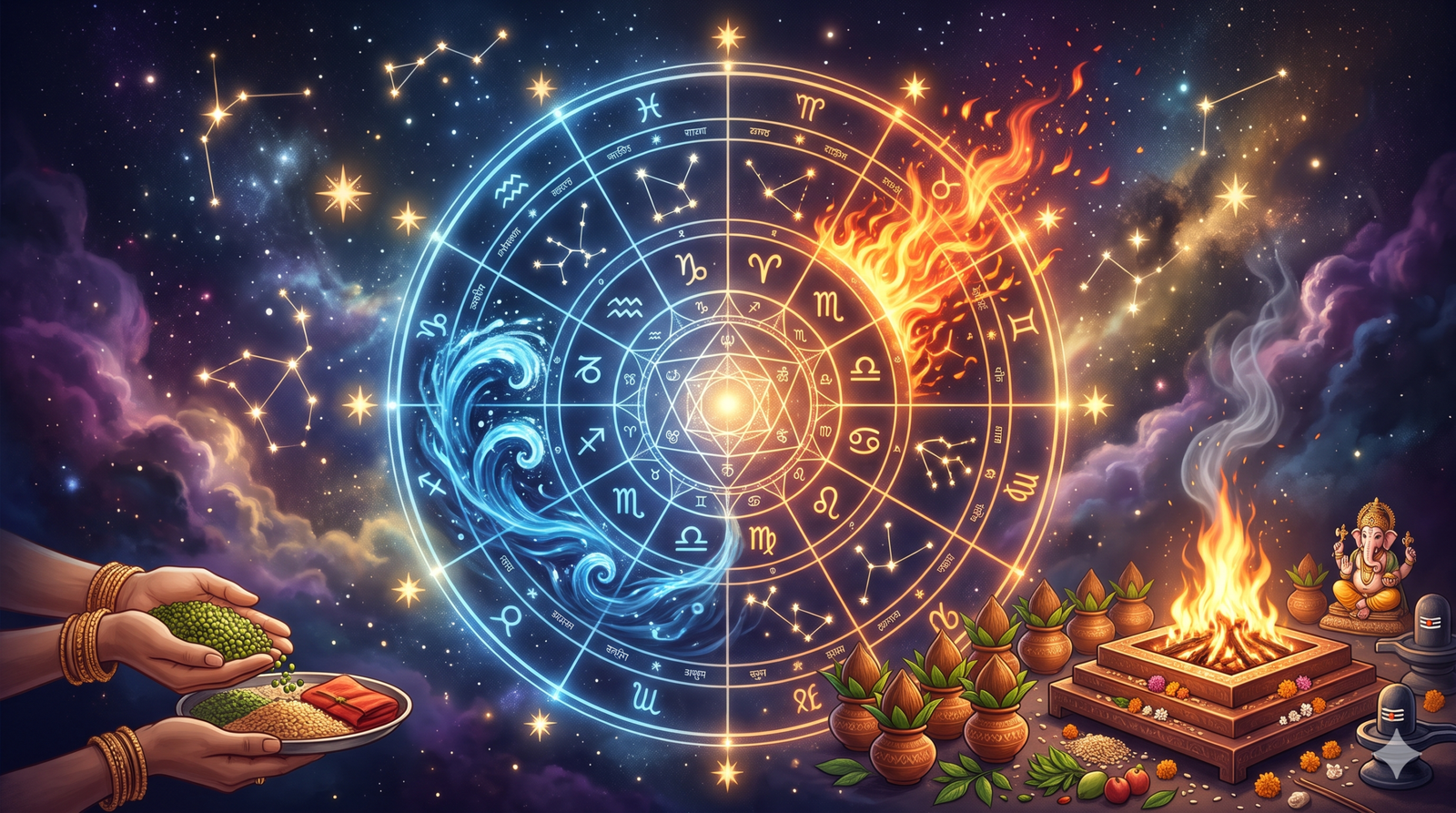
Gandmool Nakshatra refers to a birth in which the Moon falls in one of six Nakshatras: Ashwini, Ashlesha, Magha, Jyeshtha, Moola, or Revati.
In Vedic astrology, these Nakshatras are seen as sensitive. Some traditional beliefs link them to challenges in early childhood or concerns about family members. However, astrologers may also consider the full birth chart before reaching a conclusion.
Some families perform Gandmool Shanti Puja to follow this tradition. They often choose the 27th day after birth, when the Moon returns to the birth Nakshatra. Still, Gandmool does not mean that a child is cursed or destined for a difficult life.
What Is Gandmool Nakshatra?
Gandmool Nakshatra, also called Gand Mool, Ganda Mool, or Ganda Moola, is a concept in Vedic astrology, also known as Jyotish. It applies when the Moon sits in one of six specific Nakshatras at birth.
These Nakshatras lie around the junctions between water and fire signs. Therefore, some traditional astrologers view them as sensitive points in the zodiac.
The term also has a symbolic meaning. According to the etymology discussed by Ask Ayurveda, Gand means a knot or joint, while Mool means a root or beginning. Together, the words describe a point where one phase ends and another begins.
Two main factors help explain Gandmool:
- Birth Nakshatra: The Moon’s position at birth determines whether a person falls under this classification.
- Pada: Each Nakshatra has four parts, called padas. As a result, traditional interpretations can differ depending on the Moon’s exact position.
The Six Gandmool Nakshatras
Each of the 27 Nakshatras covers 13°20′ of the zodiac. In the Vimshottari Dasha system, each Nakshatra also has a ruling planet.
Among these 27 Nakshatras, six form the Gandmool group. Ketu rules three of them, while Mercury rules the other three.
| Nakshatra | Sidereal Range | Ruling Planet | Presiding Deity | Zodiac Junction |
|---|---|---|---|---|
| Ashwini | 0°–13°20′ Aries | Ketu | Ashwini Kumaras | Pisces to Aries |
| Ashlesha | 16°40′–30° Cancer | Mercury | Nagas | Cancer to Leo |
| Magha | 0°–13°20′ Leo | Ketu | Pitris | Cancer to Leo |
| Jyeshtha | 16°40′–30° Scorpio | Mercury | Indra | Scorpio to Sagittarius |
| Moola | 0°–13°20′ Sagittarius | Ketu | Nirriti | Scorpio to Sagittarius |
| Revati | 16°40′–30° Pisces | Mercury | Pushan | Pisces to Aries |
Source note: The original draft attributes the planetary rulers and ranges to Dekho Panchang and Ishvaram. It lists Ishvaram and RoxyAPI for the presiding deities. Please verify the details against these sources before publishing.
You can remember the ruling planets with this simple guide:
- Ketu: Ashwini, Magha, and Moola.
- Mercury: Ashlesha, Jyeshtha, and Revati.
Why Are These Six Nakshatras Considered Sensitive?
The zodiac has three water signs: Cancer, Scorpio, and Pisces. It also has three fire signs: Aries, Leo, and Sagittarius.
According to one traditional explanation, the six Gandmool Nakshatras occur around the points where these water and fire signs meet. Astrologers who follow this view consider the change between elements a sensitive point in the zodiac.
The Nakshatras form three pairs:
- Revati and Ashwini: Pisces to Aries.
- Ashlesha and Magha: Cancer to Leo.
- Jyeshtha and Moola: Scorpio to Sagittarius.
Together, these six Nakshatras make up 6 out of 27, or about 22%, of the total. Therefore, birth in a Gandmool Nakshatra is not rare.
Gandmool Effects by Pada
Some classical texts and later astrological guides link each Nakshatra and pada with certain family members. The table below summarizes the traditional associations described in the original article.
| Nakshatra | Family Member or Area | Traditional Interpretation |
|---|---|---|
| Ashwini | Father | Some sources link it to concerns about the father’s health or career, especially in Pada 1. |
| Ashlesha | Mother or mother-in-law | Some interpretations mention concerns about the mother’s health or tension with in-laws. |
| Magha | Mother and family | Traditional sources link it to concerns about the mother’s health. |
| Jyeshtha | Elder siblings | Some interpretations mention possible strain in sibling relationships. |
| Moola | Father and family wealth | Some sources describe it as one of the more feared placements. |
| Revati | General well-being | It is often viewed as milder and linked with Pushan, a deity associated with nourishment and safe passage. |
Source note: The original article lists the Dekho Panchang Learning Module, Boldsky, and SmartPuja for these interpretations.
Why Do the Interpretations Differ?
Not all astrology sources agree on the effects of each pada. For example, some say the first pada of Ashlesha has no negative effects. Others link concerns to the third and fourth padas.
Moola also has several interpretations. Some sources link its first pada to the father, the second to the mother, the third to ancestral property, and the fourth to happiness and success.
For this reason, treat these lists as traditional beliefs rather than certain predictions. Some modern astrologers also examine the full birth chart, including planetary aspects, dashas, and house strength.
Positive Qualities Linked to Gandmool Births
Many articles focus on the concerns linked to Gandmool. However, traditional astrology also connects these Nakshatras with positive qualities.
Intelligence and Curiosity
Some interpretations link these Nakshatras with intelligence, deep thinking, curiosity, and spiritual interests.
Leadership and Determination
People born under these Nakshatras are sometimes described as determined, independent, and willing to take responsibility.
Strengths of Individual Nakshatras
Each Nakshatra has its own traditional qualities:
- Ashwini: Quick action, healing, and new beginnings.
- Magha: Leadership, authority, and links with ancestors.
- Jyeshtha: Protection, responsibility, and seniority.
- Moola: Research, investigation, and a search for deeper meaning.
- Revati: Care, guidance, and safe passage.
These meanings vary across astrological traditions. Most importantly, the word sensitive does not automatically mean unlucky.
Gandmool vs. Gandanta: What Is the Difference?
Gandmool and Gandanta sound similar, but they describe different concepts in Vedic astrology.
| Feature | Gandmool | Gandanta |
|---|---|---|
| Meaning | A classification involving six Nakshatras | A sensitive area near certain zodiac sign junctions |
| Area covered | The full span of a listed Nakshatra | A smaller area around a sign junction |
| Example | The Moon in Ashwini falls under Gandmool | The Moon near the Pisces–Aries junction may be checked for Gandanta |
For example, a Moon placement at 10° Aries falls within Ashwini Nakshatra. Therefore, it counts as Gandmool under this system. However, the placement does not automatically count as Gandanta.
Some traditional sources describe the junction area as more sensitive than the middle parts of the relevant Nakshatras. The exact degrees and rules can vary, so check the tradition you follow.
Common Myths About Gandmool Nakshatra
Myth 1: Gandmool Babies Are Unlucky or Cursed
Fact: Gandmool is a traditional astrological classification. Some families follow rituals linked to it, but the placement does not prove that a child is unlucky or cursed.
Myth 2: Gandmool Always Causes Problems for Parents
Fact: Some traditional interpretations link certain Nakshatras and padas with family concerns. However, sources differ, and these links do not guarantee that problems will occur.
Myth 3: The Father Must Not See the Baby
Fact: Some traditions advise keeping the baby away from the father for a set period, often 12 to 27 days. The timing may depend on the pada and local custom. Practices vary, and many families do not follow this restriction.
Myth 4: The Puja Will Not Work After the 27th Day
Fact: Some traditions allow the ritual when the birth Nakshatra returns, on the child’s birthday, or later in life. Families can ask a trusted practitioner about the timing followed in their region.
Myth 5: Gandmool and Gandanta Are the Same
Fact: They are different concepts. Gandmool covers six specific Nakshatras, while Gandanta refers to certain sensitive zodiac junctions.
Myth 6: Gandmool Births Are Rare
Fact: Six of the 27 Nakshatras belong to this group. That equals about 22% of the total.
Myth 7: Gandmool Determines a Person’s Entire Life
Fact: Many astrologers also examine planetary placements, dashas, and house strength. Therefore, they do not rely on Gandmool alone to interpret a person’s life.
Gandmool Shanti Puja: Traditional Remedies
Gandmool Shanti Puja is a ritual that some families perform to address concerns linked to Gandmool within their astrological tradition.
People may also call it Mool Shanti, Nakshatra Shanti, or Sataisa Puja. The name and procedure can vary by region.
When Should You Perform Gandmool Shanti Puja?
Some traditions recommend the 27th day after birth. This timing relates to the Moon’s journey through the 27 Nakshatras.
However, if the family cannot perform the puja that day, some traditions allow it when the birth Nakshatra returns, on the child’s birthday, or later in life.
What Happens During the Puja?
The ritual depends on the family, region, birth Nakshatra, and priest. Common practices include:
- Shanti Puja or Homa: A priest performs the ceremony according to the chosen tradition.
- Mantra chanting: The priest may recite mantras linked to the presiding deity of the birth Nakshatra.
- Charity or daan: Some traditions recommend charitable giving and feeding Brahmins.
- Nakshatra-specific rituals: The ceremony may differ according to the Nakshatra. For example, some sources describe the Revati ritual as simpler than the Moola Shanti Maha Puja.
Before arranging a ceremony, ask the priest to explain the steps, costs, and customs involved.
Practical Tips for Parents
If you are worried about a child’s Gandmool placement, these steps may help you approach the subject calmly.
- Confirm the birth details. Check the date, exact time, and place of birth. These details help determine the Moon’s Nakshatra and pada.
- Ask for a clear explanation. A trusted practitioner should explain the traditional meaning without creating unnecessary fear.
- Understand the ritual first. Ask which ceremonies the priest will perform and why the family might choose them.
- Avoid fear-based claims. Be cautious if someone pressures you into expensive rituals by making frightening predictions.
- Prioritize practical care. Astrology is a belief-based tradition. It should never replace medical care or emotional support.
Gandmool and Muhurta
Some Panchangs mark Gandmool periods because certain traditions avoid these times for weddings, housewarmings, or new business activities.
However, customs differ by region and tradition. If you are choosing a date for an important event, consult a local Panchang and follow the guidance that suits your family’s practice.
How to Check Whether You Have Gandmool Nakshatra
You can check your birth Nakshatra in a few steps.
- Find your date of birth, exact birth time, and place of birth.
- Create a sidereal Vedic birth chart using these details.
- Look for the Moon’s birth Nakshatra and pada.
- Check whether the Nakshatra is Ashwini, Ashlesha, Magha, Jyeshtha, Moola, or Revati.
- If it belongs to this group, you can consult a knowledgeable astrologer about its traditional meaning in the full chart.
You can also use a local Panchang to check when the Moon passes through these Nakshatras. The original article suggests Drik Panchang’s Gandamool Times and Dekho Panchang’s Ganda Mool Dates as starting points.
Frequently Asked Questions
What does Gandmool Nakshatra mean?
Gandmool Nakshatra refers to a birth in which the Moon is in Ashwini, Ashlesha, Magha, Jyeshtha, Moola, or Revati. In Vedic astrology, some traditions view these Nakshatras as sensitive.
What are the six Gandmool Nakshatras?
The six are Ashwini, Ashlesha, Magha, Jyeshtha, Moola, and Revati. Ketu rules Ashwini, Magha, and Moola. Mercury rules Ashlesha, Jyeshtha, and Revati.
Is Gandmool Nakshatra bad?
Not necessarily. Traditional interpretations vary. Some sources discuss possible challenges, while others highlight positive qualities. Astrologers may also consider the pada and the full birth chart.
How does Gandmool Nakshatra affect parents?
Some traditional interpretations link certain Nakshatras and padas with the father, mother, in-laws, or siblings. These are beliefs, not guaranteed outcomes. Sources may also disagree on the details.
When should Gandmool Shanti Puja be performed?
Some traditions recommend the 27th day after birth. Others allow the ritual when the birth Nakshatra returns, on the child’s birthday, or later in life.
Can Gandmool Dosha be cured or reduced?
Traditional remedies include Shanti Puja, mantra chanting, and charity. Whether these practices change outcomes is a matter of spiritual or religious belief.
Is Gandmool the same as Gandanta?
No. Gandmool refers to six specific Nakshatras. Gandanta refers to smaller sensitive areas near certain zodiac sign junctions.
Does Gandmool affect marriage or career?
Astrologers who follow this tradition may examine the full birth chart, including relevant houses, planetary placements, and dashas, when discussing marriage or career. Gandmool alone does not establish a definite outcome.
Can an adult perform Gandmool Shanti Puja?
Some traditions allow the ritual later in life. If you wish to follow this practice, ask a trusted practitioner about the procedure and timing.
Final Thoughts
Gandmool Nakshatra is a traditional concept in Vedic astrology that covers six birth Nakshatras. Some interpretations link these placements with family concerns. Others highlight qualities such as leadership, curiosity, determination, and care.
If you are a parent who feels worried, start by checking the birth details. Then, if you want to explore the astrological meaning, speak with a trusted practitioner who can explain the tradition without using fear.
Remember that an astrological placement does not predict every event in a person’s life.
Disclaimer: This article explains beliefs within Vedic astrology. Astrology is a traditional belief system and should not replace medical, legal, or financial advice. Interpretations and rituals vary across texts, regions, and practitioners.
Sources and further reading
| Resource | Why it is useful |
|---|---|
| Drik Panchang: Gandamool dates and timings | Location-based Gandamool timings, effects summary and remedies |
| Dekho Panchang: Ganda Mool dates | Junction degrees, rulers and note on relaxed separation customs |
| Dekho Panchang: Ganda Mula learning module | Nakshatra-wise family effects and remedies |
| Ask Ayurveda: Gandmool meaning | Etymology and Gandmool vs Gandanta |
| Daanyam: Gandmool Dosha guide | Pada intensity and shanti timing |
| Daanyam: Gandmool baby guide | Parent-focused reassurance |
| Ishvaram: Gandmool Nakshatra | Deities, rulers and pada table |
| AstroMedha: What is Gand Mool | Concise definition and FAQ |
| SmartPuja: Gand Mool Shanti Puja | Puja timing and alternatives if the 27th day is missed |
| RoxyAPI: 27 Nakshatras guide | Rulers, deities and symbols for all nakshatras |