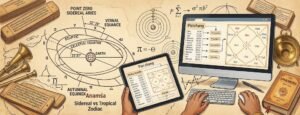

Introduction: Same Sky, Two Different Systems
You check your horoscope online and it tells you that you’re a Leo. Then you generate a Vedic Kundli, and it tells you that you’re a Cancer.
Same birth date. Same person. Different signs.
This does not necessarily mean there is an error. Vedic and Western astrology generally use different zodiac systems. Vedic astrology traditionally uses the sidereal zodiac, while Western astrology generally uses the tropical zodiac.
This difference affects how astrologers calculate and interpret planetary positions. The two traditions also differ in their house systems, use of planets and lunar nodes, timing methods, and approaches to interpretation.
In this guide, we’ll explore the main differences between Vedic and Western astrology. We’ll also explain why the same birth details can produce different-looking charts.
Core Difference: Sidereal vs. Tropical Zodiac
The biggest technical difference between the two systems is the zodiac they use.
Western Astrology: Tropical Zodiac
Western astrology generally uses the tropical zodiac.
In this system, 0° Aries begins at the vernal equinox. This point marks the start of astronomical spring in the Northern Hemisphere.
The tropical zodiac connects the signs with the Earth’s seasonal cycle. It does not try to keep each 30-degree sign permanently aligned with a specific constellation.
Vedic Astrology: Sidereal Zodiac
Vedic astrology generally uses the sidereal zodiac.
This system takes the position of the stars into account. It uses a measurement called ayanamsha to describe the difference between the tropical and sidereal zodiacs.
Earth’s axis slowly changes its orientation over time. This movement is called axial precession. As a result, the relationship between the equinox and the stellar background also changes.
Today, the difference between the tropical and sidereal zodiacs is around 24 degrees. The exact value can vary because different systems use different ayanamshas.
This difference can change a person’s Sun sign or other planetary signs when they compare a Western chart with a Vedic chart.
Historical Origins
Vedic and Western astrology have long and complex histories.
Western astrology developed from several older traditions. Babylonian astronomical practices strongly influenced it. Later, Greek and Roman traditions helped shape Western horoscopic astrology during the Hellenistic period.
Vedic astrology, also known as Jyotisha, developed within the Indian astronomical and cultural tradition. Indian scholars created and refined different astronomical and astrological texts over many centuries.
The Indian tradition also interacted with Hellenistic astrology. These exchanges influenced some zodiac and horoscope techniques.
Texts linked to Vedic astrology include works such as the Brihat Parashara Hora Shastra. However, scholars still debate the exact dating, authorship, and history of some classical Jyotisha texts.
Neither tradition came from a single book or developed at one specific moment. Both systems changed over many centuries.
House Systems: Whole Sign, Placidus, and Others
Both Vedic and Western astrology divide a birth chart into 12 houses.
However, astrologers can use different methods to calculate those houses.
Vedic Astrology
Many traditional Vedic approaches use the Whole Sign method.
With this method, the zodiac sign containing the Ascendant becomes the first house. The next sign becomes the second house, and the pattern continues around the chart.
For example, if Taurus is the Ascendant, Taurus becomes the first house. Gemini becomes the second, Cancer becomes the third, and so on.
Still, Vedic astrology does not use only one house method. Different schools and techniques can use other approaches.
Western Astrology
Western astrology also has several house systems.
Placidus is one of the most widely used systems. Other examples include Whole Sign, Equal House, Koch, Campanus, and Regiomontanus.
Placidus calculates house cusps by considering the movement of celestial bodies in relation to the horizon and meridian.
So, the difference is not simply:
Vedic = Whole Sign
Western = Placidus
A better explanation is that different Vedic and Western schools use different house calculation methods.
Planets and Grahas: 9 vs. 10+
Another major difference involves the celestial bodies that each tradition uses.
Western Astrology
Modern Western astrology commonly works with:
- Sun
- Moon
- Mercury
- Venus
- Mars
- Jupiter
- Saturn
- Uranus
- Neptune
- Pluto
Astronomers discovered Uranus in the 18th century, Neptune in the 19th century, and Pluto in the 20th century.
Modern Western astrology later incorporated these outer planets into many contemporary systems.
Vedic Astrology
Classical Vedic astrology commonly works with nine Grahas:
- Sun
- Moon
- Mars
- Mercury
- Jupiter
- Venus
- Saturn
- Rahu
- Ketu
Rahu and Ketu are the ascending and descending lunar nodes. They are mathematical points rather than physical planets.
Traditional Vedic astrology does not normally include Uranus, Neptune, and Pluto among its nine Grahas. Some modern practitioners may discuss these planets, but they do not belong to the classical nine-Graha framework.
The Moon also plays a major role in many Vedic approaches. Astrologers often pay close attention to the Moon sign and Nakshatra.
Western astrology also considers the Moon, Ascendant, planets, houses, and aspects. However, the Sun sign has become especially important in popular Western horoscope culture.
Unique Features: Nakshatras and Dasha
Vedic astrology has several techniques that make its approach distinctive. Two important examples are Nakshatras and Dasha systems.
Nakshatras
Vedic astrology divides the zodiac into 27 Nakshatras.
Each Nakshatra covers 13°20′ of the zodiac.
Tradition associates each Nakshatra with a planetary ruler, deity, symbolism, and other qualities.
The Moon moves quickly through the zodiac. For this reason, the Moon’s Nakshatra at birth plays an important role in many Vedic interpretations.
Dasha
The Dasha system provides another important Vedic timing method.
In Vimshottari Dasha, astrologers divide a person’s life into planetary periods. These periods include Mahadashas and Antardashas.
The birth Nakshatra of the Moon helps determine the starting point and sequence of these planetary periods.
Astrologers can then study these periods along with the natal chart and planetary transits.
Western astrology does not have a direct equivalent to Vimshottari Dasha. Instead, Western astrologers use techniques such as transits, progressions, directions, and time-lord methods.
Prediction and Timing: Dasha, Transits, and Progressions
Both traditions use timing techniques, but they approach timing in different ways.
Vedic Astrology
Vedic astrologers may combine Dasha periods with planetary transits, traditionally called Gochara.
The Dasha system provides a planetary-period framework. Transits show the current movement of planets in relation to the natal chart.
Together, these techniques can help astrologers interpret different periods of life.
Western Astrology
Western astrologers commonly use transits and progressions.
A progressed chart changes certain positions from the natal chart according to a specific progression method.
One well-known method is secondary progression. It uses a symbolic relationship in which one day after birth represents one year of life.
Both traditions therefore use planetary movement for timing. However, their methods and underlying calculations differ.
Philosophy and Interpretation
The philosophical differences between Vedic and Western astrology are more complex than simply saying “karma vs. psychology.”
Vedic astrology has strong links with Indian philosophical ideas such as karma, dharma, life stages, and spiritual development.
Many Vedic practitioners use astrology within a broader framework that considers a person’s duties, life circumstances, and spiritual path.
Western astrology has also changed over time. Modern Western astrology often places greater emphasis on personality, self-understanding, psychological symbolism, and individual experience.
These descriptions are broad tendencies rather than strict rules.
Some Vedic astrologers use psychological interpretations. Likewise, some Western astrologers work with ideas related to fate, spirituality, and traditional astrology.
Can You Combine Vedic and Western Astrology?
Yes, you can study and use both systems. However, it helps to understand the framework behind each one.
For example, a Vedic astrologer may use a sidereal zodiac with Nakshatras and Dasha calculations.
A Western astrologer may use a tropical zodiac along with aspects, transits, and progressions.
Mixing techniques without understanding these differences can create confusion.
A simple approach is to keep the two systems separate:
Vedic chart: Sidereal zodiac + Vedic techniques
Western chart: Tropical zodiac + Western techniques
This approach lets you compare both traditions while keeping their calculations and methods clear.
Vedic vs. Western Astrology: Comparison
| Factor | Vedic Astrology | Western Astrology |
|---|---|---|
| Common Zodiac | Sidereal | Tropical |
| Historical Development | Indian/Jyotisha tradition with multiple historical influences | Babylonian, Hellenistic, Roman, medieval, and modern traditions |
| House Methods | Whole Sign and other approaches | Placidus, Whole Sign, Equal, Koch, and others |
| Traditional Celestial Set | 9 Grahas, including Rahu and Ketu | Sun, Moon, five classical planets, plus outer planets in modern astrology |
| Lunar Framework | Strong emphasis on Moon and Nakshatras | Moon is important, while Sun sign is especially prominent in popular astrology |
| Timing Techniques | Dasha systems such as Vimshottari Dasha | Progressions, transits, directions, and other methods |
| Lunar Mansions | 27 Nakshatras | No direct equivalent in mainstream Western astrology |
| Interpretive Traditions | Karma, dharma, life periods, and other traditional concepts | Personality, symbolism, psychological, and traditional approaches |
| Zodiac Framework | Sidereal reference framework | Tropical reference framework linked to the seasons |
Which Is “More Accurate”?
There is no scientifically established way to say that Vedic astrology is more accurate than Western astrology, or that Western astrology is more accurate than Vedic astrology.
The two systems use different reference frameworks and interpretive traditions.
The tropical zodiac connects the signs with the equinoxes and seasonal cycle. The sidereal zodiac uses a stellar reference framework. The exact sidereal position depends on the ayanamsha used.
Because the systems use different methods, people may connect more with one style of interpretation than another.
The key is to understand how each system calculates and interprets a birth chart.
Conclusion
The main difference between Vedic and Western astrology starts with the zodiac system.
Vedic astrology generally uses a sidereal zodiac, while Western astrology generally uses a tropical zodiac.
This difference can change planetary sign placements between the two types of birth charts.
The traditions also differ in their house systems, celestial bodies, Nakshatras, timing techniques, and philosophical approaches.
Neither system simply represents a more advanced version of the other. Each developed through different historical and cultural traditions.
In short, Vedic and Western astrology offer different ways to interpret the same sky.
Frequently Asked Questions
Why is my Vedic sign different from my Western sign?
The main reason is the difference between the sidereal zodiac used in Vedic astrology and the tropical zodiac commonly used in Western astrology.
Earth’s axial precession creates a difference of roughly 24 degrees between the two reference systems. The exact value depends on the ayanamsha used.
Which is older, Vedic or Western astrology?
Both traditions have long and complex histories.
Western horoscopic astrology developed from earlier Babylonian traditions and became more organized during the Hellenistic period.
Vedic astrology developed within the Indian Jyotisha tradition and has its own long history.
Because both traditions developed over many centuries, it is difficult to reduce their history to a simple “which one is older?” comparison.
Does Vedic astrology use the same 12 zodiac signs as Western astrology?
Yes.
Both systems use the same basic sequence of 12 zodiac signs. Each sign covers 30 degrees.
The main difference is the reference system used to determine where the signs begin.
Western astrology generally uses the tropical zodiac, while Vedic astrology generally uses the sidereal zodiac.
Why doesn’t traditional Vedic astrology use Uranus, Neptune, and Pluto?
Classical Vedic astrology developed its traditional Graha system before astronomers discovered these planets.
The traditional system includes the Sun, Moon, five visible planets, and the lunar nodes Rahu and Ketu.
Rahu and Ketu are not substitutes for Uranus, Neptune, or Pluto. They represent the two points where the Moon’s orbit crosses the ecliptic.
Can I combine Vedic and Western astrology techniques?
Yes, you can study both traditions.
However, each system uses its own calculations and interpretive framework.
For example, Vedic Dasha calculations traditionally use the sidereal zodiac and Nakshatras. Many Western techniques use the tropical zodiac.
Understanding these differences can help you compare both systems without mixing their calculations incorrectly
External Authority & Reference Backlinks
- Wikipedia – Western Astrology https://en.wikipedia.org/wiki/Western_astrology
- Wikipedia – Jyotisha (Vedic Astrology) https://en.wikipedia.org/wiki/Jyotisha
- Wikipedia – Sidereal and Tropical Astrology https://en.wikipedia.org/wiki/Sidereal_and_tropical_astrology
- Wikipedia – Precession of the Equinoxes https://en.wikipedia.org/wiki/Axial_precession/
- Encyclopaedia Britannica – Astrology Background https://www.britannica.com/topic/astrology
- Drik Panchang – Planetary Positions Reference https://www.drikpanchang.com/planet/position/