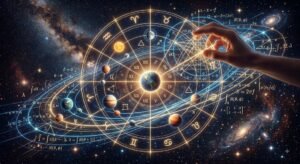
For thousands of years, humans have looked at the night sky and searched for meaning in the stars. The zodiac has been one of the most fascinating systems created by ancient civilizations, connecting constellations, seasons and human interpretation.
However, many people today are surprised to learn that the zodiac signs used in astrology do not perfectly match the actual positions of the constellations in the sky anymore.
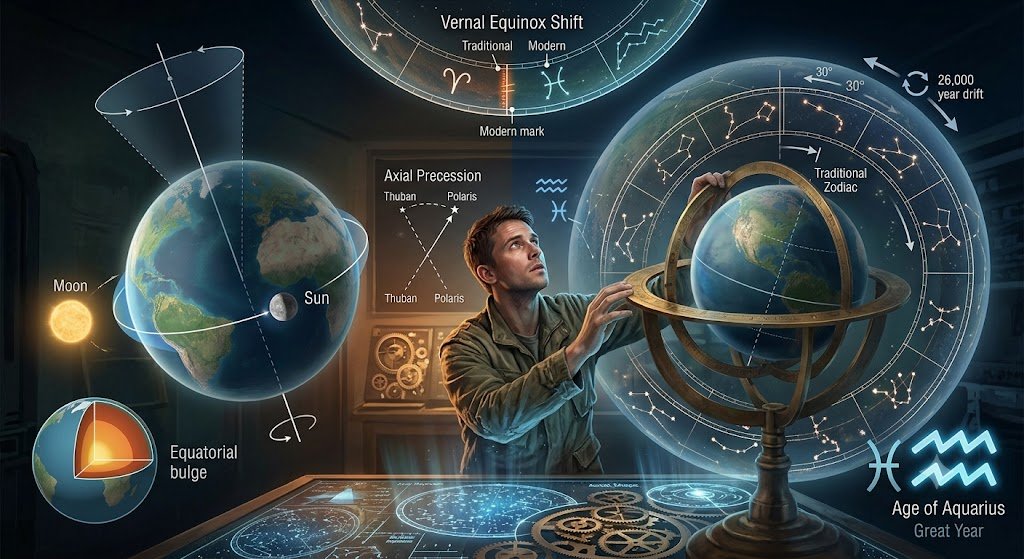
The reason behind this cosmic shift is a scientific phenomenon called the precession of the equinoxes — a slow movement of Earth’s rotational axis that gradually changes our view of the stars over thousands of years. NASA explains that Earth’s axis slowly changes direction like a spinning top, completing one cycle in approximately 26,000 years.
Understanding this difference between astrology and astronomy reveals one of the most interesting connections between ancient knowledge and modern science.
The Ancient Origins of the Zodiac
The zodiac system originated from ancient civilizations that carefully observed the movement of the Sun, Moon and planets across the sky.
Ancient astronomers noticed that planets appeared to travel through a specific region of the sky known as the ecliptic. This area contains the constellations traditionally associated with the zodiac, such as Aries, Taurus, Gemini, Cancer, Leo and others.
The Babylonians divided this region into twelve sections, creating the foundation for the zodiac system that became popular throughout history.
These signs were created thousands of years ago when the positions of the stars were different from what we observe today.
Why Did the Zodiac Move?
The main reason is Earth’s axial precession.
Earth does not rotate perfectly like a fixed spinning ball. Its axis slowly wobbles over time because of gravitational forces from the Sun and Moon.
This movement causes the position of the equinoxes to gradually shift against the background stars.
Scientists estimate that this complete cycle takes around 26,000 years.
Because of this movement, the location where the Sun appears during certain times of the year has slowly changed compared with the ancient zodiac system.
Your Zodiac Sign and the Actual Constellation
Many people believe their zodiac sign represents the exact constellation where the Sun was located at their birth.
However, there is a difference between:
Tropical Zodiac
Used mainly in Western astrology, this system is based on seasons and fixed points such as the spring equinox.
Sidereal Zodiac
Used in systems such as Vedic astrology, this approach considers the actual position of stars and includes adjustments for astronomical shifts.
Because of these different methods, the same birth date can produce different zodiac interpretations depending on the system being used.
The Role of Ophiuchus: The Forgotten Constellation
Another interesting topic is Ophiuchus, a constellation located along the Sun’s apparent path.
Astronomically, the Sun passes through thirteen constellations along the ecliptic, including Ophiuchus. However, traditional zodiac systems commonly use twelve signs because they were designed around a twelve-part structure.
This does not mean that astrology suddenly gained a new sign. Instead, it highlights the difference between astronomical constellations and symbolic zodiac divisions.
Astronomy vs Astrology: Understanding the Difference
Astronomy is the scientific study of planets, stars, galaxies and the universe.
Astrology is a cultural system that interprets celestial positions in relation to human experiences.
While both have historical connections, they follow different approaches.
Astronomy uses scientific observation, mathematics and physical laws to understand space, while astrology focuses on symbolic interpretations of celestial patterns.
NASA has also clarified that it studies astronomy and does not change zodiac signs; discussions about changing signs often come from comparing modern astronomical positions with ancient zodiac systems.
Why This Topic Interests Astrology Enthusiasts
The shifting zodiac raises fascinating questions:
- How did ancient civilizations understand the sky?
- How accurate were early astronomical observations?
- How have planetary movements changed our view of the universe?
- What is the connection between mythology and science?
The zodiac remains an important part of human history because it represents our desire to understand our relationship with the cosmos.
The Importance of Learning the Science Behind Astrology
Whether someone follows astrology, astronomy or simply enjoys learning about space, understanding the science behind the zodiac provides a deeper appreciation of the universe.
The movement of Earth reminds us that the cosmos is not static. Stars, planets and galaxies are constantly moving, creating a dynamic universe that continues to inspire curiosity.
How KundliTime Connects Ancient Wisdom With Modern Understanding?
Modern astrology platforms like KundliTime explore the relationship between celestial calculations, traditional knowledge and technology.
By combining ancient systems with modern computational methods, astrology enthusiasts can explore birth charts, planetary positions and cosmic patterns in a more structured way.
Understanding the astronomical background behind zodiac signs helps users appreciate both the historical significance and scientific complexity behind celestial observations.
Conclusion
The reason zodiac signs do not perfectly match the sky anymore is not because the stars disappeared or changed overnight. It is because Earth itself has slowly shifted its orientation over thousands of years.
The phenomenon of precession shows how even small cosmic movements can create major changes over time.
The zodiac is a fascinating example of how humans have always looked toward the sky for knowledge, meaning and inspiration.
Useful External Resources
NASA – Precession of the Equinoxes
https://pwg.gsfc.nasa.gov/stargaze/Sprecess.htm
NASA – Zodiac Constellations Explanation
https://pwg.gsfc.nasa.gov/stargaze/Secliptc.htm
NASA Official Website
https://www.nasa.gov/